
July 10, 2026 • General • By Sayad Md Bayezid Hosan
MODULE 16: Email Marketing — The Complete A to Z Mega Guide for Beginners
A complete, deeply detailed, beginner-friendly A to Z guide to email marketing — building and managing an email list the right way from day one, planning campaign strategy that actually maps to real goals, crafting content that gets opened and clicked rather than ignored, setting up the automation flows that consistently outperform one-off sends, understanding which metrics and KPIs actually matter now that open rate can no longer be trusted on its own, choosing the right tools for your stage of growth, solving the deliverability challenges that have quietly gotten stricter over the past two years, and pulling every piece into one real, working email marketing plan.
Welcome to Module 16: Email Marketing
This course has now covered search — Modules 10 through 14 — and video, in Module 15. Both of those channels share something in common that's worth naming directly: you're building on land you don't own. A Google algorithm update or a YouTube policy change can reshape your traffic overnight, no matter how well you followed every rule in this course. Email marketing is different, and it's exactly why it earns its own module here.
Your email list is the one genuinely owned audience in a digital marketer's entire toolkit. Nobody can deprioritize it in a feed, demonetize it, or change an algorithm underneath it. That makes it, by a meaningful margin, the highest-ROI channel most businesses have access to. But that ownership comes with real responsibility attached, and 2024 through 2026 specifically have made that responsibility non-negotiable: Google, Yahoo, and Microsoft have all rolled out strict new authentication and deliverability requirements over this period, and a beginner who skips Section 8 of this module can do everything else right and still watch their emails land in spam.
Before diving in, if you haven't already gone through the earlier modules in this course, I'd recommend starting there, since each module builds on the concepts that came before it:
- Introduction to Online Digital Marketing: A Beginner's Guide
- Module 3: Social Media Marketing (SMM) — Advertising Concepts and Platform Selection
- Module 4: Meta (Facebook) Marketing — The Complete A to Z Mega Guide
- Module 5: Instagram Marketing — The Complete A to Z Mega Guide
- Module 6: X (Formerly Twitter) Marketing — The Complete A to Z Mega Guide
- Module 7: LinkedIn Marketing — The Complete A to Z Mega Guide
- Module 8: Pinterest Marketing — The Complete A to Z Mega Guide
- Module 9: Creating a WordPress Website — The Complete A to Z Mega Guide
- Module 10: Search Engine Optimization (SEO) — The Complete A to Z Mega Guide
- Module 11: Off-Page Optimization — The Complete A to Z Mega Guide
- A Complete Guide to Automated Sitemap Management for Modern SEO
- Module 13: Algorithm Updates and Analysis — The Complete A to Z Mega Guide for Beginners
- Module 14: Technical SEO Optimization — The Complete A to Z Mega Guide for Beginners
- Module 15: Video Marketing Through YouTube — The Complete A to Z Mega Guide for Beginners
- Module 16: Email Marketing — The Complete A to Z Mega Guide for Beginners
Why This Guide Treats Email as the Most Valuable Channel You Own
Industry ROI figures for email marketing get cited constantly, and while the exact multiple varies by source and year, the consistent pattern across independent benchmarks is a return somewhere in the range of $36 to $42 for every $1 spent — a figure no other digital channel covered so far in this course reliably matches. That number alone is why this module exists, but it's only half the story worth telling honestly.
The other half is that email marketing quietly got harder to do well over the past two years, in a way a lot of existing beginner content hasn't caught up to. Starting in February 2024, Google and Yahoo began enforcing strict authentication requirements for anyone sending meaningful volume, and Microsoft followed with its own enforcement by May 2025. A guide written before that shift would still be telling you that a working "From" address and a decent subject line are enough. They aren't anymore, and Section 8 of this module treats that shift with the seriousness it deserves rather than burying it in a footnote.
That's the standard this whole module holds itself to: real ROI numbers, presented honestly rather than inflated, and genuinely current technical guidance rather than advice that quietly stopped being true sometime in the last two years.
Why You Can Trust This Email Marketing Guide (Our E-E-A-T Commitment)
Google's own quality guidelines ask whether content demonstrates real Experience, Expertise, Authoritativeness, and Trustworthiness — E-E-A-T. Here's exactly how this module earns that standard.
Experience. Every metric and benchmark in this module is presented as a real range drawn from how actual campaigns perform, not a single suspiciously precise number. Where industry data disagrees — and Section 6 explains exactly why open-rate benchmarks vary so widely across sources — that disagreement is explained rather than hidden.
Expertise. This module reflects the genuinely current state of email deliverability, including the Google, Yahoo, and Microsoft authentication requirements that fully reshaped what "best practice" means for bulk senders between 2024 and 2026. A guide still describing SPF and DKIM as optional extras would be giving advice that can now get a sender's mail rejected outright.
Authoritativeness. This is Module 16 in a structured, sequential digital marketing course, building on the audience-building principles from Modules 3 through 9 and the search and content fundamentals from Modules 10 through 15. It's published under a consistent, named byline across every module in this series.
Trustworthiness. This module doesn't recommend one "best" email platform and stop there — Section 7 gives you the actual evaluation criteria (deliverability infrastructure, automation depth, pricing model) so you can make the right call for your own stage of growth, since the right tool for a solo creator and the right tool for an ecommerce brand are rarely the same one.
What Is Email Marketing? A Clear Definition Before We Start
Email marketing is the practice of sending purposeful, permission-based messages to a list of subscribers in order to build relationships, promote products or content, and drive measurable action — all through a channel the sender fully owns rather than rents from a platform's algorithm. That single word, permission, is the foundation everything else in this module rests on: every list-building tactic, every deliverability rule, and every automation flow in this guide assumes the recipient actually asked to be there.
This module follows the natural lifecycle of a real email marketing program, in order: building the list (Section 2), planning what to send and why (Section 3), writing content worth opening (Section 4), automating the repeatable parts (Section 5), measuring what's actually working (Section 6), choosing the right software (Section 7), solving the problems every sender eventually hits (Section 8), and tying it all into one working plan (Section 9).
1. Introduction to Email Marketing
Why Email Has Outlasted Two Decades of "Email Is Dead" Predictions
Email marketing has been declared obsolete by some new platform or trend roughly once a decade since the early 2000s, and it has outlasted every one of those predictions for a structural reason: it's the only major marketing channel built on an open, portable standard rather than a proprietary platform. A subscriber's email address works the same way regardless of which software sends to it, which is precisely why the ROI figures cited above have remained so durable across two decades of platform churn elsewhere.
The Core Types of Marketing Email
Four broad categories cover almost everything a business sends: promotional emails (sales, launches, offers), newsletters (recurring, relationship-building content), transactional emails (order confirmations, password resets — triggered by a specific user action), and lifecycle or behavioral emails (welcome series, abandoned cart, re-engagement — covered in full in Section 5). Understanding which category a given message falls into matters because each one carries different subscriber expectations, and mismatching them is a common source of the unsubscribes and complaints covered in Section 8.
Owned Media vs. Rented Media
This is worth stating plainly because it's the single biggest strategic argument for investing seriously in email, especially after the platform-dependent channels covered in Modules 3 through 9 and 15. Every social and video platform in this course is, structurally, rented media — you're building an audience inside infrastructure someone else controls, subject to algorithm changes, policy shifts, and reach decisions made entirely outside your hands. An email list is owned media. Nobody else can decide tomorrow that fewer of your subscribers see your next message.
Permission as the Foundation of Everything Else
Every tactic in the rest of this module assumes real, explicit permission — a subscriber who took a deliberate action to join your list. This isn't just an ethical baseline; it's the direct, practical foundation of good deliverability, covered in depth in Section 8. Lists built on genuine consent have dramatically lower complaint rates than lists built any other way, and complaint rate is one of the exact numbers Google and Yahoo now use to decide whether your mail reaches the inbox at all.
2. Building and Managing Email Lists
Single Opt-In vs. Double Opt-In
A single opt-in list adds a subscriber the moment they submit a form. A double opt-in list sends a confirmation email first and only adds the subscriber once they click to confirm. Double opt-in produces a smaller list, but a meaningfully cleaner one — it filters out mistyped addresses, bots, and people who don't actually recognize signing up, all of which directly protect the sender reputation and spam-complaint rate covered in Section 8. For anyone sending at real volume under the current authentication landscape, double opt-in has shifted from a "nice to have" to a genuinely defensible default.
Lead Magnets That Actually Build a List
A lead magnet — a free guide, template, discount code, or tool access offered in exchange for an email address — remains the most reliable way to convert a website visitor into a subscriber. The strongest lead magnets solve one specific, narrow problem extremely well rather than promising something broad and vague; specificity converts better and also pre-qualifies subscribers who are genuinely interested in what you'll send next.
Where Signup Forms Actually Belong
High-converting signup placements include an exit-intent popup (triggered when a visitor is about to leave), an embedded form within high-traffic blog content — including the technical SEO and YouTube guides covered in Modules 14 and 15 — and a dedicated, simple landing page you can link to directly from social profiles and video descriptions.
Segmentation From Day One
Segmentation — dividing a list into groups based on behavior, interests, or lifecycle stage rather than treating every subscriber identically — consistently outperforms undifferentiated "send to all" campaigns across every benchmark study on the subject. Start simple: even a basic split between engaged and unengaged subscribers, or between customers and non-customers, meaningfully improves relevance immediately. Section 4 covers how segmentation directly shapes content, and Section 5 covers how it powers automation.
List Hygiene: Why a Bigger List Isn't Always a Better One
Regularly removing or suppressing subscribers who haven't opened or clicked in an extended window — a common benchmark is around 120 days — protects sender reputation more than it costs in reach, since inactive subscribers drag down engagement rates and can quietly increase spam complaints over time. Never buy an email list. Purchased lists have never given real permission, they produce spam complaints almost immediately, and under the current bulk-sender enforcement covered in Section 8, they're one of the fastest ways to damage a sending domain's reputation. A healthy, actively-managed list typically sees net growth of roughly 1-3% a month after accounting for this kind of natural churn — a useful benchmark for judging whether your acquisition efforts are keeping pace.
Consent, Privacy Law, and What It Means for a Beginner
Data privacy regulation has only expanded since GDPR's introduction, with a growing number of U.S. states now enforcing their own email and data privacy laws alongside it. The practical takeaway for a beginner is straightforward regardless of jurisdiction: collect consent explicitly, make unsubscribing genuinely easy (a requirement covered further in Section 8), and never add someone to a marketing list simply because you have their address from an unrelated transaction.
3. Email Campaign Strategy
Campaigns vs. Flows: Two Different Tools
A campaign is a one-time, manually-sent message — a newsletter edition, a product launch, a holiday promotion. A flow (covered in full in Section 5) is an automated sequence triggered by a subscriber's behavior. Most mature email programs send the large majority of their total volume through campaigns, while flows — despite representing a small fraction of sends — typically generate a disproportionate share of total email revenue. Strategy means using each tool for what it's actually good at rather than treating every send as a broadcast.
Setting a Real Goal for Every Send
Every campaign deserves one clear, specific goal before a single word gets written — a click to a specific product, a reply, a registration — rather than the vague, unmeasurable goal of generic "engagement." A campaign with a specific goal is also the only kind you can meaningfully A/B test, covered below.
Frequency and Cadence
There's no universal right frequency, but there is a universal wrong direction: sending more often than your content quality can sustain reliably increases both unsubscribe and spam-complaint rates. Match cadence to the genuine pace of content or offers you can produce well, and treat consistency — the same pattern subscribers can predict — as more valuable than raw frequency.
Send-Time Considerations
Aggregate data across most industries consistently shows Tuesday and Wednesday as the strongest-performing send days, with Monday, Thursday, and Friday typically trailing due to weekend transition and catch-up effects. This is a starting point worth testing against your own list rather than a rule to follow blindly — your specific audience's actual behavior, visible in your own platform's analytics, always outranks an aggregate benchmark.
A/B Testing as an Ongoing Habit, Not a One-Time Project
Testing one variable at a time — a subject line, a send time, a call-to-action — against a specific, predetermined goal turns campaign strategy from guesswork into a compounding, evidence-based practice. The discipline matters more than any single test result: a strategy of continuous, small, single-variable tests consistently outperforms occasional large redesigns based on assumption alone.
4. Crafting Engaging Email Content
The Subject Line's Real Job
A subject line has exactly one job: earning the open. Specificity and genuine relevance to the recipient consistently outperform generic hype or manufactured urgency, and given how unreliable raw open-rate tracking has become (Section 6 explains exactly why), the more honest long-term test of a good subject line is whether the people who do open actually go on to click — your click-to-open rate.
Preview Text Is Not Optional
The preview text (or preheader) displayed alongside your subject line in most inboxes is prime, free real estate that a large share of senders leave as a default, unhelpful snippet of their email's first line. Writing this deliberately — as a genuine second sentence that extends the subject line's promise — is one of the easiest, most consistently underused wins available in email content.
Personalization Beyond a First Name
First-name personalization is table stakes at this point. Real personalization draws on genuine behavioral and transactional data — what someone has browsed, purchased, or clicked before — and this kind of behavior-based content consistently and measurably outperforms generic broadcasts sent to an entire list, often by a wide margin. This is also where Section 2's segmentation work and Section 5's automation directly pay off inside the content itself.
Writing for Mobile First
More than half of all email opens now happen on a mobile device, which means design and copy decisions should be made mobile-first, not adapted afterward. Short paragraphs, a single clear column, generous tap-target sizing on buttons (the same 44-48px standard covered for mobile web design in Module 14), and a call-to-action that doesn't require zooming all directly affect whether a mobile reader converts or deletes.
One Clear Call-to-Action
Every promotional email performs best with one single, unambiguous primary call-to-action rather than several competing options. Additional links can exist, but visual hierarchy should make it obvious which single action the email actually wants a reader to take.
Plain-Text and Visual Balance
Heavily designed, image-dependent emails can look impressive but often underperform simpler, more text-forward messages that read like they came from an actual person — a pattern that shows up consistently in newsletter and B2B contexts especially. Test both against your own audience rather than assuming more design automatically means more performance.
5. Email Automation
Why Automated Flows Consistently Outperform One-Off Campaigns
This is one of the most consistently replicated findings in modern email marketing data: automated, behavior-triggered flows reliably deliver dramatically higher click rates, open rates, and revenue per recipient than manually-sent campaigns, despite representing a small share of total send volume. The reason is structural, not accidental — a flow reaches someone at the exact moment their own behavior signals relevance (they just abandoned a cart, just signed up, just went quiet), while a campaign reaches everyone at the same moment regardless of where they individually are.
The Core Automation Flows Worth Building First
A welcome series, triggered immediately after signup, sets expectations and converts fresh interest while it's highest. An abandoned cart flow, for anything ecommerce, recovers purchase intent that's already been demonstrated. A browse abandonment flow targets interest shown without an item ever reaching the cart. A post-purchase flow builds the relationship after the sale, supporting retention and repeat purchases. And a win-back or re-engagement flow targets subscribers who have gone quiet before they're removed during the list-hygiene process covered in Section 2. These five, built in roughly that priority order, cover the overwhelming majority of automation value available to a beginner.
Trigger Logic and Conditional Branching
Modern automation tools let a flow branch based on a subscriber's specific action — did they open the first email, did they click, did they purchase — rather than sending every subscriber down one identical path. Starting simple with a linear sequence and adding branching once the basic flow is proven and performing is a more reliable path than attempting a complex, fully-branched journey on the first attempt.
Where AI Genuinely Helps in Automation (and Where It's Just a Label)
AI-assisted send-time optimization, subject line variant generation, and product recommendation logic inside flows are genuinely useful and increasingly standard across major platforms. It's worth staying appropriately skeptical, though — most software in this category now claims some form of "AI features," and the real, measurable value tends to concentrate specifically in scaling experimentation and fine-tuning relevance at the margins, not in replacing the strategic decisions covered throughout this module.
6. Email Marketing Metrics and KPIs
Why Open Rate Can No Longer Be Trusted on Its Own
This is the single most important, most current concept in this section, and it's exactly the kind of shift a stale guide would miss entirely. Since September 2021, Apple's Mail Privacy Protection (MPP) has automatically pre-fetched images in emails opened through Apple Mail, registering an "open" even when a recipient never actually views the message. Because a large share of any list reads mail through Apple devices, this artificially inflates open-rate data by an amount that varies by list and platform — which is exactly why you'll find wildly different "average open rate" figures across different industry benchmark reports. None of those reports are simply wrong; they're measuring against different levels of MPP contamination and using different correction methods.
The Metrics Worth Trusting Instead
Click-through rate (CTR) — clicks as a percentage of emails delivered — requires a deliberate action from a real human, making it far more reliable than open rate as a genuine engagement signal. Click-to-open rate (CTOR) — clicks as a percentage of opens — helps isolate whether your actual content and offer are compelling, independent of subject-line or deliverability performance. Revenue per recipient (RPR) — total revenue divided by unique recipients — is increasingly treated as the metric that matters most for judging real business impact, since it cuts through vanity engagement numbers and measures what a campaign or flow is actually worth.
Realistic Benchmark Ranges
Given the MPP distortion explained above, treat any single open-rate benchmark with real skepticism, but as a general, rough compass: campaign open rates commonly land somewhere in the 20-45% range depending on industry, list health, and how a given platform corrects for MPP, while click-through rates cluster much more tightly, typically in the 1.5-3% range for general campaigns. Automated flows consistently and substantially outperform campaigns on every one of these metrics — often by several times over — which is the clearest data-driven argument for prioritizing the automation work covered in Section 5.
The Health Metrics You Should Never Ignore
Bounce rate (undeliverable addresses) should stay low, generally under 2%, and a rising trend is an early warning sign of list decay. Unsubscribe rate in the range of roughly 0.5-0.9% is broadly normal; a spike after a specific send is a direct, specific signal about that email's relevance. Spam complaint rate is the one metric with a hard, external consequence attached, covered fully in Section 8 — Google's own guidance is to stay under 0.1% and never approach the 0.3% threshold where inbox providers begin actively degrading deliverability.
7. Email Marketing Tools and Software
What Actually Matters When Choosing a Platform
Four criteria matter more than any feature checklist: deliverability infrastructure (built-in authentication support, sender reputation monitoring), automation depth (real conditional branching vs. basic linear sequences), pricing model (per-contact vs. per-email-sent, since these scale very differently as you grow), and genuine ease of use for whoever will actually operate the platform day to day. Independent testing has found inbox placement rates varying dramatically between platforms sending identical content, which makes deliverability infrastructure a far more consequential differentiator than most beginners initially assume.
Choosing by Use Case Rather Than by "Best Overall"
| Your Situation | What to Prioritize | Typical Fit |
|---|---|---|
| Just starting, small list, tight budget | Generous free tier, simple builder | Beginner-friendly platforms with strong free plans |
| Ecommerce store | Deep store-platform integration, purchase-based automation, revenue attribution | Ecommerce-native platforms |
| Complex, multi-step automation needs | Visual workflow builder, conditional branching, built-in CRM | Advanced automation platforms |
| Solo creator, newsletter, or digital products | Simple sequences, landing pages, audience monetization tools | Creator-focused platforms |
| Already using a CRM for sales | Native CRM integration, unified contact records | All-in-one marketing/CRM suites |
Free Plans Are Shrinking — Read the Fine Print
Several major platforms have meaningfully scaled back free-tier features in recent years, commonly moving automation itself behind a paywall or capping daily sending volume tightly enough to matter for a growing list. Confirm exactly what a free plan includes today, specifically, rather than relying on its reputation from a year or two ago before evaluating it against your actual needs.
Compliance Support Is No Longer a "Nice to Have"
Given the deliverability requirements covered in Section 8 and the expanding privacy regulation covered in Section 2, confirm any platform under consideration offers built-in support for the current authentication standards, consent management, and data-deletion requests before making a final choice — this has shifted from an advanced consideration to baseline due diligence for every sender.
8. Email Marketing Challenges and Solutions
Challenge: The 2024-2026 Deliverability Shift
This is the single most consequential change in email marketing since this course's earlier modules were written, and it deserves to be treated as the centerpiece of this section rather than a footnote. Starting in February 2024, Google and Yahoo began requiring SPF, DKIM, and DMARC — three layered email authentication standards — from any domain sending 5,000 or more messages a day to their users, a classification that, once triggered, applies permanently regardless of later volume. Microsoft followed with its own enforcement by May 2025. As of 2026, enforcement across all three has moved from soft warnings to hard rejections at the point of send.
The solution, broken down simply: SPF publishes a list of servers allowed to send on your domain's behalf. DKIM adds a cryptographic signature proving a message wasn't altered in transit. DMARC ties the two together and tells receiving servers what to do if a message fails both — and critically, DMARC also requires alignment, meaning the domain in your visible "From" address has to match the domain validated by SPF or DKIM, not just pass each check independently. If you send through a third-party platform, this typically means explicitly configuring that platform's custom domain authentication rather than relying on its default setup, which will otherwise authenticate as the platform's own domain instead of yours.
Challenge: Keeping Spam Complaints Below the Threshold
Every major inbox provider now tracks spam complaint rate as a hard gate, not a soft signal — Google's guidance is to stay under 0.1% and never approach 0.3%, since crossing that threshold measurably and sometimes lastingly degrades inbox placement. The solution: genuine permission from Section 2, honest subject lines that match actual content, an easily accessible unsubscribe link, and mandatory support for one-click unsubscribe (a technical header requirement, not just a visible link, now required by Google, Yahoo, and Apple alike) all directly and measurably reduce complaint rates.
Challenge: List Fatigue and Slowly Declining Engagement
Every list naturally decays over time as subscribers change interests, change addresses, or simply disengage — this is normal, not a sign of failure. The solution is the list hygiene practice from Section 2 (regularly suppressing long-term unengaged subscribers) paired with the segmentation and personalization work from Sections 2 and 4, since relevance is the most reliable defense against fatigue that a list without it doesn't have.
Challenge: Standing Out in an Overloaded Inbox
The average subscriber receives far more marketing email than they'll ever meaningfully engage with, and competing purely on frequency is a losing strategy. The solution is competing on relevance and genuine usefulness instead — the segmentation, personalization, and automation timing covered throughout this module — rather than trying to out-shout every other sender in the same inbox.
Challenge: Measuring Success Honestly After Apple MPP
As Section 6 covered in depth, open-rate data alone can no longer be trusted as a clean signal. The solution is shifting primary reporting weight toward click-through rate, click-to-open rate, and revenue per recipient, and treating open rate as a rough directional signal at most rather than a headline metric worth optimizing in isolation.
9. Creating an Email Marketing Plan
Bringing Every Section Together Into One Working Document
A real email marketing plan isn't a separate, additional task — it's simply the previous eight sections of this module written down in order, with your own specific numbers attached. Start with a goal: a specific number tied to list growth, revenue, or engagement, not a vague intention. Define your audience and list-building approach from Section 2. Map your core campaign types and cadence from Section 3. Set content and design standards from Section 4 so quality stays consistent as volume grows. Prioritize your first automation flows from Section 5 — the welcome series and abandoned cart flow first, in almost every case. Choose the specific metrics you'll actually review from Section 6, on a set schedule, not just when something feels off. Confirm your platform meets the criteria from Section 7. Document your deliverability setup from Section 8 so it's never left as an afterthought after a domain's reputation is already damaged. And build in a fixed review cadence — monthly is a reasonable default — to revisit every one of these decisions as your list and results grow.
Keeping the Plan a Living Document
The single biggest failure mode for a beginner's email marketing plan isn't writing a bad one — it's writing a reasonable one once and never revisiting it as the list, the goals, and the deliverability landscape all continue to change. Treat this module's structure as a template to revisit on the same monthly cadence recommended above, not a one-time exercise.
Email Marketing Glossary: Key Terms Explained
- Email Marketing — sending permission-based email to build relationships and drive measurable action.
- Open Rate — the percentage of delivered emails recorded as opened; increasingly unreliable due to Apple MPP.
- Click-Through Rate (CTR) — the percentage of delivered emails that received a click.
- Click-to-Open Rate (CTOR) — the percentage of opened emails that received a click.
- Revenue Per Recipient (RPR) — total revenue divided by unique recipients; a key ROI metric.
- Double Opt-In — a signup process requiring email confirmation before a subscriber is added to a list.
- Segmentation — dividing an email list into groups based on behavior or characteristics.
- Flow / Automation — a pre-built, triggered email sequence sent automatically based on subscriber behavior.
- SPF, DKIM, DMARC — the three email authentication standards required for bulk senders as of 2024-2026.
- DMARC Alignment — the requirement that a message's visible From domain match the domain validated by SPF or DKIM.
- Bulk Sender — a domain sending 5,000+ daily messages to Gmail addresses, subject to stricter requirements.
- Apple Mail Privacy Protection (MPP) — an Apple feature that inflates open-rate data by pre-fetching email images.
- List Hygiene — the ongoing practice of removing or suppressing inactive or invalid subscribers.
- Lead Magnet — a free resource offered in exchange for an email signup.
- E-E-A-T — Experience, Expertise, Authoritativeness, and Trustworthiness; Google's content quality framework.
Visual Summary
Below is an original infographic built specifically for this guide, mapping the complete email marketing system covered in this module — from list building and strategy, through content, automation, the metrics that actually matter in 2026, and the deliverability requirements every sender now has to meet.
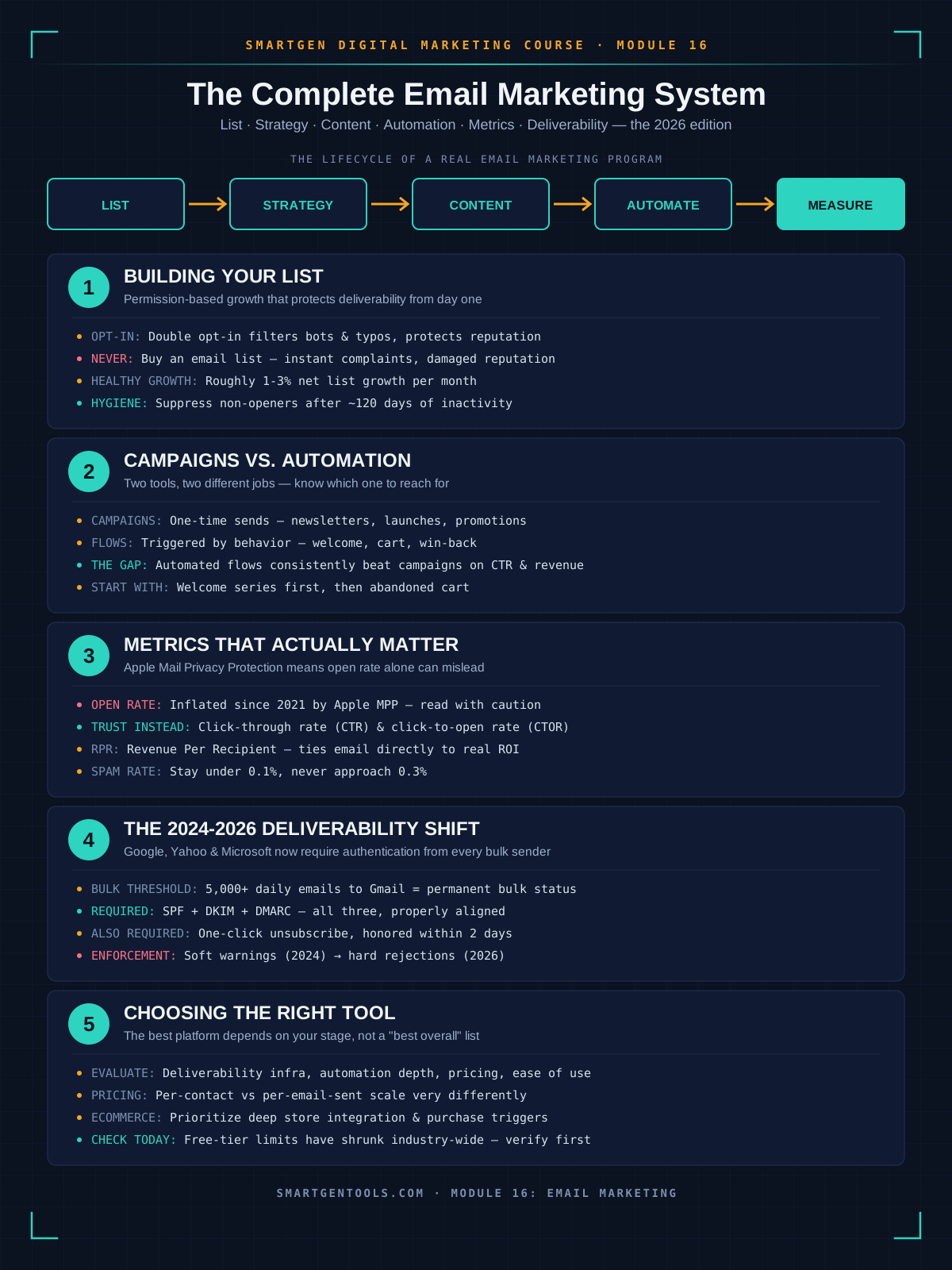
Module 16 Mega Guide Summary
In this module, we covered email marketing as the one channel in this entire course you genuinely own rather than rent from a platform algorithm. We introduced why email has outlasted two decades of predicted obsolescence and the owned-versus-rented distinction that makes it strategically different from every other channel covered so far. We covered building and managing a real list — opt-in methods, lead magnets, segmentation, and the list hygiene that protects deliverability. We covered campaign strategy, content that earns opens and clicks in an Apple-MPP world, and the automation flows that consistently and substantially outperform one-off sends. We covered the metrics and KPIs that actually matter now, why raw open rate can no longer be trusted alone, and how to choose software using real evaluation criteria instead of a "best overall" list. And we closed with an honest look at the 2024-2026 deliverability shift — SPF, DKIM, and DMARC — and a practical framework for turning all nine sections into one real, living plan.
Practice exercise: This week, audit your own email setup against three things from this module: check whether your sending domain has valid SPF, DKIM, and an aligned DMARC record (Section 8); calculate your actual click-to-open rate for your last three sends rather than relying on open rate alone (Section 6); and map out the single highest-priority automation flow you don't have yet — for most beginners, that's the welcome series (Section 5).
Frequently Asked Questions
Is email marketing still worth it in 2026, or have social and video taken over?
Worth it, and arguably more so — email remains the one channel in this course you fully own rather than rent from a platform's algorithm, and its ROI consistently outperforms other digital channels by a wide margin. Social and video (Modules 3-9 and 15) are excellent for discovery and reach; email is where that reach converts into an owned, durable relationship.
What's the difference between SPF, DKIM, and DMARC, in plain terms?
SPF lists which servers are allowed to send for your domain. DKIM adds a digital signature proving a message wasn't altered. DMARC ties both together and tells receiving servers what to do if a message fails — and requires that your visible "From" domain actually match what SPF or DKIM validated. All three are now required for anyone sending bulk volume to Gmail or Yahoo addresses.
Why does my open rate look so different from the benchmarks I see online?
Almost certainly Apple Mail Privacy Protection, which has automatically inflated open-rate data since September 2021 by registering opens that never really happened. Different benchmark reports correct for this differently, which is exactly why published "average open rate" figures vary so widely. Click-through rate and click-to-open rate are more reliable numbers to trust and compare.
Should I buy an email list to grow faster?
No, without exception. Purchased lists were never given genuine permission, they generate spam complaints almost immediately, and under current bulk-sender enforcement, they're one of the fastest ways to damage a sending domain's reputation — potentially affecting deliverability for legitimately-earned subscribers too.
What's the single automation flow I should build first?
A welcome series, triggered immediately after signup. It reaches subscribers at their highest point of interest, sets expectations for what they'll receive, and consistently converts better than almost any other single flow a beginner can build.
How often should I email my list?
There's no universal right frequency, but there is a clear wrong direction: sending more often than your content quality can sustain. Match cadence to what you can genuinely produce well and keep consistent, and let your own unsubscribe and complaint data — not a generic rule — tell you if you've gone too far.
Do I need a paid email marketing tool, or is a free plan enough to start?
A free plan is genuinely enough to start, but check exactly what's included today — several major platforms have significantly scaled back free-tier automation and sending limits in recent years. Confirm current features rather than relying on a platform's older reputation.
What's the one metric I should check first if a campaign underperforms?
Click-to-open rate. It isolates whether the people who actually saw your email found the content compelling, independent of the deliverability and subject-line factors that open rate alone can't cleanly separate.
— Written by Sayad Md Bayezid Hosan for the SmartGen blog
 ✓
✓
Sayad Md Bayezid Hosan
Founder & Tech Entrepreneur | Full-Stack Developer
Full-stack Web Developer, Digital Marketing Strategist, and Tech Entrepreneur with 5+ years of experience delivering innovative digital solutions. Specializing in web development, AI integration, strategic digital marketing, and tech entrepreneurship. As a leading Tech Provider, I help audiences navigate digital platforms safely through permission-based technical solutions and digital business asset management.
Credentials & Expertise:
- Founder of CWB Agency & GenZFrontier
- Final-year English Student at Northern University Bangladesh
- Specialized in AI-powered web development & content strategy
- Published author on tech, digital marketing & entrepreneurship
What's Next?
Take a moment to revisit the earlier lessons in this course if you need a refresher, since each module builds on what came before it:
- Introduction to Online Digital Marketing: A Beginner's Guide
- Module 3: Social Media Marketing (SMM) — Advertising Concepts and Platform Selection
- Module 4: Meta (Facebook) Marketing — The Complete A to Z Mega Guide
- Module 5: Instagram Marketing — The Complete A to Z Mega Guide
- Module 6: X (Formerly Twitter) Marketing — The Complete A to Z Mega Guide
- Module 7: LinkedIn Marketing — The Complete A to Z Mega Guide
- Module 8: Pinterest Marketing — The Complete A to Z Mega Guide
- Module 9: Creating a WordPress Website — The Complete A to Z Mega Guide
- Module 10: Search Engine Optimization (SEO) — The Complete A to Z Mega Guide
- Module 11: Off-Page Optimization — The Complete A to Z Mega Guide
- A Complete Guide to Automated Sitemap Management for Modern SEO
- Module 13: Algorithm Updates and Analysis — The Complete A to Z Mega Guide for Beginners
- Module 14: Technical SEO Optimization — The Complete A to Z Mega Guide for Beginners
- Module 15: Video Marketing Through YouTube — The Complete A to Z Mega Guide for Beginners
- Module 16: Email Marketing — The Complete A to Z Mega Guide for Beginners