
Welcome to Module 3
In Module 2, you learned how to optimize your social media profiles and content organically — building visibility without paying for it. Now we move into Module 3: Social Media Marketing (SMM), where we introduce paid strategies and the deeper question of where you should actually be focusing your efforts in the first place.
SMO and SMM are closely related but distinct. SMO is about optimizing what you already have — your profile, content, and engagement. SMM is the broader strategy of using social media (often including paid advertising) to actively achieve specific marketing goals: brand awareness, lead generation, website traffic, or direct sales.
This module covers two essential skills: understanding how social media advertising actually works, and — just as importantly — how to choose the right platform for your specific audience, instead of spreading your time and budget thin across every platform at once.
1. Social Media Advertising Concept
What Is Social Media Advertising?
Social media advertising is the practice of paying social media platforms to display your content — posts, images, videos, or carousels — to a specific, targeted audience, rather than relying solely on organic reach. Unlike organic posts, which are only shown to your existing followers (and even then, only a fraction of them due to algorithm limits), paid ads can reach completely new audiences who have never heard of your brand before.
This matters enormously because organic reach on most major platforms has declined significantly over the years, as algorithms increasingly prioritize content from friends, family, and paid advertisers over business pages. For many businesses today, some level of paid advertising isn't optional — it's necessary to be seen at meaningful scale.
How Social Media Advertising Works
Social media advertising operates on an auction-based system. When you create an ad, you're essentially bidding for the chance to show that ad to a specific audience, competing against other advertisers targeting similar people. The platform's algorithm decides which ads to display based on a combination of your bid amount, the ad's expected relevance to the viewer, and its predicted engagement quality.
This means a smaller business with a highly relevant, well-targeted ad can sometimes outperform a larger competitor with a bigger budget but poorly targeted, irrelevant ad — relevance matters as much as money.
Core Advertising Concepts You Need to Know
Campaign objective. Every ad campaign starts by choosing a specific goal — awareness, traffic, engagement, leads, app installs, or sales. This choice shapes how the platform's algorithm optimizes delivery, so selecting the right objective for your actual business goal is critical.
Targeting. This is what makes social media advertising so powerful compared to traditional advertising. You can target audiences based on demographics (age, gender, location), interests (hobbies, pages they follow, behaviors), custom audiences (people who already visited your website or are on your email list), and lookalike audiences (new people who share characteristics with your existing best customers).
Ad formats. Common formats include single image ads, video ads, carousel ads (multiple swipeable images or videos in one ad), and collection ads (a primary visual with a browsable product catalog beneath it). Choosing the right format depends on your objective and what you're promoting.
Budget and bidding. You can set a daily budget (a consistent amount spent each day) or a lifetime budget (a total amount spent across the campaign's full duration), and choose between automatic bidding (letting the platform optimize spend for you) or manual bidding (setting your own maximum bid per result).
Ad placement. Most platforms let you choose where your ad appears — within the main feed, in Stories, in search results, or across a network of partner apps and websites. Beginners often benefit from automatic placements, which let the platform's algorithm find the best-performing spots on your behalf.
Frequency and ad fatigue. Frequency measures how many times, on average, a single person sees your ad. When frequency climbs too high, engagement typically drops as the audience grows tired of seeing the same ad repeatedly — a phenomenon known as ad fatigue, which signals it's time to refresh your creative.
Retargeting. This involves showing ads specifically to people who already interacted with your brand — visited your website, watched part of a video, or engaged with a previous post — and tends to produce notably higher conversion rates than ads shown to a completely cold audience, since these viewers already have some familiarity with your brand.
A Simple Beginner Workflow for Social Media Advertising
Start by clearly defining one specific goal for the campaign, such as generating newsletter sign-ups or driving sales for a specific product. Next, identify your target audience as precisely as possible, using demographic and interest-based targeting relevant to that goal. Then, create ad creative (image, video, or carousel) specifically designed for the platform and placement you're using, following the same visual content principles from Modules 1 and 2. After that, set a modest test budget rather than committing your entire budget upfront, since you'll want to see real performance data before scaling spend. Finally, monitor key metrics daily during the early days of the campaign, and be willing to pause or adjust underperforming ads quickly rather than letting a poor campaign run unchecked.
Common Beginner Mistakes in Social Media Advertising
Targeting too broadly, which wastes budget showing ads to people unlikely to be interested, is one of the most frequent errors. Using overly promotional, sales-heavy creative that doesn't match the more casual, native style audiences expect from their social feeds often underperforms compared to content that feels authentic to the platform. Ignoring the landing page experience — sending paid traffic to a slow, irrelevant, or poorly designed page — undermines even a perfectly targeted ad. And stopping a campaign too early, before the platform's algorithm has had enough time and data to properly optimize delivery, frequently leads marketers to wrongly conclude a strategy "doesn't work" when it simply needed more time.
2. Selecting the Perfect Social Media Platform Based on Target Audience
One of the most costly mistakes beginners make in SMM is trying to maintain a strong presence on every single platform at once. This spreads time, budget, and creative energy too thin, usually resulting in mediocre performance everywhere instead of strong performance somewhere. The smarter approach is choosing the platform — or two — that best matches your specific target audience and business goals.
Step 1: Define Your Target Audience Clearly
Before choosing any platform, you need real clarity on who you're trying to reach. Consider their age range and life stage, their interests and the problems they're trying to solve, where they're at in considering a purchase like yours (just discovering the need, comparing options, or ready to buy), and importantly, where they already naturally spend time online — this is usually the single biggest factor in this decision.
Step 2: Match Audience Demographics to Platform Strengths
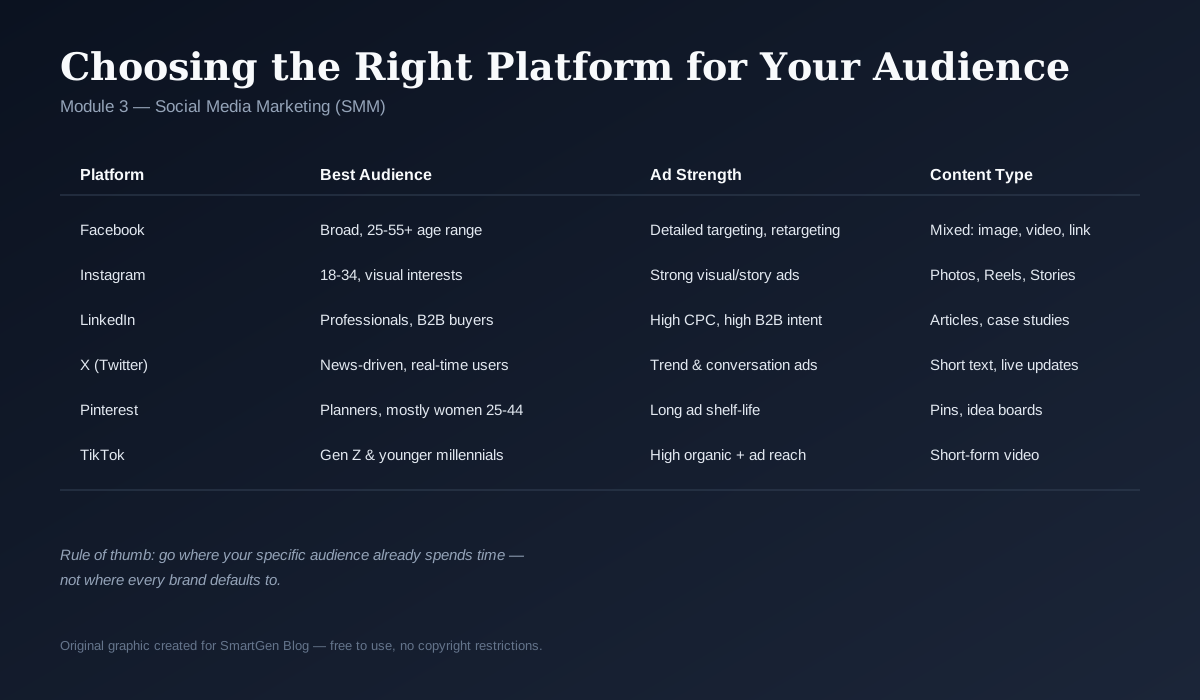
Each major platform tends to attract a somewhat different audience profile, and understanding these general tendencies helps narrow your choice:
Facebook tends to skew toward a broad, often slightly older audience compared to newer platforms, and remains strong for local businesses, community groups, and audiences who value detailed information and longer-form posts.
Instagram attracts a strong base of younger and middle-aged users, particularly suited to visually-driven industries like fashion, food, beauty, fitness, and travel.
LinkedIn is overwhelmingly used by working professionals, decision-makers, and B2B audiences, making it the clear choice for service businesses, recruiters, consultants, and any brand targeting other businesses rather than individual consumers.
X (Twitter) attracts users interested in real-time news, public conversation, and industries like tech, media, finance, and politics, where timely commentary and engagement matter more than polished visuals.
Pinterest skews toward users actively planning future purchases or projects, especially strong for home decor, weddings, recipes, fashion, and DIY content, where users are searching with clear purchase or project intent.
TikTok draws a younger audience that values authenticity, creativity, and entertainment, making it especially powerful for brands willing to create fun, fast-paced, trend-aware content rather than traditional polished advertising.
Step 3: Match Platform Strengths to Your Business Goal
Beyond demographics, consider what each platform does best functionally. If your goal is brand awareness among a broad consumer audience, Facebook and Instagram typically offer the widest reach. If your goal is B2B lead generation, LinkedIn consistently outperforms other platforms for reaching professional decision-makers. If your goal is driving sales for visually appealing physical products, Instagram and Pinterest tend to perform particularly well, since both are built around strong visual discovery. If your goal is building a fast-growing brand among younger audiences, TikTok currently offers some of the strongest organic reach potential of any platform.
Step 4: Start Narrow, Then Expand
A practical rule for beginners: choose one primary platform that most strongly matches both your audience and your goal, and commit to doing it well for several months before adding a second platform. It's far more effective to build real expertise and consistent results on one platform than to be mediocre across four platforms simultaneously, especially with limited time or budget.
Step 5: Validate with Data, Not Assumptions
Once you begin posting and advertising, let real performance data — not assumptions — guide further decisions. Track which platform actually drives engagement, traffic, and conversions for your specific business, since real-world results sometimes differ from general industry patterns. A business might assume Instagram is the obvious choice for their industry, only to discover through testing that their specific audience responds far better on Facebook or Pinterest.
Visual Summary
Below is an original infographic mapping common business goals to the platforms best suited for them, summarizing the platform-selection framework covered in this module. This graphic was created specifically for this guide and is completely free of copyright restrictions.
Module 3 Summary and Practice Exercise
In this module, we covered how social media advertising actually works, from the auction system to targeting, ad formats, budgeting, and retargeting, along with the most common mistakes beginners make when running paid campaigns. We also built a clear, step-by-step framework for selecting the right platform for your specific audience and goals, instead of spreading effort across every platform at once.
Practice exercise: Write a short profile of your ideal target audience (age, interests, online habits, and where they are in their buying journey). Based on that profile, identify which one platform from this module is the strongest match, and explain your reasoning in two or three sentences.
What's Next?
In Module 4, we'll shift focus to Search Engine Optimization (SEO) — learning exactly how to make your website and content discoverable through organic search, building on the platform-specific skills you've developed in Modules 1 through 3.
This article was written by Sayad Md Bayezid Hosan for the SmartGen blog. For free tools to support your digital marketing journey, visit smartgentools.com.