
July 02, 2026 • General • By Sayad Md Bayezid Hosan
MODULE 13: Algorithm Updates and Analysis — The Complete A to Z Mega Guide for Beginners
A complete, deeply detailed, beginner-friendly A to Z guide to Google algorithm updates — what an algorithm update actually is, the real role and story behind every major named update (Panda, Penguin, Pirate, Hummingbird, Pigeon, RankBrain, Possum, Fred, Medic, and BERT), how Google penalties actually work and how they differ from an ordinary ranking drop, and exactly how to prevent your own website from ever being caught by one.
Welcome to Module 13: Algorithm Updates and Analysis
Take a moment to think about everything you've built through this course so far. In Module 9, you built a real WordPress website. In Module 10, you learned how search engines actually crawl, index, and rank that website. In Module 11, you learned how to research the exact keywords your future readers are typing. In Module 12, you learned how to turn all of that into genuinely valuable content that earns trust instead of just shouting for attention.
Now imagine waking up one morning, checking your analytics the way you always do, and finding that your traffic has fallen by 60% overnight. Nothing on your website changed. You didn't do anything differently. And yet the traffic you spent months earning has quietly evaporated.
This happens to real website owners, regularly, and it is almost never random bad luck. It is almost always the direct result of a Google algorithm update — a change to the enormous, constantly evolving system that decides what appears in search results and in what order. This module exists so that this never happens to you without you understanding exactly why, and so that you build your website, from the very beginning, in a way that these updates were never designed to punish in the first place.
I am going to slow down in this module more than in previous ones. Algorithm updates involve some genuinely confusing terminology, a lot of half-true myths that circulate in beginner SEO communities, and a real history spanning more than a decade. My goal in this guide is not to impress you with jargon — it's to make sure that by the time you finish reading, you could confidently explain to a friend what Panda did, what a manual penalty actually is, and why "just write good content" turns out to be the single most powerful piece of protection you will ever have. So take your time with this one. There's no rush, and every section builds carefully on the one before it.
Before diving in, if you haven't already gone through the earlier modules in this course, I'd strongly recommend starting there, since this module leans heavily on concepts from Modules 10, 11, and 12 in particular:
- Introduction to Online Digital Marketing: A Beginner's Guide
- Module 3: Social Media Marketing (SMM) — Advertising Concepts and Platform Selection
- Module 6: X (Formerly Twitter) Marketing — The Complete A to Z Mega Guide
- Module 7: LinkedIn Marketing — The Complete A to Z Mega Guide
- Module 9: Creating a WordPress Website — The Complete A to Z Mega Guide
- Module 10: Search Engine Optimization (SEO) — The Complete A to Z Mega Guide
- Module 11: Analysis and Keyword Research — The Complete A to Z Mega Guide
Why I'm Writing This Guide the Way I Am
Most explanations of Google's algorithm updates fall into one of two unhelpful extremes. Either they're written as dry, chronological trivia — "Penguin launched in April 2012 and targeted webspam" — with no real explanation of why it mattered or what a beginner is actually supposed to do about it today. Or they lean into fear and mystery, treating Google's algorithm like an unknowable black box that could strike your website at any moment for reasons no one can explain.
Neither approach is true, and neither actually helps you. The real story is more encouraging than either extreme suggests: every single major update covered in this guide was Google trying to solve one specific, identifiable problem — a way that dishonest or lazy website owners were gaming the system at the expense of the person doing the searching. Once you understand the problem each update was solving, the solution for your own website almost always becomes obvious, and a lot of the fear disappears.
So this guide is built around telling each update as a small story: here's what the internet looked like before this update, here's the specific bad behavior it existed to stop, here's what changed, and here's exactly what that means for you, today, building an honest website. By the end, algorithm updates should feel less like unpredictable weather and more like a fairly consistent, fairly logical pattern you can actually plan around.
1. Understanding Major Search Engine Algorithm Updates
What an "Algorithm Update" Actually Means
Let's start with the basics, in the plainest language possible. Google's algorithm is the enormous set of rules and mathematical calculations Google's systems use to decide, out of the billions of pages in its index (remember indexing from Module 10), which ones to show for any given search, and in what order. An algorithm update is simply a change to some part of that system — big or small.
Here's the detail that surprises most beginners: Google makes an enormous number of changes to its algorithm every single year — commonly cited figures put it in the thousands. The overwhelming majority of these are tiny, invisible tweaks that no ordinary website owner would ever notice or need to react to. Only a small handful, historically, have been significant enough that Google either names them directly, or the SEO community notices the pattern and gives them a nickname. Those are the ones this module focuses on, because those are the ones that have genuinely reshaped what "doing SEO well" means at different points in the last fifteen years.
The Two Broad Families of Update
It helps enormously to sort updates into two broad families, because they behave differently and they teach different lessons.
Quality and integrity updates exist to catch websites that are gaming the system dishonestly — publishing thin, unhelpful content just to attract clicks, buying fake links to appear more trustworthy than they are, or stealing other people's work. Panda, Penguin, Pirate, Fred, and Medic — all covered in detail in Section 2 — fall into this family. Their common thread is enforcement: they punish specific bad behaviors.
Understanding and comprehension updates exist to make Google better at figuring out what a person actually means when they type or speak a search query, and better at figuring out what a piece of content is actually about. Hummingbird, RankBrain, and BERT fall into this family. Their common thread is intelligence: they don't punish anyone directly; they simply make Google smarter at matching real intent to real content, which sometimes causes rankings to shift as a side effect.
A third, smaller family — local search structure updates, covering Pigeon and Possum — exist specifically to make location-based search results (restaurants near me, plumbers in my city) fairer, more relevant, and more resistant to manipulation.
Keeping these three families in mind as you read Section 2 will make the individual stories click together far more easily than memorizing ten isolated facts.
Core Updates vs. Named Updates vs. Manual Actions
One more piece of vocabulary is worth nailing down before going further, because beginners mix these up constantly.
A broad core update is a periodic, wide-reaching refinement to Google's overall ranking systems, generally released several times a year, that doesn't target one specific tactic the way Panda targeted thin content — instead, it re-evaluates the entire landscape of quality signals at once. Google now typically confirms these publicly by name (for example, "the March 2024 core update") but doesn't disclose exactly what changed inside them.
A named or nicknamed update (Panda, Penguin, and the rest of Section 2) is usually a specific, identifiable change targeting one particular problem, and its effects are commonly agreed on and documented by the wider SEO community, even in cases where Google itself didn't originally give it that nickname.
A manual action is not an algorithm update at all — it's a human reviewer at Google directly examining a specific website and applying a penalty by hand. We'll cover this important distinction thoroughly in Section 3, because confusing an algorithmic effect with a manual action leads to completely different — and often wrong — recovery strategies.
Why This History Still Matters in 2026
It's fair to ask why a beginner starting a website today should care about an update from 2011. Three genuinely practical reasons.
The underlying principles never expired. Google didn't retire Panda's standards when it introduced Penguin — it simply layered new standards on top of the old ones. A website that would have been hurt by Panda in 2011 would still be hurt by today's quality systems, because "don't publish thin, unhelpful content" never stopped being true.
It helps you correctly diagnose a real traffic drop. If your traffic falls off a cliff and you know roughly when it happened, comparing that date against Google's public record of confirmed update rollouts (available on Google's Search Status Dashboard and widely reported by SEO news sites) is often the single fastest way to understand why — which then tells you exactly what to fix.
It protects you from repeating history's mistakes. Nearly every manipulative shortcut a beginner might be tempted to try — buying links, stuffing keywords, spinning thin content, copying competitors — has already been tried at scale by someone else, and has already been directly targeted by one of the updates in this module. Understanding that history is, in a very real sense, a shortcut to avoiding a decade-old, already-solved mistake.
How to Stay Informed Going Forward
A few genuinely useful habits: Google's own Search Status Dashboard publicly logs when broad core updates and other significant, confirmed changes roll out, and is the single most authoritative source. Reputable SEO news sites (Search Engine Land and Search Engine Roundtable are two long-standing, widely respected examples) report on and analyze new updates within hours of rollout. And several third-party tools track daily "ranking volatility" across large sets of search results, which can flag that something changed industry-wide even before Google confirms it. You don't need to obsessively check these daily — but knowing they exist means that if your own traffic ever shifts sharply, you have somewhere real to check rather than guessing in the dark.
2. Roles and Responsibilities of Major Algorithm Updates
This is the heart of the module. We're going to walk through ten updates that, together, tell the real story of how Google search evolved from a fairly simple keyword-matching tool into the sophisticated, quality-conscious system it is today. I've arranged them in the order they actually happened, because the story makes far more sense read as a timeline than as a random list.
For each one, I'll cover the same three things: what the internet looked like right before it, what actually changed, and what it means for your website today.
Panda (2011) — The Content Quality Filter
Before Panda, it was entirely possible — common, even — for a website to rank extremely well while offering almost nothing of real value. So-called "content farms" would mass-produce thousands of short, shallow, often poorly written articles purely to capture search traffic and display ads, with little regard for whether the content actually helped anyone. Meanwhile, genuinely well-researched, carefully written websites were often buried beneath this flood of thin content.
What Panda changed: Panda introduced Google's first large-scale system for directly evaluating content quality — not just whether a page contained the right keywords, but whether it was genuinely thorough, original, and useful. Sites with large amounts of thin, duplicate, or low-effort content saw sweeping ranking drops, sometimes across their entire domain, even on pages that were individually fine, because Panda evaluated quality signals at the whole-site level.
What it means for you: This is the single most foundational lesson in all of SEO, and it started here: never publish content purely to fill space or capture a keyword. Every page on your WordPress site should exist because it genuinely helps a specific reader with a specific need — the same principle Module 12 built its entire content strategy chapter around.
Penguin (2012) — The Link Spam Police
Before Penguin, the fastest way to boost your rankings wasn't necessarily better content — it was more backlinks, regardless of where they came from or how unnatural they looked. An entire industry existed around buying links, exchanging links in bulk ("link farms"), and stuffing keyword-rich anchor text into as many other websites as possible.
What Penguin changed: Penguin specifically targeted manipulative link-building and keyword-stuffing practices, directly devaluing or penalizing sites that relied heavily on unnatural, purchased, or spammy link patterns. In its early versions, Penguin's effects could be severe and required an active recovery process; later refinements made Penguin run continuously, so it now devalues bad links on more of an ongoing basis rather than waiting for periodic, dramatic updates.
What it means for you: Backlinks should be earned, not manufactured. A link from a genuinely relevant, reputable site that references your content because it's actually useful is worth incomparably more than a hundred purchased links from irrelevant or low-quality sites — and unlike in 2012, the bad kind can now actively hurt you rather than simply failing to help.
Pirate (2012) — The Copyright Enforcer
Before Pirate, websites that hosted or heavily linked to pirated content — illegally copied movies, music, books, and software — could still rank competitively in search results, effectively giving Google's own visibility to sites built on repeated, often blatant copyright infringement.
What Pirate changed: This update allowed Google to demote sites in search rankings based specifically on a high volume of valid copyright removal requests (DMCA takedown notices) filed against them, directly connecting a site's legal compliance record to its search visibility.
What it means for you: This one is refreshingly simple for a legitimate business or blogger: respect copyright law, in your own content and in what you link to or embed. This directly reinforces the copyright principles that responsible content creators — and, frankly, that this very course — already take seriously.
Hummingbird (2013) — The Meaning Engine
Before Hummingbird, Google's search engine leaned heavily on matching the literal words in a query to the literal words on a page. A search for "place to buy affordable hiking boots for a beginner" would look primarily for pages containing exactly those words, rather than truly understanding the underlying request: someone new to hiking, on a budget, looking to purchase boots.
What Hummingbird changed: This was not a narrow penalty like Panda or Penguin — it was a fundamental rewrite of Google's core search algorithm, designed to understand the full meaning and context behind a query rather than just matching individual keywords. It was one of the key technical foundations that made natural, conversational, question-style searches genuinely useful for the first time.
What it means for you: This is where the shift from "write for keywords" toward "write for genuine meaning and context" really began — a shift Module 11's keyword research module and Module 12's content writing module both build directly on top of. Content that thoroughly and naturally answers the real underlying question, rather than mechanically repeating an exact keyword phrase, has been rewarded ever since.
Pigeon (2014) — The Local Search Realignment
Before Pigeon, Google's local search results (the map-based results you see for searches like "coffee shop near me") were generated through a somewhat separate system from its traditional, non-local ranking signals — which sometimes produced local results that felt disconnected from the broader quality standards applied elsewhere.
What Pigeon changed: Pigeon tied local search rankings much more closely to Google's core, traditional ranking signals — meaning the same fundamentals that helped a page rank well generally (relevance, authority, on-page quality, covered back in Module 10) started to meaningfully influence local pack rankings too, rather than local results running on a largely separate set of rules.
What it means for you: If you run or market a local business, your website's general SEO health — not just your Google Business Profile listing — genuinely affects your local search visibility. The two are connected, not separate projects.
RankBrain (2015) — The Machine-Learning Layer
Before RankBrain, Google's ranking systems were built primarily from rules that engineers wrote directly. This worked well for common, well-understood searches, but struggled with the roughly 15% of searches Google receives every day that are entirely new or highly unusual phrasings no engineer had specifically anticipated.
What RankBrain changed: RankBrain introduced a machine-learning system into Google's core ranking process — a component that learns from patterns in enormous amounts of search data to make educated interpretations of unfamiliar or ambiguous queries, rather than relying solely on pre-written rules. It became, and remains, one of the significant signals feeding into Google's overall ranking system.
What it means for you: There's no separate checklist to "optimize for RankBrain" the way you might optimize a page title. The practical takeaway is the same one running through this whole module: genuinely comprehensive, well-organized content that clearly satisfies real intent gives a learning-based system the strongest, clearest signal to learn from and reward.
Possum (2016) — The Local Diversifier
Before Possum, local search results were more easily dominated by whichever businesses happened to cluster in the exact same small geographic area, and multiple businesses sharing a single address or building could sometimes crowd out genuinely distinct, relevant competitors from a searcher's local results entirely.
What Possum changed: Possum made local rankings more sensitive to the precise physical location of the person searching, filtered results more aggressively based on business address and category similarity, and generally diversified the local pack so a wider, fairer range of relevant nearby businesses could be found rather than a small cluster dominating everything.
What it means for you: For local businesses specifically, accurate, consistent, honestly-categorized location information (in your Google Business Profile and across your website) matters more, not less, after Possum — and results can genuinely vary for two searchers standing just a short distance apart.
Fred (2017) — The Anti-Thin-Monetization Update
Before Fred (a nickname the SEO community gave this update since Google didn't originally confirm an official name for it), a specific type of website had become common: content that existed mostly as a thin vehicle for displaying as many ads as possible, sometimes barely disguising the fact that generating ad revenue, not helping the reader, was the entire point.
What Fred changed: Sites showing this pattern — aggressive, intrusive monetization paired with low-value, thin content that didn't genuinely serve the reader — saw significant ranking drops. In many ways, Fred can be understood as a direct descendant of Panda's original mission, specifically targeting a monetization-driven variant of the same underlying problem.
What it means for you: If you run ads or affiliate links on your WordPress site (a natural next step once your content marketing from Module 12 is driving real traffic), monetization is completely fine — but it must sit on top of genuinely valuable content, not substitute for it. Ask honestly: if I removed every ad and affiliate link from this page, would a reader still feel it was worth their time?
Medic (2018) — The E-E-A-T Wake-Up Call
Before Medic, a wide range of websites — particularly those covering health, medical, financial, and legal topics — could rank well without always clearly demonstrating genuine expertise, accurate sourcing, or real accountability for the advice being given, despite these topics having serious real-world consequences if the information was wrong.
What Medic changed: This broad core update (nicknamed "Medic" because of how heavily it affected health and medical sites, though its actual scope was wider) triggered a significant industry-wide re-evaluation of a concept Google calls E-E-A-T — Experience, Expertise, Authoritativeness, and Trustworthiness. Google pays particularly close attention to E-E-A-T on what it calls YMYL pages — "Your Money or Your Life" content, covering anything that could meaningfully affect a person's health, finances, safety, or major life decisions.
What it means for you: If your website touches health, finance, legal, or safety topics in any way, clear authorship with real, verifiable credentials, accurate and well-sourced information, transparency about who runs the site, and visible accountability all matter enormously. But even outside strict YMYL categories, demonstrating genuine first-hand experience and real expertise — rather than generic, recycled information — has become one of the clearest, most consistent things Google's systems reward.
BERT (2019) — The Language Understanding Leap
Before BERT, even with Hummingbird's and RankBrain's improvements, Google could still struggle with the subtle ways small words dramatically change a sentence's meaning — prepositions like "for," "to," and "without" can completely flip what a query is actually asking.
What BERT changed: BERT (an acronym for a natural-language-processing technique) dramatically improved Google's ability to understand words in relation to all the other words around them, rather than processing a query more piece by piece. This made Google noticeably better at correctly interpreting longer, more conversational, more naturally-phrased searches — including the small connecting words that previous systems tended to treat as unimportant.
What it means for you: Write the way real people actually speak and ask questions, with natural sentence structure and genuine context — not in the clipped, keyword-stuffed phrasing that older SEO advice sometimes encouraged. By 2019, Google had become sophisticated enough to reward writing that sounds genuinely human, which is, not coincidentally, also simply better writing for your actual reader.
A Quick-Reference Timeline
Here's the entire story from this section condensed into one table you can come back to any time you need a fast reminder of what each update was really about.
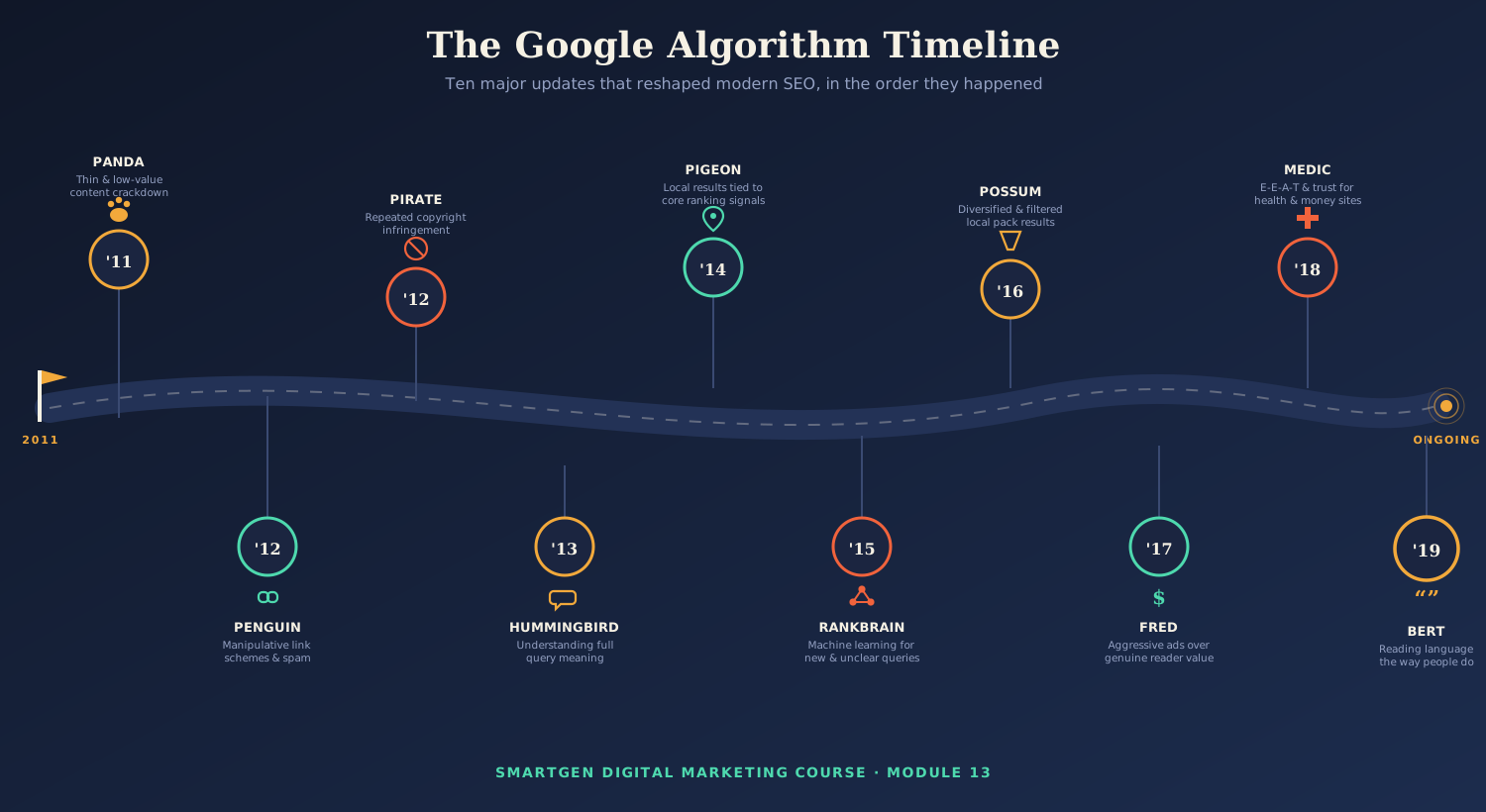
| Year | Update | Primary Target | One-Line Takeaway |
|---|---|---|---|
| 2011 | Panda | Thin, low-value content | Never publish content that doesn't genuinely help someone |
| 2012 | Penguin | Manipulative link schemes | Earn links naturally; never buy or manufacture them |
| 2012 | Pirate | Repeated copyright infringement | Respect copyright, in what you publish and what you link to |
| 2013 | Hummingbird | Literal keyword matching | Write for real meaning and intent, not just keyword phrases |
| 2014 | Pigeon | Disconnected local rankings | Your site-wide SEO health affects local visibility too |
| 2015 | RankBrain | Unfamiliar, ambiguous queries | Comprehensive content helps a learning system understand you |
| 2016 | Possum | Local result clustering | Accurate, honest location data matters more than ever |
| 2017 | Fred | Thin content built for ads | Monetize on top of value, never in place of it |
| 2018 | Medic | Weak E-E-A-T on YMYL topics | Prove real expertise, experience, and trustworthiness |
| 2019 | BERT | Misreading natural language | Write the way real people actually speak and ask questions |
A Mid-Guide Reality Check — What I Actually Want You to Walk Away Understanding
We've just covered ten updates and a decade of history, so it's worth pausing here to name the one thread running through every single one of them, because it's easy to lose sight of it in the details.
Not one of these updates introduced a brand-new rule that a well-intentioned website owner would have found surprising. Panda said: don't publish junk. Penguin said: don't fake your credibility with bought links. Pirate said: don't build a business on stolen work. Medic said: prove you actually know what you're talking about, especially when it matters. Every "understanding" update — Hummingbird, RankBrain, BERT — simply made Google better at recognizing genuine quality when it saw it, which only ever threatened websites that were relying on tricking a less sophisticated system in the first place.
The other thing worth naming clearly, heading into the next two sections: knowing this history is protective, but it doesn't automatically tell you what to do if you've already been hit by one of these effects, or how to build the kind of ongoing habits that keep you safely away from all of them at once, going forward. That's exactly where we turn next — first understanding what a "penalty" actually is and isn't, and then building a concrete, practical system for prevention.
3. Google Penalties
The word "penalty" gets used loosely and often incorrectly in beginner SEO conversations. Getting this section right matters enormously, because the correct response to a real penalty is completely different from the correct response to an ordinary ranking fluctuation — and confusing the two wastes time and can even make things worse.
The Critical Distinction: Algorithmic Effects vs. Manual Actions
An algorithmic effect happens automatically, as a direct consequence of one of the updates covered in Section 2 (or a broad core update) re-evaluating your site. Nobody at Google personally looked at your website and decided to punish it — an automated system simply reassessed your content or links against its current standards and adjusted your rankings accordingly. There is no formal notification for this. You simply notice a ranking or traffic change that correlates with a known update's rollout date. Because it's automatic, recovery is also automatic: once you've genuinely fixed the underlying issue, your rankings can improve the next time Google's systems reprocess your site — though this can take weeks or even months, since it depends on Google's own crawling and reassessment schedule, not a request you can submit.
A manual action, by contrast, is a genuine human being on Google's search quality team directly reviewing your website — usually after it was flagged by an algorithm or a user report — and applying a penalty by hand. Manual actions are formally documented and always visible in the Manual Actions report inside Google Search Console (the same free tool introduced back in Module 10), which names the specific issue and tells you whether it applies to your entire site or only specific pages.
This distinction changes everything about how you respond, which is exactly why Section 4 treats them separately.
The Most Common Manual Action Categories
Understanding the actual categories Google uses helps demystify what "getting penalized" really covers. A few of the most common:
Thin content with little or no added value — pages that exist but don't genuinely inform, entertain, or help a visitor, echoing the exact concern Panda first raised back in 2011.
Unnatural links to your site — typically a sign of paid link schemes or manipulative link exchanges, directly descended from Penguin's original targets.
Unnatural links from your site — this one surprises beginners: if your site sells links or participates in link exchanges without properly marking them as sponsored or nofollowed (a technical detail worth discussing with whoever manages your WordPress site), you can be penalized for passing manipulative value to other sites, not just for receiving it.
Cloaking and sneaky redirects — showing search engines different content than what a real visitor sees, or redirecting visitors somewhere unexpected after they click a search result.
User-generated spam — spammy, low-quality content posted by others in your comments sections, forums, or guest content areas, which Google holds site owners responsible for moderating.
Hacked content — this isn't your fault in the sense of intent, but if your site has been compromised and is serving malicious or spammy content without your knowledge, Google can and will apply a manual action until it's cleaned up.
Structured data issues — marking up content with schema data (mentioned back in the Pinterest and WordPress modules for Rich Pins and rich search results) that doesn't accurately reflect what's actually visible on the page.
How to Actually Diagnose a Traffic Drop
Here is a simple, honest, step-by-step way to figure out what's really going on if your traffic falls sharply — far more useful than guessing.
Step one: check Search Console's Manual Actions report first, always. This takes thirty seconds and immediately tells you whether you're dealing with a manual action at all. If it's empty, you are not manually penalized, full stop — whatever is happening is either algorithmic or something else entirely.
Step two: check the Security Issues report. This catches hacked-site scenarios, which can look like a mysterious traffic drop but have a completely different, more urgent fix (securing your site) than a content or link problem.
Step three: compare the timing against known update rollout dates. If your drop lines up closely with a confirmed core update or a specific named update's rollout, that's strong evidence of an algorithmic cause — and Section 2 just gave you the vocabulary to guess which kind of issue to look for based on which update it was.
Step four: honestly rule out non-penalty explanations before assuming the worst. A significant share of "mystery" traffic drops turn out to be something far more mundane: an accidental noindex tag left on from a site redesign (covered back in Module 10), a broken robots.txt file blocking important pages, a botched site migration missing proper redirects, normal seasonal demand changes, or simply a strong new competitor that has out-earned you fairly. Not every drop is a penalty, and assuming it must be one can send you chasing the wrong fix entirely.
4. Prevention Of Algorithm Penalties to Website
Everything in this final section follows from one honest starting principle: you cannot reliably reverse-engineer an algorithm you don't have access to, but you can absolutely build a website that never needed to. Every update in Section 2 only ever threatened sites that were cutting a corner a genuine, reader-first website was never going to cut in the first place.
The Core Prevention Philosophy
Before any checklist, internalize this single test, because it will serve you better than any individual rule: if a tactic only makes sense as a way to influence Google, and offers no real benefit to an actual human reader, don't do it. Buying links, publishing thin filler content, stuffing keywords unnaturally, hiding text, cloaking pages — every one of these fails that test instantly. Genuinely helpful content, naturally earned links, accurate information, and honest site structure all pass it easily, and every update in this module's history rewards exactly that side of the line.
A Practical, Ongoing Prevention Checklist
On content quality: Make sure every page earns its place — genuinely thorough, accurate, and written to help a specific real reader, never published purely to fill a content calendar or chase a keyword in isolation. Keep older content updated and accurate rather than letting it quietly go stale, and avoid publishing large volumes of thin, auto-generated, or barely-reworded content, regardless of how that content was produced.
On links: Earn backlinks the honest way — through content genuinely worth referencing, real relationships, and legitimate outreach — and never buy links or join reciprocal link-exchange schemes. If you accept guest posts or sell any kind of sponsored placement, use proper rel="sponsored" or rel="nofollow" attributes so you're not passing manipulative ranking value in either direction. Treat Google's Disavow Tool as a rare, last-resort remedy for a genuine negative-SEO attack — not a routine maintenance task.
On technical health: Keep your site fast, mobile-friendly, and secure with a valid SSL certificate (all covered back in the WordPress module), make sure structured data accurately reflects your visible content, avoid cloaking or sneaky redirects entirely, and handle any site migration or URL changes with careful, complete 301 redirects so you never accidentally orphan or hide previously healthy pages.
On E-E-A-T, especially for YMYL topics: If your content touches health, finance, legal, or safety topics, make authorship and real credentials clearly visible, cite reputable, verifiable sources, keep an honest, transparent About page, and have genuinely qualified people review sensitive content. Even outside strict YMYL categories, favor content that demonstrates real, first-hand experience over generic information that could have been written by anyone about anything.
On ongoing monitoring: Build the simple monthly habit, extending the analytics discipline from Modules 8 and 12, of checking Search Console's Manual Actions, Security Issues, and Coverage reports — not because you expect a problem, but because catching one early, before it compounds, is always easier than recovering from one that's been quietly growing for months.
What to Actually Do If You Get Hit
If, despite all of this, you do notice a serious drop, follow this sequence rather than panicking or guessing:
First, correctly diagnose it using the four-step process from Section 3 — manual action, algorithmic effect, or something else entirely. This determines everything that follows.
Second, fix the actual root cause thoroughly, not superficially. If thin content is the issue, substantially improve or remove it — don't just add a few extra paragraphs to check a box. If unnatural links are the issue, work to have the worst offenders removed at the source before ever reaching for the disavow tool.
Third, for a confirmed manual action, submit a genuine reconsideration request through Search Console only after the real fix is complete — and be specific and honest in it about exactly what was wrong and exactly what you changed. A rushed or vague reconsideration request submitted before real fixes are in place is a common, avoidable mistake that just delays real recovery.
Fourth, for an algorithmic effect, understand that there is no request-a-review button — you simply keep genuinely improving, and wait for Google's systems to naturally reprocess and reassess your site, which realistically can take anywhere from several weeks to a few months, particularly for broad core updates.
The Reassuring Truth to Carry Forward
If you take only one thing from this entire module, let it be this: across more than a decade and ten major, genuinely different updates, Google's underlying message to website owners has never actually changed. Be honest. Be genuinely useful. Prove that you know what you're talking about. Earn trust instead of manufacturing it. Every algorithm update in this guide, and almost certainly every one still to come, is really just a more sophisticated way of enforcing that same simple standard — which means the single best long-term protection you have was never a secret technical trick. It's everything you've already been building, module by module, throughout this entire course.
Visual Summary
Below is an original infographic built specifically for this guide, laying out all ten major algorithm updates in the order they happened, from Panda in 2011 through BERT in 2019 and the ongoing core updates that have continued ever since.
Module 13 Mega Guide Summary
In this module, we covered what an algorithm update actually is and the difference between broad core updates, named updates, and manual actions, the full story behind ten major Google algorithm updates — Panda, Penguin, Pirate, Hummingbird, Pigeon, RankBrain, Possum, Fred, Medic, and BERT — including what each one targeted and what it means for your website today, exactly how Google penalties work, including the critical difference between an automatic algorithmic effect and a human-applied manual action, and a complete, practical system for preventing penalties in the first place, plus exactly what to do if you're ever hit by one.
Practice exercise: Open Google Search Console for your own WordPress site (or a test site if you're still building one) and check both the Manual Actions and Security Issues reports, confirming they're clear. Then pick any one piece of existing content on your site and honestly evaluate it against the E-E-A-T principles from the Medic section: is the authorship clear, is the information accurate and well-sourced, and does it demonstrate genuine expertise or experience rather than generic, could-be-anyone information? Make one concrete improvement based on what you find.
Frequently Asked Questions
Did Google stop releasing major updates after BERT in 2019?
No — Google has continued releasing broad core updates multiple times most years since then, along with more targeted systems, including a dedicated "helpful content" signal introduced in 2022 that was later folded directly into Google's broader core ranking systems. The specific named updates change over time, but Google's official Search Central blog and Search Status Dashboard remain the best way to stay current on whatever is newest.
How do I know if a core update helped me or hurt me?
Compare your organic traffic and rankings in Google Search Console for the weeks immediately before and after a confirmed core update's rollout dates. A clear, sustained shift in either direction that lines up with those dates is a strong signal the update affected you; if your numbers were already trending that way beforehand, the update likely isn't the real cause.
Should I proactively use the Disavow Tool just in case I have bad links I don't know about?
Generally no. The Disavow Tool is designed for genuine negative-SEO situations or a confirmed manual action tied to unnatural links, and using it aggressively on links that aren't actually causing harm can occasionally do more harm than good. For most sites that have never manipulated links themselves, it's simply unnecessary.
Can a small, brand-new website really get caught by these updates?
Yes, though the practical risk is usually lower simply because a new, honest site typically hasn't engaged in any of the specific behaviors these updates target in the first place. The real value of this module for a small site is prevention — building good habits from day one — rather than recovery.
How long does recovery actually take after fixing the problem?
For a manual action, once a genuine reconsideration request is approved, recovery can happen within days to a few weeks. For an algorithmic effect, there's no formal approval step — improvement typically becomes visible only after Google's systems naturally reprocess your site during a subsequent update, which can reasonably take anywhere from several weeks to a few months.
Is E-E-A-T only something Google can measure through hidden technical signals?
Not entirely — much of it is genuinely visible and improvable: clear author bios with real credentials, accurate citations, transparent business information, and content that reads like it was written by someone who actually knows the subject firsthand. Improving how clearly you demonstrate your expertise, not just how much you technically possess, is often the most immediately actionable step.
What's Next?
In the next module, we'll continue building on these foundations. Take a moment to revisit the earlier lessons in this course if you need a refresher, since each module builds on what came before it:
- Introduction to Online Digital Marketing: A Beginner's Guide
- Module 3: Social Media Marketing (SMM) — Advertising Concepts and Platform Selection
- Module 6: X (Formerly Twitter) Marketing — The Complete A to Z Mega Guide
- Module 7: LinkedIn Marketing — The Complete A to Z Mega Guide
- Module 9: Creating a WordPress Website — The Complete A to Z Mega Guide
- Module 10: Search Engine Optimization (SEO) — The Complete A to Z Mega Guide
- Module 11: Analysis and Keyword Research — The Complete A to Z Mega Guide
This article was written by Sayad Md Bayezid Hosan for the SmartGen blog. For free tools to support your digital marketing journey, visit smartgentools.com.