

July 01, 2026 • General • By Sayad Md Bayezid Hosan
MODULE 10: Search Engine Optimization (SEO) — The Complete A to Z Mega Guide for Beginners
A complete, practical A to Z guide to Search Engine Optimization for beginners — what SEO actually is and why it underlies everything else in this course, how search engines really work behind the scenes, how to read and understand the SERP the way a search engine sees it, and how crawling and indexing determine whether your content can ever be found at all.
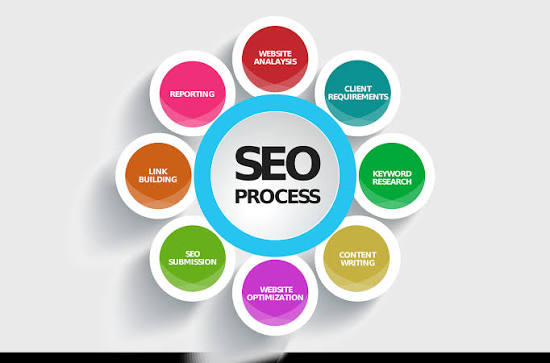
Welcome to Module 10: Search Engine Optimization
Every module in this course so far has, in one way or another, pointed back to the same destination: the WordPress website you learned to build in Module 9. Social platforms send traffic there. Pinterest Pins link there. Landing pages live there. But getting a website built is only half the story. The other half — arguably the more important half over the long run — is making sure that website can actually be found by the people looking for what it offers, without you having to pay for every single visit.
That's what SEO is for.
Search Engine Optimization is different from every paid tactic covered elsewhere in this course. Paid ads stop the moment you stop paying. SEO, done properly, keeps working for you month after month, year after year, off the back of work you largely do once. It is, without exaggeration, one of the highest long-term-return skills in all of digital marketing — and also one of the most widely misunderstood, buried under myths, outdated advice, and a genuine amount of complexity that beginners rarely have explained to them properly from the ground up.
This module is where we start building that understanding properly, from the actual mechanics upward rather than from tips and tricks downward. Before diving in, if you haven't already gone through the earlier modules in this course, I'd recommend starting there, since each module builds on the concepts that came before:
- Introduction to Online Digital Marketing: A Beginner's Guide
- Module 3: Social Media Marketing (SMM) — Advertising Concepts and Platform Selection
- Module 4: Meta (Facebook) Marketing — The Complete A to Z Mega Guide
- Module 5: Instagram Marketing — The Complete A to Z Mega Guide
- Module 6: X (Formerly Twitter) Marketing — The Complete A to Z Mega Guide
- Module 7: LinkedIn Marketing — The Complete A to Z Mega Guide
- Module 8: Pinterest Marketing — The Complete A to Z Mega Guide
- Module 9: Creating a WordPress Website — The Complete A to Z Mega Guide
- Module 10: Search Engine Optimization (SEO) — The Complete A to Z Mega Guide
Why I'm Writing This Guide the Way I Am
SEO has a reputation problem. To a lot of beginners, it sounds like either dark, mysterious wizardry ("nobody really knows how Google's algorithm works") or a checklist of shallow tricks ("just add more keywords and backlinks"). Neither framing is accurate, and both lead to bad decisions.
The truth is more grounded than either myth suggests. Search engines are trying to solve a genuinely simple problem: given what someone typed, find and rank the most useful, trustworthy, relevant content that answers it, as fast as possible. Nearly everything in SEO — every recommendation you'll encounter in this course and beyond — exists in service of helping a search engine recognize that your content is, in fact, the useful, trustworthy, relevant answer to a real question someone is asking.
This guide is built around that single idea. It starts with the actual mechanics of how search engines operate, because you cannot optimize for a system you don't understand, and every later module in this SEO series will build on the foundation laid here.
1. Introduction to Search Engine Optimization
What SEO Actually Is
Search Engine Optimization (SEO) is the practice of improving a website so that it appears higher in the unpaid, "organic" results of a search engine for the searches that matter to your business — and so that it earns more clicks, more relevant visits, and ultimately more of the outcomes you actually care about, whether that's sales, sign-ups, or readership.
Notice the word "organic" in that definition. It's the key distinction that separates SEO from paid search advertising (which we'll cover in a later module). When you search something on Google and see results with a small "Sponsored" or "Ad" label, that's paid placement — someone paid for that position. Everything below and around those ads is the organic results, and that's the territory SEO is fought over. You cannot pay a search engine directly to rank higher organically; you earn that position through the quality, relevance, and trustworthiness of your actual content and site.
Why SEO Matters So Much
A few practical realities make SEO worth the sustained attention this and later modules will give it.
Search is where intent lives. Unlike a social media feed, where someone might stumble across your content while looking for something else entirely, a search query is a direct statement of what someone wants right now. Someone searching "best running shoes for flat feet" is telling you, explicitly, what they're looking for. Ranking well for that query means showing up at the exact moment someone has already decided they want an answer — which is an extraordinarily valuable moment to be visible in.
Organic traffic compounds and persists. A well-optimized page that earns a strong ranking can continue generating visits for months or years with little additional investment, in much the same way the Pinterest module described Pins compounding over time. Paid traffic disappears the instant the budget does; a strong organic ranking, once earned, tends to be considerably more durable.
Search engines still dominate how people find information. Despite the rise of social platforms and AI-driven discovery, search engines remain one of the primary ways people research purchases, solve problems, and find businesses. A website with no organic visibility is, for a huge number of potential customers, effectively invisible.
The Three Broad Pillars of SEO
Most SEO work falls into three interconnected categories, each of which later modules in this course will explore in depth:
Technical SEO covers how easily a search engine can access, crawl, and understand your site — site speed, mobile-friendliness, site structure, and the crawling and indexing mechanics covered later in this very module.
On-page SEO covers the content and structure of individual pages themselves — keyword usage, headings, page titles, meta descriptions, internal linking, and content quality and depth.
Off-page SEO covers signals that happen outside your own website but still affect how search engines evaluate it — most importantly backlinks (other reputable websites linking to yours), which function as a kind of trust vote in the eyes of a search engine.
A genuinely effective SEO strategy pays attention to all three. A technically flawless site with thin, unhelpful content won't rank. Brilliant content on a site search engines can't properly crawl won't rank either. They work together, not in isolation.
What SEO Is Not
It's worth clearing up a few persistent myths before going further. SEO is not a one-time task you complete and then forget — search engines, competitors, and user behavior all keep shifting, which makes SEO an ongoing practice rather than a project with a finish line. SEO is also not primarily about "tricking" an algorithm; the search engines covered in the next section have spent decades specifically refining their systems to detect and penalize exactly that kind of manipulation. And SEO is not instant — unlike a paid ad that can drive traffic within minutes of launching, meaningful organic results typically take weeks or months to materialize, which is precisely why understanding the fundamentals properly, rather than chasing shortcuts, matters so much.
2. How Search Engines Work
To do SEO well, you need an accurate mental model of what a search engine is actually doing behind that simple search box. It comes down to three core processes, each of which builds on the one before it.
Process One: Crawling
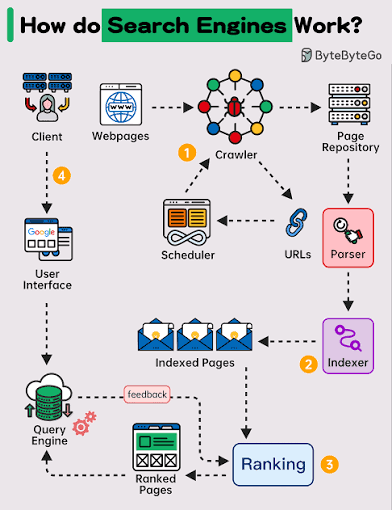
Search engines use automated programs — commonly called crawlers, spiders, or bots (Google's is called Googlebot) — that continuously travel across the web, moving from page to page by following links, in order to discover what content exists. A crawler lands on a page, reads its content, notes every link on that page, and then follows those links to discover more pages, repeating this process endlessly across billions of pages.
This is why links matter so fundamentally to how the web is discovered at all: a page with no links pointing to it anywhere on the internet may never be found by a crawler in the first place, no matter how good the content is. We'll go much deeper into the mechanics of crawling in Section 4 of this module.
Process Two: Indexing
Once a crawler has read a page, the search engine doesn't just note that the page exists — it analyzes the page's content and stores relevant information about it in a massive database called the index. Think of the index as an extraordinarily detailed library catalog of the entire crawlable web: what each page is about, what words and phrases appear on it, how it's structured, and various other signals used later to determine relevance.
A page must be indexed before it can ever appear in search results. A page can be perfectly crawlable and still fail to get indexed for a variety of reasons, which is why indexing, covered further in Section 4, is treated as its own distinct concern in SEO rather than assumed to happen automatically.
Process Three: Ranking
When someone types a search query, the search engine doesn't search the live web in real time — that would be far too slow. Instead, it searches its own pre-built index and runs the query through a ranking algorithm: an enormously complex system of mathematical signals that evaluates every indexed page that could plausibly be relevant, and orders them by how well each one is predicted to satisfy the person's actual intent.
Modern ranking algorithms weigh hundreds of signals simultaneously, and the exact weighting is a closely guarded secret that also changes constantly. But the broad categories of what these signals measure are well understood and consistently confirmed by search engines themselves: relevance (does the content actually match what was searched), quality and depth (is the content thorough, accurate, and genuinely useful, rather than thin or superficial), authority and trust (do other reputable sources treat this content or site as credible, and does the site demonstrate real expertise), user experience (does the page load quickly, work well on mobile, and avoid intrusive or disruptive design), and freshness (for time-sensitive queries, how recent and up to date is the content).
Why This Model Matters for Everything Else
Every practical SEO recommendation you'll ever encounter — write better content, get quality backlinks, improve site speed, use clear headings — is really just a specific tactic aimed at improving your performance on one or more of the ranking signals described above, made possible in the first place by successful crawling and indexing. Once you see SEO through this three-stage lens, most individual tips stop feeling like arbitrary rules and start making obvious, logical sense.
3. Understanding the SERP
The SERP — Search Engine Results Page — is the page that appears after someone runs a search. Learning to actually read a SERP the way a search engine and a searcher both experience it is a foundational SEO skill, because the SERP tells you an enormous amount about what a search engine believes people want for any given query, before you write a single word of content.
The Building Blocks of a Modern SERP
Today's SERPs are far more complex than the simple list of ten blue links that search engines used to return. A typical SERP for a competitive query might include several distinct elements stacked together.
Paid ads typically appear at the very top (and sometimes the bottom) of the page, clearly labeled as sponsored or as an ad. These are the paid search placements referenced earlier, and they are not something organic SEO work affects directly.
Featured snippets are highlighted boxes, often near the top of organic results, that pull a direct, concise answer — a definition, a short list, a table — straight from a webpage and display it before the searcher even clicks through. Earning a featured snippet is a distinct and valuable SEO goal in its own right, since it can capture attention and clicks even from a page not ranked in the very top organic position.
The organic results are the traditional, unpaid list of ranked pages that SEO work is ultimately trying to influence — each one typically shown with a clickable title, a URL, and a short descriptive snippet of text.
Local pack results (sometimes called the "map pack") appear for searches with local intent — "coffee shop near me," "plumber in [city]" — and display a small cluster of nearby business listings with a map, ratings, and hours, pulled from each business's local listing profile rather than their website content directly.
"People also ask" boxes show a short list of related questions that expand into brief answers when clicked, often pulled from other ranking pages, and are a genuinely useful research tool for understanding what related questions your own content should be prepared to answer.
Image and video results, knowledge panels, and shopping results may also appear depending on the nature of the query, each pulling from different specialized indexes the search engine maintains.
Why the SERP Itself Is Research
One of the most underused SEO habits, and one worth adopting immediately, is simply studying the SERP for any keyword you're considering targeting before writing anything. The SERP tells you, directly from the search engine itself, what kind of content it currently believes best answers that query. If every top result for a keyword is a long, detailed guide, that's a strong signal the search engine associates that query with depth and thoroughness, and a short, shallow page is unlikely to compete no matter how well-optimized it is technically. If the SERP is dominated by local pack results, that tells you the query has strong local intent, and a purely informational blog post is the wrong content format entirely. If shopping results dominate, the search engine has interpreted the query as commercial and transaction-focused.
Reading the SERP this way — as a direct signal of a search engine's interpretation of intent — is far more reliable than guessing, and it's a skill that pays off across every keyword you'll ever research.
Understanding Search Intent Through the SERP
Underlying all of this is the concept of search intent — the actual underlying goal behind a query, which SEO practitioners generally group into four broad categories: informational (the searcher wants to learn something, like "how does SEO work"), navigational (the searcher wants to reach a specific known site or page, like "Pinterest login"), commercial investigation (the searcher is comparing options before a decision, like "best running shoes for flat feet"), and transactional (the searcher is ready to take an action, like "buy running shoes online"). Matching your content's format and goal to the actual intent behind a query, as revealed by the SERP itself, is one of the most consistently important and consistently overlooked fundamentals in all of SEO.
A Mid-Guide Reality Check — What I Actually Want You to Walk Away Understanding
Halfway through a guide like this, it's worth pausing to name the thing that separates beginners who eventually succeed at SEO from those who spend months frustrated and get nowhere.
The mistake is skipping straight to tactics — keyword density, backlink counts, title tag formulas — without first understanding that a search engine is fundamentally trying to serve its own users well, not reward specific technical patterns for their own sake. Every tactic that has ever reliably worked in SEO works because it genuinely helps a search engine identify content that satisfies real intent, and every tactic that has ever been discovered as a shortcut and later penalized was one that tried to fake that signal without actually delivering the underlying value.
The other thing worth naming clearly, heading into the final section of this module: crawling and indexing are not automatic guarantees. A website can have superb content, a beautifully designed layout, and genuinely helpful information — and still be functionally invisible to search engines if it has technical barriers preventing it from being properly crawled and indexed in the first place. That's exactly the foundation the next section builds.
4. Crawling & Indexing
We introduced crawling and indexing conceptually in Section 2. This section goes deeper into the practical mechanics — because understanding these two processes in detail is what allows you to diagnose why a page isn't showing up in search results at all, which is a completely different problem from a page that's indexed but simply ranking poorly.
How Crawlers Actually Discover Your Pages
A crawler discovers a page in one of a few ways: by following a link from another page it has already crawled (the most common path), by reading a sitemap — a structured file, typically at a URL like yourdomain.com/sitemap.xml, that explicitly lists every important page on your site for a search engine to find — or, less commonly today, through a direct manual submission via a tool like Google Search Console.
This is why internal linking, first mentioned back in the WordPress module, matters so much beyond just user navigation: every internal link on your site is also a pathway a crawler can follow to discover another page. A page buried with no links pointing to it anywhere on your site — sometimes called an "orphan page" — may never be crawled at all, no matter how good its content is.
Controlling What Gets Crawled
Website owners have real, direct control over crawler behavior through a small file called robots.txt, placed at the root of a domain (yourdomain.com/robots.txt). This file tells crawlers which parts of a site they're allowed or not allowed to crawl — useful for keeping crawlers away from admin areas, duplicate content, or pages with no value in search results, so that a crawler's limited attention (search engines allocate a finite "crawl budget" to each site) is spent on the pages that actually matter.
It's worth being precise here: robots.txt controls crawling, not indexing directly. A page blocked in robots.txt can, in some cases, still end up indexed with a bare URL and no description if other pages link to it, simply because the search engine knows it exists even without being able to read its content. For a firmer instruction not to index a specific page at all, site owners use a separate signal — a noindex meta tag placed directly in that page's code — which explicitly tells a search engine not to include the page in its index even if it is crawled.
What Determines Whether a Crawled Page Gets Indexed
Being crawled does not guarantee being indexed. A search engine evaluates a crawled page and decides whether it's worth adding to the index, and a number of common, very fixable issues can keep a perfectly legitimate page out:
Thin or duplicate content. Pages with very little unique content, or pages that substantially duplicate content found elsewhere (including elsewhere on your own site), are frequently left unindexed because they add little value to the index.
Accidental noindex tags. It's a surprisingly common technical mistake, particularly during a site redesign or migration, to leave a noindex tag active on pages that should absolutely be indexed, effectively making a whole section of a site invisible to search without anyone realizing it.
Poor site structure or crawl errors. Broken links, redirect chains, or pages that return server errors can prevent a crawler from ever successfully reaching or fully reading a page's content.
Low overall site quality signals. A site with a broad pattern of thin, low-value pages can affect how thoroughly and how often a search engine chooses to crawl and index that site's other pages, which is part of why the on-page content quality covered in Section 1 connects directly back to these more technical concerns.
Practical Tools for Checking Crawling and Indexing
Google Search Console (free, and essential for any serious website owner) is the primary tool for understanding exactly how Google is crawling and indexing your specific site. Its Coverage and Page Indexing reports show precisely which pages are indexed, which are excluded, and the specific reason for each exclusion — turning what would otherwise be invisible, guesswork-driven technical problems into a clear, actionable list.
A simple, genuinely useful habit for any website owner: periodically search site:yourdomain.com directly into a search engine. This returns a rough list of the pages from your site that the search engine currently has indexed, giving you a quick, practical sanity check on whether your important pages are actually present in the index at all — the essential first checkpoint before worrying about ranking position for any of them.
Why This Section Comes Before Everything Else in SEO
It's worth being direct about why this module ends with crawling and indexing rather than starting with keywords or content writing, which is where many beginner guides jump in immediately. Keyword research, content quality, and on-page optimization — all covered in upcoming modules — are entirely wasted effort on a page that a search engine cannot crawl or has not indexed. Confirming that your content is even eligible to appear in search results at all is the true starting point of SEO, and it's exactly the foundation the rest of this SEO series will build on.
Visual Summary
Below is an original infographic built specifically for this guide, mapping out how search engines discover, store, and rank web content — from crawling and indexing through the modern SERP.
Module 10 Mega Guide Summary
In this module, we covered what SEO actually is and why it matters as a durable, compounding counterpart to the paid and social strategies covered elsewhere in this course, the three-stage mechanical process search engines use to build their results — crawling, indexing, and ranking — how to read a modern SERP and use it as direct research into search intent before creating any content, and the practical mechanics of crawling and indexing, including robots.txt, noindex tags, sitemaps, and the common technical reasons a page can fail to appear in search results at all.
Practice exercise: Pick a keyword genuinely relevant to your business or the WordPress site you built in Module 9. Search that keyword and study the resulting SERP: note what content formats dominate the organic results, whether a local pack or featured snippet appears, and what that tells you about the underlying search intent. Then open Google Search Console for your own site (or set it up if you haven't yet) and check your Page Indexing report to confirm your key pages are actually indexed, resolving any exclusions you find before moving on to the next module.
you can free to use SmartGen Google SERP Snippet Preview
Frequently Asked Questions
How long does SEO actually take to show results?
Most sites begin seeing meaningful organic movement after a few months of consistent, genuine effort, with substantial results often taking six months to a year, particularly for newer or more competitive sites. This is a direct consequence of how crawling, indexing, and trust-building signals accumulate over time rather than instantly — which is precisely why SEO is treated as a long-term investment rather than a quick campaign.
Is SEO still worth learning with AI-driven search and chatbots on the rise?
Yes. The underlying mechanics — crawlable, well-structured, genuinely useful content that clearly answers real questions — are the same content AI-driven search features and chatbot answer engines pull from and cite. Strong SEO fundamentals remain the foundation for visibility across essentially every current and emerging way people search for information.
Do I need to know how Google's algorithm works exactly?
No, and nobody outside Google fully does. What matters is understanding the broad, well-confirmed categories of what the algorithm evaluates — relevance, quality, authority, user experience, and freshness — and consistently building toward those categories rather than chasing exact technical specifics that change constantly and are never fully public.
What's the difference between crawling and indexing again?
Crawling is a search engine discovering that a page exists and reading its content. Indexing is the search engine deciding to store that page's information in its searchable database. A page can be crawled without being indexed, but it cannot be indexed without first being crawled — which is why the two are related but genuinely separate checkpoints.
Can I do SEO myself, or do I need to hire someone?
The fundamentals covered in this module and the ones that follow are genuinely learnable by a business owner or marketer without a technical background. Very large, competitive sites or highly technical issues sometimes benefit from a specialist, but a huge amount of effective SEO work is well within reach for anyone willing to apply these fundamentals consistently.
What's Next?
In the next module, we'll continue building on these SEO fundamentals with keyword research and on-page optimization. Take a moment to revisit the earlier lessons in this course if you need a refresher, since each module builds on what came before it:
- Introduction to Online Digital Marketing: A Beginner's Guide
- Module 3: Social Media Marketing (SMM) — Advertising Concepts and Platform Selection
- Module 4: Meta (Facebook) Marketing — The Complete A to Z Mega Guide
- Module 5: Instagram Marketing — The Complete A to Z Mega Guide
- Module 6: X (Formerly Twitter) Marketing — The Complete A to Z Mega Guide
- Module 7: LinkedIn Marketing — The Complete A to Z Mega Guide
- Module 8: Pinterest Marketing — The Complete A to Z Mega Guide
- Module 9: Creating a WordPress Website — The Complete A to Z Mega Guide
- Module 10: Search Engine Optimization (SEO) — The Complete A to Z Mega Guide
This article was written by Sayad Md Bayezid Hosan for the SmartGen blog. For free tools to support your digital marketing journey, visit smartgentools.com.