
Welcome to Module 6: X (Formerly Twitter) Marketing
We've now covered Facebook and Instagram in real depth. Today we're moving onto a platform that works completely differently from both of them: X, the platform formerly known as Twitter. If you walk into X expecting it to behave like Instagram or Facebook, you'll struggle, because the entire culture, pace, and content style here is built around something different — speed, conversation, and real-time relevance.
I'll be honest with you: X is one of the most misunderstood platforms in digital marketing. A lot of businesses set up an account, post a few polished promotional graphics like they would on Instagram, get almost no engagement, and quietly give up. The businesses that actually succeed on X understand it's not a billboard — it's a live conversation, and you have to show up and participate in it, not just broadcast at it.
This guide walks you through exactly how to set up your profile correctly, understand the metrics that actually matter, grow a relevant following, write posts people genuinely want to engage with, and run effective ad campaigns when you're ready to invest in paid reach.
Before diving in, if you haven't already gone through the earlier modules, I'd recommend doing so, since the concepts build on one another throughout this course:
- Introduction to Online Digital Marketing: A Beginner's Guide
- Module 3: Social Media Marketing (SMM) — Advertising Concepts and Platform Selection
- Module 4: Meta (Facebook) Marketing — The Complete A to Z Mega Guide
- Module 5: Instagram Marketing — The Complete A to Z Mega Guide
Why I'm Writing This Guide the Way I Am
I've spent time actually building and managing accounts on this platform, watching what gets buried in silence and what genuinely sparks a real conversation. X rewards a completely different instinct than the other platforms we've covered so far — being early to a conversation, being useful in the moment, and being willing to have an actual opinion, rather than just posting something polished and walking away. Everything in this guide is built around that reality, not generic advice copied from outdated playbooks.
1. How to Create and Curate a Profile on X
Your X profile is small and simple compared to Facebook or Instagram, but every element still matters because people make snap judgments here faster than almost anywhere else online.
Choose a clear, recognizable profile photo. For a business, this is almost always your logo. For a personal brand or solo entrepreneur building authority, a clear, friendly photo of your actual face tends to perform better, since X rewards an authentic human presence more than a polished corporate one.
Write a header image that reinforces your brand. This is prime visual real estate sitting right above your bio, often overlooked by beginners. Use it to reinforce your branding, highlight a current offer, or simply extend your visual identity.
Craft a bio that earns a follow in seconds. You have a tight character limit, so every word needs to work hard. A strong bio usually communicates who you are, what you talk about or offer, and a hint of personality, since X audiences respond well to genuine voice rather than stiff corporate language. Many accounts also include a relevant link and a location, both of which add legitimacy.
Pin your strongest post. Whatever sits at the top of your profile is often the very first piece of content a new visitor reads. Pin an introduction post, your best-performing content, or your most important current offer, and update it periodically rather than leaving the same pin for months.
Stay visibly active. Because X moves in real time, an account with no recent posts signals abandonment almost instantly to a new visitor. Before promoting your profile anywhere else, make sure you have a reasonable, recent posting history so new visitors land on an account that feels alive.
2. Followers, Retweets, Clicks: Understanding the Core Metrics
Before you can grow strategically, you need to understand what you're actually measuring, since these terms get thrown around constantly without much explanation.
Followers represent your audience size — people who've chosen to see your posts in their timeline. While follower count gets a lot of attention, it's genuinely one of the weaker indicators of real marketing success on its own, since a large but disengaged following won't drive meaningful business results.
Retweets (reposts) happen when someone shares your post directly to their own followers, instantly extending your reach beyond your existing audience for free. A high retweet rate is one of the strongest organic growth signals on the platform, since it means your content is genuinely resonating enough that people want to associate themselves with it publicly.
Clicks measure how many people actually followed through on a link, image, or other interactive element within your post. This metric matters enormously if your goal involves driving traffic to a website, since likes and retweets don't always translate into someone actually leaving the platform to visit your site.
Understanding the relationship between these numbers matters more than fixating on any single one. A post with modest likes but a strong retweet rate is often doing more for your long-term growth than a post with many likes but almost no shares, since shares are what introduce you to entirely new audiences.
3. Conversions and Hashtags
Conversions
A conversion on X refers to the actual business outcome you care about beyond engagement — a newsletter sign-up, a purchase, a lead form submission, or any other meaningful action taken after someone interacted with your content or ad. It's important to separate engagement metrics (likes, retweets, replies) from conversion metrics, since high engagement doesn't always translate directly into business results.
To track conversions properly, you'll generally want to use a website pixel or conversion tracking tool connected to your X Ads account (we'll touch on this more in the ads section below), along with clear, trackable links so you can see exactly which posts or campaigns are actually driving the outcomes that matter to your business.
Hashtags on X
Hashtags function a bit differently here compared to Instagram. On X, hashtags are primarily used to join an existing public conversation or trending topic, rather than purely for content categorization. Using a hashtag tied to a live event, industry conversation, or trending topic can expose your post to an audience actively following that conversation in real time.
A few practical guidelines: use hashtags sparingly, generally just one or two per post, since overloading a post with hashtags here tends to look cluttered and can actually reduce engagement rather than boost it. Choose relevant, currently active hashtags rather than generic ones, and pay attention to what's genuinely trending in your industry or community before jumping in, since forced or irrelevant hashtag use is easy for audiences to spot and tends to backfire.
4. Following Niche Users
Growth on X rarely happens by posting into a void and hoping the right people find you. Actively following and engaging with relevant accounts in your niche is one of the most effective, underused growth strategies on this platform.
Identify the key voices in your space. Search relevant keywords, hashtags, and topics related to your industry, and take note of accounts that are already active, respected, and engaged with by your target audience.
Follow thoughtfully, not indiscriminately. Rather than mass-following hundreds of random accounts (a tactic that rarely produces real engagement and can even get flagged by the platform), focus on genuinely relevant accounts — potential customers, industry peers, complementary businesses, and active community members in your specific niche.
Engage before you expect engagement back. Reply to posts from these accounts with genuinely thoughtful comments, not generic one-liners. This is one of the fastest ways to get noticed by both the account you're replying to and their audience, since your reply appears directly in that conversation thread.
Build real relationships over time. The accounts that grow steadily on X are rarely the ones chasing quick follower spikes. They're the ones who show up consistently in their niche's conversations, build genuine familiarity over weeks and months, and earn trust before ever asking for anything in return.
5. Creating Posts That Increase Engagement
This is where most of your actual day-to-day effort on X will go, so let's get specific about what actually works.
Lead with something that earns attention immediately. Because X is a fast-scrolling, text-heavy feed, your opening line has to do real work. A bold statement, a useful insight, a relatable observation, or a genuine question all tend to outperform a flat, generic opening line.
Keep most posts short and punchy. While X does allow longer posts, the platform's culture still rewards concise, clear thoughts over dense paragraphs for most everyday content. Save longer-form posts for when you genuinely have something substantial to say that benefits from more space.
Use threads for deeper value. When you have something worth explaining in more depth — a tutorial, a story, a breakdown of an idea — a thread (a connected series of posts) allows you to deliver real value while keeping each individual post easy to read, and threads tend to perform particularly well when the first post hooks the reader effectively.
Mix in visuals strategically. Posts with an image, video, or GIF generally receive noticeably more engagement than plain text alone, since visuals naturally interrupt the scroll and add personality to your message.
Ask real questions and respond to every reply. Genuine curiosity tends to read authentically to an audience, and a post that sparks actual replies — which you then personally respond to — builds far more engagement momentum than a post that only invites silent likes.
Post when your specific audience is actually active. Rather than relying purely on generic "best time to post" advice, check your own account's analytics over time to identify when your specific followers are genuinely online and engaging, since this varies meaningfully by industry and audience.
6. X Ads Campaign
When you're ready to extend your reach beyond organic growth, X's advertising platform offers targeted ways to put your content in front of new, relevant audiences.
Common campaign objectives. X Ads typically lets you choose objectives such as awareness (maximizing how many people see your content), engagement (encouraging likes, retweets, and replies), website traffic or conversions (driving people to take action on your site), and follower growth (specifically aimed at growing your audience). As with the Meta platforms covered in Module 4, choosing the objective that genuinely matches your business goal shapes how the algorithm optimizes your campaign delivery.
Targeting options. You can typically target by demographics (age, location, language), interests and the accounts people already follow, keywords people are actively searching or posting about, and conversation targeting based on relevant trending topics or events — this last option is fairly unique to X's real-time, conversation-driven nature compared to other platforms.
Common ad formats. Promoted posts (a regular-looking post boosted to a wider, targeted audience) tend to feel native and less disruptive than a flashy banner-style ad. Promoted trends and conversations give your brand visibility within a trending topic. And follower campaigns are specifically optimized to grow your audience by promoting your profile directly to relevant new users.
A simple beginner workflow for X Ads. Start with a clear, specific objective rather than a vague goal like "more visibility." Build your targeting around the niche audience research you've already done in Section 4 of this guide. Use creative that matches the native, conversational tone of the platform rather than something that looks like a traditional polished ad. Start with a modest test budget, monitor performance closely over the first several days, and refine your targeting and creative based on what the data actually shows you, rather than assumptions.
Visual Summary
Below is an original infographic summarizing the core growth loop on X — how following niche users, engaging genuinely, and posting strong content feed into the core metrics that ultimately drive real conversions. This graphic was created specifically for this guide and is completely free of copyright restrictions.
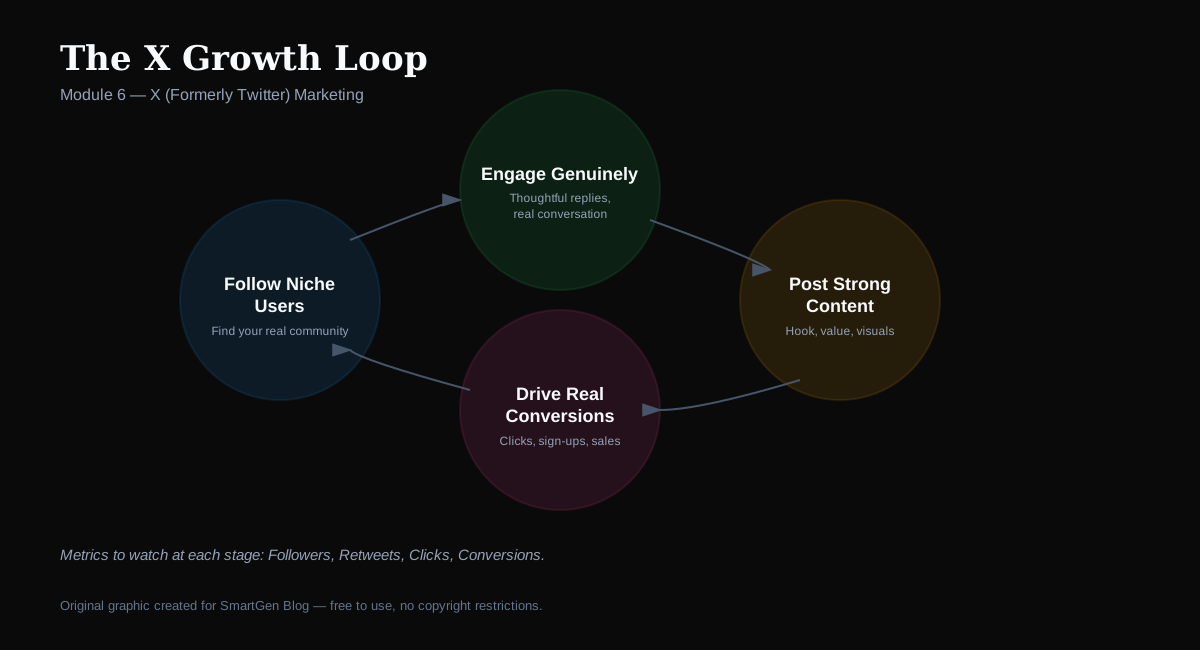
Module 6 Mega Guide Summary
In this module, we covered how to properly set up and curate your X profile, what followers, retweets, and clicks actually mean and why the relationship between them matters more than any single number, how conversions are tracked and how to use hashtags effectively on this particular platform, why and how to follow and engage with niche users in your space, what actually makes a post perform well here, and how X's advertising tools work from objectives through targeting and ad formats.
Practice exercise: Spend fifteen minutes finding five genuinely relevant accounts in your niche, follow them, and leave one thoughtful, specific reply on a recent post from each. Then write one post of your own using the "lead with something that earns attention immediately" principle from Section 5, and track how it performs over the following 48 hours.
What's Next?
In Module 7, we'll continue building your platform-specific marketing skills. Take a moment to revisit the earlier lessons in this course if you need a refresher, since each module builds on what came before it:
- Introduction to Online Digital Marketing: A Beginner's Guide
- Module 3: Social Media Marketing (SMM) — Advertising Concepts and Platform Selection
- Module 4: Meta (Facebook) Marketing — The Complete A to Z Mega Guide
- Module 5: Instagram Marketing — The Complete A to Z Mega Guide
This article was written by Sayad Md Bayezid Hosan for the SmartGen blog. For free tools to support your digital marketing journey, visit smartgentools.com.