
July 01, 2026 • General • By Sayad Md Bayezid Hosan
MODULE 11: Analysis and Keyword Research — The Complete A to Z Mega Guide for Beginners
A complete, practical A to Z guide to keyword research and analysis for beginners — the real role keywords play in SEO, the different types of keywords and what each one is actually good for, how to research and analyze keywords using Google Keyword Planner, how to pick the right keyword for a specific project, and how to analyze a competitor's website to find keyword opportunities they're already winning.
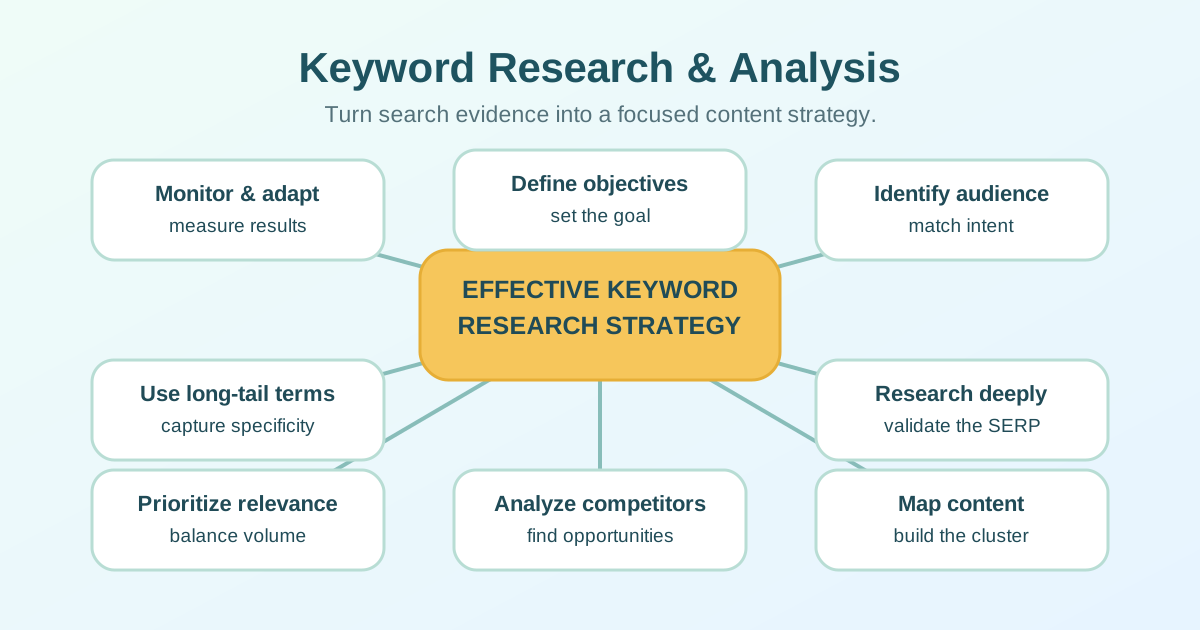
Welcome to Module 11: Analysis and Keyword Research
In Module 10, we built the mental model underneath all of SEO: search engines crawl, index, and rank content based on how well it satisfies real intent. But that raises an obvious practical question. If ranking is about satisfying intent, how do you actually know what intent to satisfy? How do you know what your audience is typing into that search box, how often they're typing it, and which version of a phrase is worth building content around versus which is a waste of effort?
That's the entire purpose of keyword research.
Keyword research is the bridge between the theory covered in Module 10 and every practical piece of SEO work that follows it — content creation, on-page optimization, site structure, even the paid search campaigns covered later in this course. Get it right, and every subsequent hour of SEO effort is aimed at a real, valuable, winnable target. Get it wrong, and you can do everything else in this course perfectly and still build content nobody was ever searching for.
Before diving in, if you haven't already gone through the earlier modules in this course, I'd recommend starting there, since each module builds on the concepts that came before:
- Introduction to Online Digital Marketing: A Beginner's Guide
- Module 3: Social Media Marketing (SMM) — Advertising Concepts and Platform Selection
- Module 4: Meta (Facebook) Marketing — The Complete A to Z Mega Guide
- Module 5: Instagram Marketing — The Complete A to Z Mega Guide
- Module 6: X (Formerly Twitter) Marketing — The Complete A to Z Mega Guide
- Module 7: LinkedIn Marketing — The Complete A to Z Mega Guide
- Module 8: Pinterest Marketing — The Complete A to Z Mega Guide
- Module 9: Creating a WordPress Website — The Complete A to Z Mega Guide
- Module 10: Search Engine Optimization (SEO) — The Complete A to Z Mega Guide
Why I'm Writing This Guide the Way I Am
A lot of beginner keyword research advice stops at "find a keyword with high search volume and low competition," as if that were the whole job. It isn't, and treating it like it is leads people straight into two common traps: chasing volume numbers that look impressive but attract the wrong audience, or avoiding anything with real competition and ending up with a pile of low-value keywords nobody actually searches for with buying intent.
Good keyword research is really a research discipline, not a numbers-lookup task. It's about understanding your specific audience's actual language, matching that language to a realistic assessment of what you can currently compete for, and being deliberate about which keywords are worth building content around at all. This guide walks through that discipline step by step — the role keywords play, the different categories worth knowing, how to actually use the tools, and how to make smart, realistic decisions with what you find.
1. The Role of Keywords in SEO
What a Keyword Actually Is
A keyword (sometimes called a search term or query) is simply the word or phrase someone types into a search engine. That's the whole definition — but its role in SEO is much larger than the simplicity of that definition suggests.
Every piece of SEO work described in Module 10 — crawling, indexing, ranking — ultimately exists so that a search engine can match a person's typed query to the most relevant piece of indexed content. Keywords are the connective tissue in that match. They are, quite literally, the language your future content needs to speak in order to be found by the people looking for it.
Keywords as a Research Tool, Not Just a Writing Tool
Beginners often think of keywords purely as something you sprinkle into a page after you've already decided what to write about. That's backwards, and it's one of the most consequential mistakes in beginner SEO.
Used properly, keyword research comes before content creation, not after. It tells you, with real data, what your audience is actually searching for, in their own actual language, at meaningful volume — which means it can and should directly shape what content you decide to create in the first place, not just how you word it once you've already chosen a topic. A business that skips this step and writes content based purely on what it assumes people search for is, more often than not, optimizing for phrases nobody is actually typing.
How Keywords Connect to Everything Else in SEO
Keywords touch nearly every layer of SEO work that follows in this course. They inform your site's content strategy and structure (which topics deserve their own page, and which belong as sections within a broader page). They shape on-page elements directly — page titles, headings, meta descriptions, and the body content itself, all of which later modules will cover in depth. They reveal search intent, connecting back to the SERP analysis covered in Module 10, since the keyword itself is the very thing that SERP is built around. And they even inform site architecture and internal linking, since related keywords often cluster naturally into groups that make sense to organize into interlinked content on your site.
Keywords Are Not Just for Written Content
It's worth noting that keyword thinking extends well beyond blog posts. Product page names and descriptions, service page headlines, image alt text, video titles, and even the Pinterest Pin descriptions covered in Module 8 all benefit from the same underlying keyword research discipline. Once you understand how to research keywords properly, the skill applies almost everywhere content meets a search function — including the search bars inside individual platforms like Pinterest, Amazon, or YouTube, not just Google.
2. Types of Keywords
Not all keywords behave the same way, and lumping them together is one of the fastest ways to make poor strategic decisions. Understanding the major categories lets you build a genuinely balanced keyword strategy rather than one accidentally skewed toward a single type.
By Length: Short-Tail vs. Long-Tail Keywords
Short-tail keywords (also called head terms) are brief, broad phrases — usually one to two words, like "shoes" or "digital marketing." They tend to carry very high search volume but are also extremely competitive, often dominated by large, well-established sites, and their brevity makes the underlying intent genuinely ambiguous. Someone searching "shoes" could be researching, browsing, or ready to buy — the keyword alone doesn't tell you which.
Long-tail keywords are longer, more specific phrases — typically three or more words, like "best running shoes for flat feet" or "affordable digital marketing course for beginners." Each individual long-tail keyword carries lower search volume, but the intent is far clearer, the competition is usually much more approachable for a newer site, and long-tail keywords collectively make up the majority of all searches performed. A realistic beginner strategy leans heavily on long-tail keywords early on, both because they're more winnable and because they tend to convert at a higher rate, precisely because the searcher's intent is so much more specific and further along in their decision process.
By Search Intent
This category connects directly back to the search intent framework introduced in Module 10, applied now specifically to keyword selection.
Informational keywords reflect a desire to learn something — "how does SEO work," "what is a keyword." Content built around these keywords should genuinely teach or explain, and while these keywords rarely convert immediately, they build trust, authority, and the kind of link-worthy content that benefits a site's broader standing.
Navigational keywords reflect a desire to reach a specific, already-known destination — "SmartGen blog," "Pinterest login." These are generally not worth targeting directly unless the query is about your own brand, in which case ranking for your own name is simply table stakes.
Commercial investigation keywords reflect comparison-stage research — "best keyword research tools," "Ahrefs vs SEMrush." Content here should help someone evaluate options fairly and thoroughly, since this is exactly the stage where trust and thoroughness tip a decision.
Transactional keywords reflect readiness to act — "buy keyword research tool," "sign up for SEO course." Content and page design here should minimize friction and make the intended action as easy and obvious as possible.
By Topic Specificity: Broad vs. Niche/LSI Keywords
Broad keywords cover a wide topic area with many possible sub-interpretations. Niche keywords, and closely related LSI keywords (Latent Semantic Indexing keywords — related terms and phrases that naturally appear alongside a topic, like "oven," "flour," and "yeast" naturally appearing near "bread recipe"), help a search engine and a reader understand the fuller context and depth of a topic beyond just the primary phrase. Including natural LSI terms throughout your content, without forcing them in awkwardly, is one of the more reliable, non-gimmicky ways to demonstrate genuine topical depth to a search engine.
By Branding: Branded vs. Non-Branded Keywords
Branded keywords include a specific company or product name — "SmartGen digital marketing course." Non-branded keywords describe the underlying need without referencing any specific brand — "digital marketing course for beginners." As the Pinterest module noted about unbranded search dominance on that platform, the same general pattern holds true in traditional search: the overwhelming majority of valuable search volume across most industries is non-branded, which is exactly why keyword research for new or growing businesses focuses overwhelmingly on non-branded terms rather than assuming people already know to search for you by name.
3. Keyword Research & Analysis on Google Keyword Planner Tool
Google Keyword Planner is a free tool, built into Google Ads, that gives you direct access to Google's own search volume and competition data — making it one of the most foundational, authoritative starting points for keyword research available to any beginner, even if you never intend to run a single paid ad campaign through it.
Getting Access to the Tool
Google Keyword Planner lives inside a Google Ads account, which is free to create even if you don't plan to spend money on ads. Once inside the Google Ads interface, it's found under Tools → Planning → Keyword Planner. It's worth noting that some data precision (exact search volume ranges versus broader estimated ranges) has historically been more detailed for accounts with active ad spend, though the tool remains genuinely useful for keyword discovery and relative comparison even for accounts not currently running paid campaigns.
The Two Core Functions
Keyword Planner offers two primary research modes, and understanding when to use each one matters.
"Discover new keywords" lets you enter one or more seed terms, or even a website URL, and returns a list of related keyword ideas Google associates with that input, along with data for each. This is the discovery mode — useful at the start of a project when you're trying to map out the full landscape of what's worth targeting, not just refine a term you've already chosen.
"Get search volume and forecasts" lets you input a specific list of keywords you already have in mind and returns detailed historical data and performance forecasts for exactly those terms. This is the validation mode — useful once you've narrowed down a shortlist and want harder data before committing.
Reading the Data That Matters
A few core data columns are worth understanding properly rather than skimming past.
Average monthly searches shows you, often as a range rather than an exact figure, roughly how many times a keyword is searched per month. Treat this as a directional signal rather than a precise count — useful for comparing keywords against each other, less useful as an exact prediction of traffic.
Competition in Keyword Planner specifically reflects advertiser competition for paid placements, not organic SEO ranking difficulty. This is a genuinely important distinction beginners frequently miss: a keyword marked "low competition" in this tool means few advertisers are bidding on it, which is a different thing entirely from how hard it is to rank for organically. Don't treat this column as organic difficulty data.
Top of page bid estimates show what advertisers are typically paying for that keyword in Google Ads. While built for paid campaigns, this figure is also a useful indirect signal for organic research: keywords with high bid estimates usually indicate strong commercial intent and real business value behind the search, which is worth knowing even if you're targeting the keyword organically rather than through ads.
Using Keyword Planner Effectively for Organic SEO Research
Since Keyword Planner's competition metric doesn't measure organic difficulty, pair it with the SERP-reading skill from Module 10: after identifying promising keyword candidates by volume and apparent commercial value, search each one directly and study who's currently ranking. If the current top results are all large, established, highly authoritative sites, that's your real organic competition signal — something Keyword Planner's own competition column won't tell you directly, but your own eyes and judgment, informed by what you learned about reading a SERP, absolutely can.
4. Pick The Right Keyword For Project
Having a list of keyword candidates with data attached is not the same as knowing which ones are actually worth building a project or piece of content around. This is where judgment enters the process, and it's arguably the single highest-leverage skill in this entire module.
Balance Volume Against Realistic Competition
The instinct to chase the highest search volume keyword available is understandable but frequently wrong for a newer site or business. A keyword with enormous volume but dominated by long-established, highly authoritative competitors may be effectively unwinnable for months or years, regardless of content quality. A more moderate-volume, more specific long-tail keyword with genuinely weaker current competition is very often the smarter real-world choice, especially early on — echoing the same "start where you can actually win" principle that runs through several earlier modules in this course.
Match the Keyword to Genuine Business Value
Search volume alone says nothing about whether the people searching a term are likely to become customers, readers, or subscribers. A keyword can have impressive volume and still be a poor project choice if the underlying intent doesn't connect to what your business actually offers. Always ask directly: if I ranked first for this exact keyword tomorrow, would the resulting visitors actually be valuable to my business? If the honest answer is no, deprioritize it regardless of how attractive the volume number looks.
Assess Your Own Site's Current Authority Honestly
A brand-new website with little existing content or backlink history is realistically not going to outrank a decade-old, highly authoritative competitor for a broad, fiercely contested keyword — no matter how well-written the content is. Be honest about where your site currently stands, and choose initial keyword targets that match that honest assessment. As your site accumulates content, backlinks, and demonstrated authority over time, you can deliberately climb toward more competitive, higher-volume targets in later phases — a progression, not a single one-time choice.
Group Keywords Into Content Clusters Rather Than Treating Them One by One
Rather than picking single, isolated keywords for single, isolated pages, look for natural clusters of related keywords that could realistically be served by one comprehensive piece of content, or by a small group of closely interlinked pages. This approach, often called topic clustering, tends to build stronger, more complete topical authority than scattering effort across many disconnected, narrowly-targeted pages — and it plays directly into the internal linking principles introduced back in the WordPress and SEO modules.
Revisit and Validate Rather Than Set-and-Forget
Keyword selection isn't a single decision made once at the start of a project and never revisited. Search behavior shifts, new competitors enter a space, and your own site's authority grows over time — all of which mean a keyword strategy built a year ago deserves periodic revisiting, using the same research process described in this module, rather than being treated as permanently settled.
A Mid-Guide Reality Check — What I Actually Want You to Walk Away Understanding
Halfway through a guide like this, it's worth naming the trap that catches even marketers who understand every individual concept covered so far.
The trap is treating keyword research as a purely internal, isolated exercise — you, a tool, and a spreadsheet of volume numbers — without ever looking outward at what's already succeeding in your specific space. Every keyword you're considering already has a live, current answer sitting in the SERP: the pages currently ranking for it. Those pages represent real, validated evidence of what a search engine currently rewards for that exact query, and ignoring that evidence in favor of pure volume-and-competition-column analysis is leaving the single richest source of research data on the table.
That's exactly the gap the final section of this module closes — because the fastest, most reliable way to understand what's realistically winnable in your space is to study, directly and deliberately, what your actual competitors are already doing successfully.
5. Competitor Website Keyword Analysis
Every business already has competitors ranking, to some degree, for the keywords that matter most in that space. Studying exactly what they're ranking for, and how, turns keyword research from a guessing exercise into an evidence-based one.
Identifying Your Real Competitors First
Before analyzing anyone's keywords, be honest about who your actual search competitors are — which may be a meaningfully different list from who you consider your business competitors. A local bakery's business competitor might be the bakery two blocks away, but its search competitor for "easy sourdough recipe" might be a large national food blog with no physical presence in the area at all. Identify search competitors by simply searching your most important target keywords and noting which domains consistently appear, rather than assuming your known business rivals are automatically your search rivals too.
Manual Competitor Keyword Analysis (No Paid Tools Required)
A genuinely useful amount of competitor keyword analysis is possible with no paid tools at all, simply by studying a competitor's site directly and deliberately.
Study their site's navigation and content structure. What topics have they built entire sections or category pages around? A competitor's site architecture is itself a signal of which topics they consider valuable enough to invest structural effort into.
Read their page titles and headings directly. A page's title and main headings are usually a fairly direct reflection of the primary keyword that page is targeting, since (as later on-page SEO modules will cover in depth) these elements carry real ranking weight, which means competitors who understand SEO tend to make their targeting fairly visible in exactly these spots.
Search your own target keywords and note every competing domain that appears, then explore their site. If the same competitor keeps appearing across many of your target keywords, their site is worth a deeper, dedicated look — visit their most-relevant-looking pages directly and note the specific phrasing, structure, and depth of what's currently working for them.
Check what content they're publishing most often. A competitor's blog archive or content section, browsed chronologically, reveals what topics they're currently prioritizing and how frequently — a practical, real-world signal of where they believe the ongoing opportunity is.
Using Dedicated Competitor Analysis Tools
Beyond manual review, a category of paid (and partially free-tier) tools — such as Ahrefs, SEMrush, and Ubersuggest — specialize specifically in competitor keyword analysis. These tools can show you, often with real precision, the actual keywords a competitor's pages currently rank for, the estimated traffic each keyword sends them, and specific keyword gaps — terms a competitor ranks for that your own site does not yet target at all. For a beginner or small business not yet ready to invest in one of these tools, the manual approach above remains a genuinely productive starting point; these tools become progressively more valuable as your keyword strategy and competitive landscape grow more complex.
Turning Competitor Analysis Into Action, Not Imitation
The goal of competitor keyword analysis is not to copy a competitor's content directly — beyond being an ethically and legally poor idea, closely copied content rarely outranks the original, since search engines have strong mechanisms for recognizing genuine originality and depth. The real goal is to identify validated keyword opportunities — proof that real search volume and real audience interest exists around a topic — and then create content that covers that same validated topic more thoroughly, more clearly, or from a genuinely different and valuable angle than what currently exists. Competitor analysis tells you where the opportunity is; the content quality principles from Module 10 still determine whether you actually capture it.
Visual Summary
Below is an original infographic built specifically for this guide, mapping out the keyword research process from understanding keyword types through tool-based research, selection, and competitor analysis.
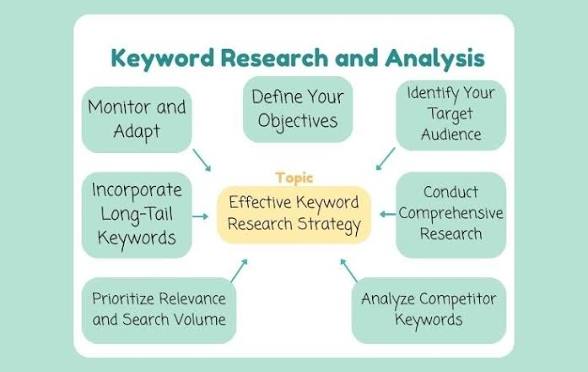
Module 11 Mega Guide Summary
In this module, we covered the real role keywords play in SEO as a research tool that should guide content decisions rather than just a writing afterthought, the major categories of keywords worth understanding — by length, by intent, by topic specificity, and by branding — and why a balanced strategy across these categories matters, how to actually use Google Keyword Planner for both discovery and validation while correctly interpreting its data (and correctly recognizing what its competition metric does not tell you), how to pick the right keyword for a specific project by balancing volume, realistic competition, genuine business value, and your site's current authority, and how to analyze a competitor's website — both manually and with dedicated tools — to find validated keyword opportunities rather than guessing at what might work.
Practice exercise: Choose one core topic relevant to your business or the WordPress site built in Module 9. Use Google Keyword Planner's "Discover new keywords" function to generate at least twenty related keyword ideas, then classify each one by length (short-tail or long-tail) and by intent (informational, navigational, commercial, or transactional). Identify three real search competitors by searching your top five candidate keywords, study their site structure and top-ranking pages manually, and select one specific, realistic keyword to target for your very next piece of content, writing down exactly why you chose it over the alternatives.
Frequently Asked Questions
Is Google Keyword Planner enough on its own, or do I need a paid tool eventually?
Keyword Planner is a genuinely strong, authoritative starting point, particularly for discovery and for validating search volume, and it's sufficient for most beginners and small businesses in the early stages. Paid tools become progressively more valuable as your strategy matures, primarily because they add direct competitor keyword visibility and organic ranking difficulty estimates that Keyword Planner, built primarily for advertisers, does not provide.
How many keywords should I target for a single piece of content?
Generally one primary keyword per page, supported by a handful of closely related secondary and LSI keywords that occur naturally within thorough, genuinely comprehensive content on that topic. Trying to aggressively target several unrelated primary keywords on a single page tends to dilute relevance for all of them rather than strengthening any single one.
What does "keyword difficulty" mean, and where do I find it?
Keyword difficulty is an estimated score, usually provided by third-party SEO tools rather than Google Keyword Planner directly, predicting how hard it would be to rank organically for a given keyword based on the current strength of the sites already ranking for it. In the absence of a dedicated tool, manually studying the current SERP's competitors, as described in Section 4, is a reasonably reliable substitute.
Should I avoid highly competitive keywords entirely as a beginner?
Not entirely — it's reasonable to note highly competitive keywords as long-term goals worth revisiting as your site's authority grows, while focusing your actual near-term content efforts on the more specific, more winnable long-tail variations within that same broader topic.
How often should I redo my keyword research?
A meaningful revisit every few months, or whenever you're planning a new content initiative, is a reasonable habit for most businesses — search behavior, competitor activity, and your own site's authority all shift enough over that kind of timeframe to make a fresh look worthwhile.
What's Next?
In the next module, we'll build directly on this keyword research foundation with on-page SEO — putting the keywords you've researched here to work inside your actual content and pages. Take a moment to revisit the earlier lessons in this course if you need a refresher, since each module builds on what came before it:
- Introduction to Online Digital Marketing: A Beginner's Guide
- Module 3: Social Media Marketing (SMM) — Advertising Concepts and Platform Selection
- Module 4: Meta (Facebook) Marketing — The Complete A to Z Mega Guide
- Module 5: Instagram Marketing — The Complete A to Z Mega Guide
- Module 6: X (Formerly Twitter) Marketing — The Complete A to Z Mega Guide
- Module 7: LinkedIn Marketing — The Complete A to Z Mega Guide
- Module 8: Pinterest Marketing — The Complete A to Z Mega Guide
- Module 9: Creating a WordPress Website — The Complete A to Z Mega Guide
- Module 10: Search Engine Optimization (SEO) — The Complete A to Z Mega Guide
This article was written by Sayad Md Bayezid Hosan for the SmartGen blog. For free tools to support your digital marketing journey, visit SmartGen.