
July 01, 2026 • General • By Sayad Md Bayezid Hosan
MODULE 10: TikTok Marketing — The Complete A to Z Mega Guide for Beginners
A complete, practical guide to TikTok marketing for beginners — setting up and optimizing a business account, building a content strategy built for TikTok's unique algorithm, mastering the tools and features that drive reach, growing a real community, reading your analytics so you know what's working, and navigating the legal and ethical responsibilities every TikTok marketer needs to understand in 2026.
Welcome to Module 10: TikTok Marketing
We've now covered Facebook, Instagram, X, LinkedIn, Pinterest, and YouTube in real depth. Each platform operates on a fundamentally different logic, and part of what this course has been building toward is your ability to read that logic clearly before you invest time and resources into any single channel. Today we're covering the platform that, more than any other in this entire series, has rewritten the assumptions about how content gets discovered, how audiences form, and how quickly a brand or creator can go from zero to a genuinely large following.
TikTok is not just another short-form video platform. It is the first major social platform in history where your content can be seen by millions of people who have never heard of you before — not because you have a massive following, not because you paid for ads, but because the content itself was good enough to earn it. That is genuinely new. Every platform we've covered before this one distributes content primarily to people who already follow you, or to audiences you've paid to reach. TikTok's algorithm distributes content based on how real viewers respond to it, then progressively shows it to larger and larger pools of users if those responses are strong. The starting point for every video is roughly equal, regardless of whether the account has ten followers or ten million.
That single fact changes everything about what TikTok marketing requires — and what it rewards.
It also makes TikTok the most misunderstood platform in this course among beginners. Many people arrive expecting it to function like Instagram Reels or YouTube Shorts: a supplementary feed where you post the same content you've been making everywhere else, formatted vertically. That strategy reliably underperforms, because TikTok's algorithm is calibrated to detect and penalize content that wasn't made for TikTok. Content that was researched on the platform, made in the platform's native formats, and published with an understanding of how TikTok's recommendation system actually works performs at a fundamentally different level.
This guide walks you through every stage of that understanding — from setting up and optimizing an account built to be found, through content strategy, TikTok's native marketing tools, community engagement, analytics, and the legal and ethical landscape that every marketer working on TikTok in 2026 needs to navigate carefully.
Before we begin: if you haven't already worked through the earlier modules in this course, each one adds context that makes the next more useful. You can find them all below.
- Importance of Digital Marketing — How It Works and Key Concepts Every Beginner Should Know
- Introduction to Online Digital Marketing: A Beginner's Guide
- Module 1: Basic Image and Video Editing — Complete Guide to Filmora and Canva for Beginners
- Module 3: Social Media Marketing (SMM) — Advertising Concepts and Platform Selection
- Module 4: Meta (Facebook) Marketing — The Complete A to Z Mega Guide
- Module 5: Instagram Marketing — The Complete A to Z Mega Guide
- Module 6: X (Formerly Twitter) Marketing — The Complete A to Z Mega Guide
- Module 7: LinkedIn Marketing — The Complete A to Z Mega Guide
- Module 8: Pinterest Marketing — The Complete A to Z Mega Guide
- Module 9: YouTube Marketing — The Complete A to Z Mega Guide
Why I'm Writing This Guide the Way I Am
TikTok rewards a fundamentally different creative instinct than every other platform covered in this course. It isn't about producing polished, high-production content like YouTube. It isn't about visual consistency like Instagram. It isn't about building professional credibility like LinkedIn. TikTok rewards one thing above all else: content that makes a real person — someone who had no idea who you were five seconds ago — want to keep watching.
That sounds simple. It is genuinely hard to do consistently, and most businesses and creators who try TikTok without understanding the platform deeply enough post content that looks fine and goes nowhere. The difference between content that earns real reach on TikTok and content that doesn't is almost never about production quality. It is almost always about whether the first three seconds earns the next sixty.
That's the lens this entire guide is built around — the real, practical mechanics of how TikTok works in 2026, written for someone who wants to build something genuine rather than chase shortcuts that stop working the moment the platform updates its algorithm. Where TikTok's own published guidance and well-documented industry research support a claim, I've included it. Where something is more a matter of tested judgment than settled fact, I've said so plainly.
1. Introduction to TikTok Marketing
Understanding the Platform
TikTok launched internationally in 2018 following ByteDance's merger of Musical.ly into its existing Chinese platform Douyin. By 2026, it has grown into one of the most-downloaded apps in history, with over 1.7 billion monthly active users globally and the highest average daily usage time of any social media platform — users spend an average of 95 minutes per day on the app, a number that has consistently outpaced every competitor platform.
But raw user statistics only tell you about scale. What matters more for marketing is understanding why people use TikTok and how the platform decides what to show them — because both answers are different from every other platform in this course.
People open TikTok in a state of open discovery. They are not searching for something specific the way they do on YouTube or Google. They are not checking in on people they know the way they do on Facebook or Instagram. They are handing the algorithm an enormous amount of behavioral trust — telling it, in effect: "I'm open to anything. Show me something good." Every swipe-up dismissal and every video watched all the way through is a signal the algorithm uses to recalibrate what it serves next. Over time, TikTok's For You Page (FYP) becomes an extraordinarily personalized content stream — which is why users describe it as addictive in a way no other platform quite matches.
For marketers, this behavioral context has a direct implication: TikTok users are extraordinarily good at detecting content that wasn't made for them. A video that opens with a branded logo and delivers a straightforward product pitch gets dismissed in under two seconds. A video that opens with a hook that immediately captures attention — a surprising statement, a relatable situation, a visual that raises a question — earns the watch time that feeds TikTok's algorithm and earns wider distribution.
Who Is on TikTok in 2026
TikTok's user base has aged meaningfully since its early reputation as a platform for teenagers. As of 2026, the breakdown by age is far more distributed:
| Age Group | Share of TikTok Users |
|---|---|
| 13–17 | ~14% |
| 18–24 | ~25% |
| 25–34 | ~27% |
| 35–44 | ~19% |
| 45+ | ~15% |
The 18–34 demographic now represents over half of the platform's active user base — which covers the primary purchasing demographic for the vast majority of consumer and B2C businesses. The platform's older demographic is growing faster in percentage terms than any other age group, meaning TikTok's reach continues to broaden year over year.
What TikTok Marketing Actually Is
TikTok marketing is not one activity — it is a system of interconnected practices:
Account strategy — deciding what your TikTok presence stands for, who it's for, and what consistent value it delivers, so a new viewer who finds you through one video immediately understands why they should follow.
Content creation — making videos that stop the scroll, deliver real value in the platform's native format and tempo, and give viewers a genuine reason to watch again next time.
TikTok SEO — optimizing captions, on-screen text, and hashtags so your videos surface in TikTok's growing search function, which has become a significant discovery channel in its own right.
Native tools and features — using TikTok's built-in features (Duet, Stitch, Green Screen, TikTok LIVE, TikTok Shop, Creator Marketplace) intelligently rather than ignoring them.
Community engagement — building real interaction with your audience and participating authentically in the broader TikTok culture within your niche.
Analytics — reading TikTok's data to understand what's actually driving results, rather than what just looks like it is.
Paid advertising — using TikTok Ads Manager to get your content in front of an audience you couldn't reach organically, when you're ready to spend.
Legal and ethical responsibility — understanding the disclosure rules, platform policies, privacy obligations, and ethical considerations that apply specifically to TikTok content in 2026.
2. Account Setup and Optimization
Setting up your TikTok account properly before you publish a single video is the difference between building on a solid foundation and retrofitting fixes later, when changing things is more disruptive to your existing content.
Personal Account vs. TikTok Business Account
TikTok offers two account types: a standard account and a Business Account. The choice matters more than most beginners realize.
A Business Account gives you access to TikTok's analytics dashboard (including detailed audience demographics and video performance data), the ability to add a website link in your bio from day one, access to TikTok Ads Manager for running paid campaigns, integration with TikTok Shop for direct e-commerce, the Commercial Music Library (a curated collection of tracks cleared for business use), and the Creator Marketplace if you want to run influencer partnerships.
A standard personal account has access to TikTok's full audio library including trending commercial music — which Business Accounts cannot legally use for marketing purposes due to licensing restrictions. Many creators who are not yet monetizing through ads or e-commerce prefer a personal account for this reason: trending audio is one of the most powerful distribution signals on TikTok, and Business Accounts are locked out of the best-performing tracks.
The practical guidance: If you're a creator building an audience first and planning to monetize later, start with a personal account and switch to a Business Account once you're ready to run ads or need analytics access. If you're a business that needs the website link, analytics, and commerce features from day one, start as a Business Account and plan your audio strategy around the Commercial Library and original sounds.
To switch between types: Settings and Privacy → Account → Switch to Business Account (or Switch to Personal Account). You can switch back and forth, though some features toggle with the account type.
Username and Display Name
Your username (@handle) appears in search results, in the comments section when you post, and in the "mention" tag when others reference you. Choose something that is easy to spell, easy to say out loud, and either matches your brand name exactly or communicates clearly what the account is about. Avoid numbers, underscores, and punctuation if possible — they make the username harder to share verbally and harder to remember.
Your display name is separate from your username and can be changed more freely. It appears in your bio and on your videos. For a business, this is typically your brand name. For a creator, it's your name or a descriptive title. Both your username and display name are indexed by TikTok's search function — include relevant keywords in your display name where they fit naturally.
Bio Optimization
TikTok bios are limited to 80 characters, which is restrictively short. That constraint makes every word count more here than on any other platform in this course. A strong TikTok bio does three things in those 80 characters: tells a new viewer who this account is for, communicates what they'll get by following, and gives them an immediate reason to act.
A formula that works across categories:
[What you make] for [who you make it for] → [what they'll gain by following]
Examples:
Free digital marketing tips for beginners → grow your business online 🚀Honest product reviews for everyday shoppers → save money every weekSimple healthy recipes for busy people → 30 mins or less, always
Include your website link (available to Business Accounts and accounts with 1,000+ followers on personal accounts) and an email address or link for business inquiries if relevant. TikTok also lets you link your Instagram and YouTube directly in your bio — do this, because it turns a TikTok viewer into a cross-platform follower, which is far more stable than a TikTok-only audience.
Profile Photo and Name Consistency
Use the same profile photo across all platforms where your brand or personal brand exists — TikTok, Instagram, YouTube, your website. Visual consistency is a trust signal that is easy to underestimate. When someone discovers you on TikTok and searches for you elsewhere, recognizing the same face or logo immediately confirms they've found the right account.
Setting Up a TikTok Business Account for Commerce
If your goal includes direct selling, TikTok Shop — available in a growing number of markets and deeply integrated with the main feed in 2026 — allows you to add a product catalog directly to your TikTok profile, tag products in your organic videos, run LIVE Shopping sessions, and have a dedicated Shop tab on your profile page. Setting this up early, even before you're actively promoting products, gives you the infrastructure you'll need when you're ready to convert viewers directly.
To apply: go to TikTok Seller Center (seller.tiktok.com), register as a seller, connect your TikTok Business Account, and submit your business documentation. Approval timelines vary by market.
3. Content Creation and Strategy
This is the most important section in the entire guide, and it's the area where the gap between beginners who grow and beginners who stall is widest. TikTok's algorithm doesn't care how many followers you have. It cares about one thing: does this video make people keep watching? Every recommendation decision, every For You Page placement, every piece of expanded distribution flows from the answer to that question.
How TikTok's Algorithm Actually Works
TikTok distributes every new video through a cascading series of increasingly large audience pools. A new video is first shown to a small test audience — typically a few hundred to a few thousand users, weighted toward accounts that have engaged with similar content before. The algorithm then measures several key signals from that initial group:
Completion rate — What percentage of viewers watched the video all the way through? This is the single most heavily weighted signal. A 100% completion rate is a strong positive signal. Dropping to 0% completion means the algorithm almost immediately stops distributing the video.
Replays — Did viewers watch the video more than once? Replays are a powerful positive signal because they indicate the content was interesting enough to revisit.
Shares — Did viewers share the video outside TikTok or send it to a friend within the app? Shares are the highest-intention engagement signal on the platform — a viewer who shares has made an active, deliberate choice to associate their identity with your content.
Comments — Did the video generate enough engagement to make people stop and type something? Comments, particularly questions or strong opinions, indicate the content generated a reaction beyond passive watching.
Likes — A standard positive engagement signal, but weighted less heavily than completion rate, replays, shares, and comments.
Follows from this video — Did viewers follow your account after watching this specific video? A high follow rate from a video tells the algorithm this content represents your channel well and should be shown to more people.
If the initial small pool responds strongly (high completion, high shares, genuine comments), TikTok expands distribution to a larger audience. If that larger audience also responds well, it expands further. This cascading process is what creates viral growth on TikTok — and crucially, it can happen to a video days, weeks, or even months after it was first published. TikTok videos don't expire the way they do on Instagram or X. A well-made video can find a new audience at any time.
The Hook — Your Most Important Three Seconds
Every viewer who lands on your video has their finger over the swipe-up button. In the first three seconds, they are making a subconscious decision: is this worth my next 30 seconds, or should I move on? This micro-decision is made before they know what your video is about, before they see your credentials, and before they've heard your audio. The visual and textual opening — what they see in those first frames — determines whether any of the rest of your video ever gets watched.
Hooks that consistently earn the watch:
Opening with an unexpected, counterintuitive, or surprising statement that creates cognitive dissonance: "Most businesses completely waste their first 1,000 TikTok followers — here's how to avoid it." The viewer thinks: "Wait, what? Tell me more."
Opening with a direct, specific promise: "In 90 seconds I'll show you the exact TikTok formula that grew this account from 0 to 50,000 followers." The viewer thinks: "I want that information."
Opening with a relatable situation or recognized frustration: "If you've ever posted a TikTok and gotten 300 views even though you followed all the advice, this is why." The viewer thinks: "That's me. Keep talking."
Opening with a visual that raises a question: a result shown before the process, a before-and-after, a reaction shot, something that visually creates a question the viewer needs the rest of the video to answer.
What kills a hook instantly: Opening with your logo, opening with a slow introduction of who you are, opening with a transition or music intro before anything meaningful has happened, or opening with your face silently in frame for more than one second before you've said or shown anything.
Video Length — The Right Answer in 2026
TikTok now supports videos up to 10 minutes long, and the platform has actively pushed creators toward longer content as part of its competition with YouTube. The practical reality is more nuanced.
Shorter videos (15–60 seconds) have the highest average completion rates, because the bar for watching to the end is simply lower. They also loop, meaning a viewer who reaches the end automatically starts watching again — and every loop counts as additional watch time in the algorithm's calculation.
Longer videos (2–5 minutes) can perform extremely well when the content is genuinely information-dense enough to hold attention for that duration — tutorials, deep-dives, and structured educational content tend to work best in this range. The risk is that if the content isn't actually dense enough to justify the length, completion rates drop sharply and the algorithm penalizes accordingly.
The practical guide: match your video length to your content's actual density, not to a target. If you can make the point in 45 seconds, make it in 45 seconds. If you need 3 minutes to deliver real value, use 3 minutes and make every 30 seconds earn the next one.
Content Types That Consistently Work on TikTok
Education and "you probably didn't know this" content is one of the highest-performing categories across virtually every niche. TikTok users have a strong appetite for fast, dense, genuinely useful information — the condensed tutorial, the counterintuitive fact, the single tip that changes how you approach something. The key is specificity: "3 TikTok mistakes beginners make" outperforms "TikTok tips for beginners" because specificity signals real knowledge, while vague titles signal generic advice.
Storytelling and narrative content performs exceptionally well because human brains are hardwired to follow stories toward their resolution, which makes the viewer compelled to keep watching. A clear narrative arc — setup, conflict or challenge, resolution — drives completion rates in almost every content category.
Trend participation — joining a current audio trend, participating in a challenge format, or putting a niche-specific spin on a widely-used sound — is the fastest way to tap into existing high-traffic content streams on TikTok. The algorithm is more likely to surface your video to users already engaging with that trend. The risk is that trends are time-sensitive: a video using a trend audio that peaked two weeks ago gets very little distribution because the algorithm has already moved on.
Behind-the-scenes and "day in the life" content feeds TikTok's culture of authenticity. Polished, corporate-feeling content consistently underperforms more casual, real, slightly imperfect content on this platform. Showing the process — how you make something, how your business actually operates, the mistakes you made and what you learned — is consistently more interesting to TikTok's audience than a finished product announcement.
Response and comment-reply videos — recording a video response to a comment on one of your previous videos — is a native TikTok feature that does two things simultaneously: it demonstrates that you engage with your community (which builds loyalty), and it often generates stronger curiosity and watch time than original content, because viewers of the original video want to see the follow-up.
TikTok SEO — Getting Found Through Search
TikTok has quietly become a primary search engine for Gen Z and Millennials, with a significant and growing percentage of younger users going to TikTok rather than Google to search for product recommendations, how-to information, local business reviews, and lifestyle advice. In 2026, TikTok's search function is no longer an afterthought — it is a major discovery channel, and optimizing for it is meaningfully different from optimizing for the FYP algorithm.
Caption optimization for TikTok search. TikTok's search indexes the text of your caption, the on-screen text overlays in your video, the spoken words in your video (via auto-generated captions), and your hashtags. Write captions that contain the natural keyword phrases your target audience would search for — not in a stuffed, unnatural way, but woven into a sentence that would make sense as a caption. A caption like "This is the TikTok SEO strategy that grew my account to 50k in 3 months — save this if you're just starting out" contains the keyword phrase "TikTok SEO strategy" naturally, invites a save (a strong engagement signal), and communicates the value of the video.
On-screen text as a search signal. Text overlays that appear in your video are indexed by TikTok's algorithm as additional context about what the video covers. This means your on-screen text is simultaneously serving the viewer and sending a signal to the algorithm — write it carefully.
Hashtag strategy for TikTok. The role of hashtags on TikTok is genuinely different from Instagram or X. On TikTok, hashtags primarily serve as category signals to the algorithm and as search pathways for users who search hashtags directly. Use 3–5 hashtags per video: one or two broad niche hashtags (e.g., #digitalmarketing, #contentcreator), one or two specific topic hashtags relevant to this particular video (e.g., #tiktokseo, #tiktokgrowth), and optionally one trending hashtag if it's genuinely relevant to your content. Avoid the strategy of dumping 20 generic hashtags — it doesn't expand reach and can actively reduce it by confusing the algorithm's understanding of who your audience is.
4. Marketing Tools and Features
TikTok has built an ecosystem of native tools that, when used correctly, dramatically expand your reach, revenue potential, and audience connection. Most beginners use two or three of these and ignore the rest. Understanding the full toolkit gives you a meaningful advantage.
TikTok LIVE
TikTok LIVE allows you to broadcast in real time directly to your followers (and to non-followers through the LIVE discovery tab). It requires a minimum of 1,000 followers to access. LIVE sessions are among the most powerful community-building tools on the platform because they create a real-time, interactive experience that pre-recorded content cannot replicate.
For marketing purposes, TikTok LIVE is most effective for:
Live Q&A sessions around your niche — which position you as an accessible, genuine expert and generate real interaction that feeds the algorithm's community signals.
Product demonstrations and LIVE Shopping — if you have TikTok Shop active, you can pin products to your LIVE stream and viewers can purchase directly without leaving the app. LIVE Shopping sessions are one of the highest-converting commerce formats on the platform in 2026.
Behind-the-scenes and event broadcasting — showing your process in real time (creating a video, setting up an event, unboxing a shipment) generates authenticity that produces extraordinarily strong community loyalty.
During LIVE, TikTok allows viewers to send "Gifts" — virtual items purchased with real money that convert into revenue for the creator. This is a direct monetization stream once your LIVE sessions build a regular audience.
Duet
The Duet feature lets you create a split-screen video that plays alongside an existing public TikTok video in real time. It is one of the most underused distribution tools on the platform, because participating in a Duet puts your content directly adjacent to an existing video — and if that video is performing well, your Duet inherits some of its momentum.
Effective marketing uses of Duet:
- Reacting to a trending video in your niche and adding expert commentary
- Responding to a customer review or testimonial video with additional context
- Participating in a challenge by Dueting the original challenge video
- Adding a product demonstration that answers a question posed in another creator's video
When you Duet a creator who has a meaningful following and your content adds genuine value, their audience is exposed to you organically — without any ad spend.
Stitch
Stitch lets you clip up to 5 seconds of another user's video and use it as the opening of your own video. Unlike Duet, which plays simultaneously, Stitch plays the clipped section first and then cuts to your content. It is particularly effective for creating response content — you show the original context and then provide your perspective, correction, or expansion.
Key distinction from Duet: Stitch is better for educational commentary and response content where you want to establish the context fully before adding your own take. Duet is better for real-time reaction content where the parallel viewing creates the dynamic.
Green Screen
Green Screen is TikTok's native effect that replaces your background with any image you choose — a screenshot, a chart, a website, a graphic. It is one of the most widely used effects in educational and commentary content because it lets you visually reference what you're talking about without complex editing.
For digital marketing content specifically, Green Screen is invaluable: you can pull up a screenshot of an analytics dashboard, a website, a social media post, or a news headline and react to it or teach from it in real time, making your content visually rich without any production complexity.
Creator Marketplace and TikTok Creator Portal
Creator Marketplace (available to Business Accounts) is TikTok's official platform for connecting brands with creators for paid partnerships. If you're a brand looking to run influencer campaigns, Creator Marketplace lets you search for creators by niche, audience demographics, engagement rate, and follower count, and reach out directly with collaboration proposals. This is the most transparent and policy-compliant route to TikTok influencer marketing.
TikTok Creator Portal is the platform's official education center for creators — a constantly updated library of guides, case studies, and best practices published by TikTok itself. For anyone serious about TikTok marketing, the Creator Portal is one of the most reliable sources of current, platform-specific guidance available.
TikTok Ads Manager
TikTok's paid advertising platform, accessed at ads.tiktok.com, allows you to run campaigns targeting specific audiences beyond your existing followers. The main ad formats available in 2026:
In-Feed Ads appear as native videos in the For You Page, indistinguishable from organic content except for a small "Sponsored" label and a call-to-action button. They support up to 60 seconds and are the most widely used format for performance marketing.
TopView Ads are the first thing a user sees when they open the app — a full-screen, high-impact video that takes over the entire interface for up to 60 seconds. TopView is TikTok's premium placement and carries a premium price to match; it's most effective for major brand moments rather than everyday campaign activity.
Branded Hashtag Challenges invite the entire TikTok community to participate in a challenge using a branded hashtag. When a user taps the challenge hashtag, they're taken to a branded landing page showing all submissions. This format generates enormous user-generated content volume and can produce viral reach — but it also requires significant investment and clear creative direction to land well.
Branded Effects are custom AR filters and effects that any TikTok user can apply to their videos. Like Hashtag Challenges, they are most effective when the effect is genuinely fun or novel enough that people want to use it without being paid to.
Spark Ads are one of TikTok Ads' most distinctive features: they let you boost an existing organic video — either from your own account or from a creator who has given you permission — as a paid ad. The video retains all its existing engagement (likes, comments, shares), making it appear more credible and trustworthy than a brand-new ad creative. For businesses with organic content already performing reasonably well, Spark Ads are often the most cost-effective entry point into TikTok's paid system.
Targeting options in TikTok Ads Manager:
Like every major platform, TikTok allows demographic targeting (age, gender, location, language), device and connectivity targeting, and interest and behavior targeting based on the content categories users engage with. Two targeting options are particularly powerful:
Custom Audiences — upload a customer email list or phone number list, and TikTok matches it against its user database to create an audience of your existing customers, which you can then target with ads.
Lookalike Audiences — once you have a Custom Audience (or a list of people who've converted on your website via TikTok Pixel), TikTok can identify users who behave similarly and expand your reach to an audience that matches your existing customer profile.
TikTok Pixel — a snippet of code placed on your website that tracks user behavior after they click a TikTok ad. Necessary for running conversion-optimized campaigns and for building website-based Custom Audiences. Install it before you run your first ad, even if you're not paying for ads yet — the data it accumulates improves campaign performance significantly when you do start.
TikTok Shop
TikTok Shop is the platform's integrated e-commerce system, allowing users to discover, research, and purchase products without leaving the app. As of 2026, TikTok Shop is live in a growing number of markets and has become one of the most significant shifts in social commerce globally.
For sellers, TikTok Shop connects to your product catalog, allows you to tag products directly in organic videos, run LIVE Shopping sessions, and sell through a dedicated Shop tab on your profile. The conversion rates for product tags in highly engaged organic videos can significantly outperform traditional e-commerce channels because the viewer is already in a discovery mindset and the purchase path has been reduced to a single tap.
For affiliate marketers, TikTok Shop's affiliate program allows creators to earn commissions by linking to products in their videos, without needing to manage inventory or fulfillment.
5. Community Engagement
TikTok's culture is more participatory than almost any other platform in this course. The content that defines TikTok isn't just content people watch — it's content people respond to, remix, stitch, duet, and recreate. Understanding engagement on TikTok means understanding that your audience is not a passive audience; they're potential co-creators of your next piece of content.
Responding to Comments — The Algorithm Multiplier
Comments are both a community-building tool and an algorithmic signal. Responding to comments in your first few hours after posting increases the total comment count on the video — and comment count is a distribution signal that tells TikTok this video is generating real conversation.
Beyond the algorithm, there's a cultural dimension to comment engagement on TikTok that doesn't have a direct equivalent on any other platform: comment sections on TikTok often become content of their own. The funniest, most interesting, or most thought-provoking comment on a popular video can accumulate hundreds of its own replies and become a separate community thread. Pinning the most engaging comment on your own videos, and then responding to the thread it generates, creates a self-reinforcing engagement loop that significantly extends how long a video stays active in the algorithm's distribution.
The most strategic form of comment response is the Video Reply — TikTok's feature that lets you record a new video as a direct response to a specific comment. The comment itself appears as a text overlay in the new video, giving the viewer the context of what's being answered. Video Replies consistently perform well because they:
- Create genuinely relevant follow-up content without requiring new idea generation
- Make the commenter feel directly acknowledged (which generates loyalty)
- Bring back previous viewers who get a notification that their comment was answered
- Introduce the topic to new viewers who never saw the original video
Participating in Trends Without Losing Your Niche Identity
Trend participation is one of TikTok's most powerful growth mechanisms, but it has a failure mode that traps many brands: jumping on every trend regardless of whether it fits, which produces content that feels disconnected from what the account is supposed to be about. This confuses the algorithm (which is trying to build a consistent audience profile for your account) and confuses your actual audience.
The right approach is niche-filtered trend participation: only participate in a trend when you can put a spin on it that is genuinely relevant to your specific audience and content category. A digital marketing account that joins a cooking trend for the sake of trend-chasing gets views from people who will never return. The same account that joins an audio trend by showing "the TikTok marketing equivalent of [trend concept]" gets views from people who are already in its target audience.
Engaging With Other Creators in Your Niche
Commenting thoughtfully on videos from other creators in your niche — not promotional comments, but genuine reactions, questions, or added perspectives — is one of the most effective ways to build visibility among an audience you don't have yet. Your comment appears alongside your username and profile photo; if it's interesting enough to generate replies, it becomes a small traffic driver back to your profile.
This is the TikTok equivalent of the LinkedIn networking principle from Module 7: engage before you ask for anything, and engage in a way that adds value rather than just announcing your existence.
User-Generated Content — The TikTok Community's Most Powerful Signal
User-Generated Content (UGC) — videos that your customers or audience members make about your product, service, or content — is the most powerful social proof signal available on TikTok. A creator with 500 followers making a genuine, enthusiastic video about your product can drive more trust and more conversions than a polished brand ad with ten times the production budget, because authenticity in user-generated content reads as real in a way that produced content cannot replicate.
Strategies for encouraging UGC:
- Create a branded hashtag challenge that gives your audience a format to participate in
- Respond publicly and enthusiastically (via Stitch or Duet) to customers who post about your product — this signals to others that posting about you gets attention
- Provide products to micro-creators (1,000–10,000 followers) in your niche in exchange for honest reviews
- Feature UGC in your own content, with credit — this gives creators a reason to make it, knowing there's a chance of amplification
A Mid-Guide Reality Check — What TikTok Actually Asks of You
At this point in the guide, we've covered account setup, content strategy, and most of TikTok's native tools. Before we move into analytics and legal considerations, I want to name something honestly that most TikTok marketing guides skip past: TikTok is genuinely the most demanding platform in this course for a specific reason that has nothing to do with technical complexity.
The demand is creative. TikTok requires you to show up, on camera or very close to on camera, consistently, in a format that is casual enough to feel authentic rather than produced. For businesses and creators who are comfortable on camera, this feels natural quickly. For those who aren't, TikTok's learning curve has a psychological dimension that no amount of strategy guides fully addresses.
The most common early mistake isn't posting the wrong content — it's overthinking the content to the point of not posting at all. TikTok's algorithm genuinely rewards consistency and volume of learning more than early perfection. A creator who posts 50 imperfect videos over three months learns more about what works for their specific audience than someone who spent those three months waiting until their setup, lighting, and script were perfect.
The guidance in this module draws on TikTok's own published Creator Portal documentation, independent platform research from firms including Bernstein Research and Morning Consult that have studied TikTok's behavioral economics and marketing effectiveness, and the practical patterns that show up consistently across accounts that have built real audiences in 2026. Where a specific benchmark is genuinely contested or highly variable across niches, I've noted it rather than presenting one number as universal truth.
6. Metrics and Performance Analysis
TikTok's analytics dashboard — accessed through the Profile tab by tapping the three-line menu, then selecting "Creator tools" → "Analytics" (on personal accounts) or directly through Business Suite (on Business Accounts) — is more granular than most beginners expect and more actionable than most beginners use it.
Overview Tab
The Overview tab shows your account-level metrics for a selected time period (7, 28, or 60 days, or a custom range):
Video Views — The total number of times your videos were watched across the selected period. This is your top-line reach metric, but it's one of the least actionable numbers in isolation because a single viral video can inflate it dramatically.
Profile Views — How many times your profile was visited. A high views-to-profile-visit ratio (many views but few profile visits) can indicate that videos are attracting passive viewers but not compelling them to investigate further — which often points to unclear calls to action or misaligned content.
Followers — Net follower change over the selected period, including both new follows and unfollows. Track this alongside specific videos rather than in isolation — seeing which videos drove follower spikes tells you which content your target audience wants more of.
Likes, Comments, Shares — Account-level engagement totals. Monitor trends over time rather than individual numbers — a consistent upward trend matters far more than a high individual week.
Content Tab — The Most Important Analytics View
The Content tab shows your individual video performance and is where the most actionable data lives. For each video, you can see:
Total play time — The raw minutes your video was watched in total. A useful absolute measure of how much audience attention a video has earned.
Average watch time — The average number of seconds each viewer watched. This is one of the two most important metrics in your analytics. Compare it to your total video length to get the implied completion rate. An average watch time above 80% of total video length is a strong performance signal. Below 50% suggests the content is losing viewers too early.
Video completion rate — The percentage of viewers who watched all the way to the end. TikTok shows this directly in video analytics for Business Accounts. This is the algorithm's primary quality signal — maximize it by keeping videos tight, front-loading value, and cutting everything that doesn't earn the next five seconds.
Traffic source types — Where your views came from: For You (FYP), Following feed, Profile page, Search, Hashtag, Sound. This breakdown is crucial. A video getting most of its views from the FYP is being amplified by the algorithm. A video getting most views from Search is performing well as discovered content. Understanding which source drives your best-performing videos informs both your content strategy and your SEO optimization priorities.
Audience territories — Which countries your video is reaching. If you're a business serving a specific market, videos reaching a very different geographic audience than your target market may be getting distributed in ways that generate views but not commercial value.
Sounds — Which sound your video used. Over time, this data lets you identify whether specific audio categories (trending audio vs. original sound vs. voiceover-only) correlate with better performance for your specific content type.
Followers Tab — Audience Intelligence
The Followers tab provides demographic and behavioral data about your existing follower base:
Gender breakdown — Useful for validating whether your content is reaching your intended audience.
Top territories — The countries your followers are most concentrated in. If 70% of your followers are in a market you don't serve commercially, your content strategy may need to be more geographically specific.
Follower activity — A chart showing the hours of day and days of week when your followers are most active on TikTok. Post within one to two hours of your audience's peak activity window to give your video the best possible environment of engaged viewership in its critical early distribution phase.
Videos your followers watched — The other content categories and creators your followers engage with heavily. This is one of the most strategically useful data points in your analytics: if your followers consistently watch content in adjacent niches, those niches represent content opportunities you may be underserving.
LIVE Tab
If you're running TikTok LIVE sessions, the LIVE tab shows total LIVE time, unique viewers, peak concurrent viewers, new followers gained during LIVE, and Diamonds earned (TikTok's gift currency). Track peak concurrent viewers as your primary LIVE health metric — it tells you how many people found the session compelling enough to stay in real time.
Building a Monthly Analytics Review Habit
Once a month, spend 20–30 minutes in TikTok Analytics reviewing four specific things:
Which three videos had the highest completion rate in the past 30 days, and what do they have in common structurally (hook type, length, format, topic)?
Which traffic source drove the highest-quality engagement (measured by follow rate, not just view count)?
What does my follower activity timing data tell me about when to post for maximum early engagement?
Are the countries and demographics in my Followers tab aligned with my actual target audience — and if not, what content shift might reorient the algorithm toward the right viewers?
These four questions, answered consistently each month, compound into a data-driven content strategy that the majority of TikTok creators never develop.
7. Legal and Ethical Considerations
This is the section most marketing guides either skip or treat as a brief footnote. It shouldn't be, because the legal and ethical landscape around TikTok marketing in 2026 is more complex, more actively enforced, and more consequential than at almost any previous point in the platform's history. Getting this wrong can mean account suspension, regulatory fines, or — for serious violations — legal liability.
Advertising Disclosure — The FTC and Global Equivalents
The United States Federal Trade Commission (FTC) requires that any material connection between a content creator and a brand — including paid partnerships, free products, affiliate commissions, or any other form of compensation — be disclosed clearly and conspicuously in the content itself. "Clearly and conspicuously" means a viewer watching at normal speed can see and understand the disclosure without needing to look for it. A small hashtag buried in a wall of other hashtags in the caption does not meet this standard. The word "ad," "sponsored," or "paid partnership with [brand]" — on screen or spoken clearly in the video — does.
Similar disclosure requirements exist in the UK (under ASA guidelines), the EU (under the Digital Services Act framework), Australia (under ACCC guidelines), and most other major markets. The global standard, regardless of jurisdiction, is the same in practical terms: if you were compensated in any way for mentioning or promoting something, the audience must be told.
TikTok has its own disclosure infrastructure — a "Paid Partnership" label that can be added directly to a video when you're working with a brand through Creator Marketplace. Use it. It satisfies platform policy and most regulatory disclosure requirements simultaneously, and it is significantly cleaner than trying to write an adequate disclosure into your caption manually.
The consequences of non-disclosure are real. The FTC has levied substantial fines against brands (not just individual creators) for failing to ensure their influencer partners disclosed properly. In 2026, enforcement has increased meaningfully, and "I didn't know" is not a defense that regulators accept.
TikTok's Community Guidelines and Content Policies
TikTok's Community Guidelines prohibit a long and specific list of content categories. The most relevant for marketers include:
Misleading, false, or deceptive content — including false product claims, fabricated reviews, misleading before-and-after content, and unsubstantiated health or financial outcome claims. The prohibition on misleading content applies to both organic and paid content.
Dangerous activities and challenges — Content that encourages viewers to attempt dangerous physical challenges or activities that could result in injury is prohibited and can result in immediate removal and account suspension.
Counterfeit goods — Promoting, selling, or facilitating the purchase of counterfeit products violates both TikTok's policies and most countries' trademark laws.
Prohibited product categories — TikTok prohibits advertising for tobacco products, firearms and ammunition, certain regulated financial products, and adult content, among other categories. Always review current Community Guidelines before running a campaign in any category that could be considered sensitive or restricted.
Spam and artificial engagement — Purchasing followers, likes, comments, or views violates TikTok's Terms of Service and, beyond the policy issue, artificially inflates metrics in ways that mislead brands in influencer partnerships and advertisers in media buying. TikTok actively detects and removes inauthentic engagement, often resulting in account suspension.
Privacy Considerations — Particularly Around Minors
TikTok has faced significant regulatory scrutiny globally regarding its handling of user data, particularly data belonging to users under 18. For marketers, this has several direct implications:
Do not target advertising to users under 13 — TikTok prohibits it under its platform policies, and it is illegal under COPPA (Children's Online Privacy Protection Act) in the United States and equivalent laws in most other markets.
Be careful with content that is particularly attractive to minors — If your brand's primary target demographic is adults but your content format or tone also strongly attracts younger audiences, you have a heightened responsibility to ensure your content (particularly product promotions and calls to action) would be appropriate for all ages of viewer.
Do not collect personal data from TikTok viewers without appropriate disclosure and consent mechanisms. If you are driving TikTok viewers to an external website or app that collects personal information, your privacy policy must cover TikTok as a traffic source and must be compliant with applicable privacy law in the jurisdictions you operate in.
Intellectual Property — Music, Visuals, and Copyright
Music is the most common intellectual property issue on TikTok for business accounts. As covered in the Account Setup section, Business Accounts do not have access to the same broad commercial music library that personal accounts do. Using a trending commercial track on a Business Account without a license violates both TikTok's policies and copyright law, and the resulting video will be muted, removed, or demonetized.
Safe music options for business accounts:
- TikTok's Commercial Music Library (available in Business Suite — a growing catalog of tracks cleared for commercial use)
- Original sounds you've created or commissioned
- Royalty-free music platforms with explicit commercial licensing (Epidemic Sound, Artlist, Musicbed)
- Music licensed under Creative Commons (verify the specific license terms before use)
For visual content: do not use images, graphics, or video clips in your TikTok videos that you don't have the rights to use commercially. This includes stock images from sites that have free personal-use licenses but require a paid commercial license for business use.
Data Sovereignty and Regulatory Risk
TikTok has faced bans, restricted access, and regulatory investigations in multiple countries over data sovereignty concerns — specifically, concerns about whether user data can be accessed by ByteDance's parent company or the Chinese government. The regulatory situation varies significantly by country and changes over time.
As a TikTok marketer, this creates a business risk worth acknowledging and planning for: TikTok access could be disrupted in specific markets through regulatory action, as has happened intermittently in the United States and has been more sustained in India (where TikTok has been banned since 2020). Building your audience so that TikTok followers can be converted to subscribers on platforms you control — your email list, your website, your YouTube channel — is the responsible risk-mitigation approach.
This isn't a reason to avoid TikTok — it's a reason not to build a marketing strategy that is 100% dependent on TikTok. Treat it as a major channel in a diversified platform mix, not as the single point of audience ownership.
Ethical Responsibility Beyond Legal Compliance
Legal compliance is the floor, not the ceiling, of responsible TikTok marketing. Several ethical considerations go beyond what the law currently requires:
Authenticity in influence — Endorsing products you haven't used, or creating a false impression of personal experience with something you're promoting commercially, erodes audience trust in ways that eventually destroy the credibility that made the audience valuable in the first place. The short-term revenue from a questionable partnership rarely compensates for the long-term damage to the trust that makes your platform marketable.
Mental health and body image sensitivity — TikTok's personalization algorithm can create echo chambers that amplify content around sensitive topics. Creators and brands operating in health, fitness, beauty, and lifestyle categories have a heightened responsibility to consider how their content contributes to the overall content environment around these topics, particularly given the platform's younger demographic.
Environmental and social claims — "Greenwashing" — making false or exaggerated environmental responsibility claims — is increasingly scrutinized both legally and by consumers. Make only claims you can substantiate, and be specific rather than vague about what "sustainable" or "eco-friendly" actually means in the context of your specific product or business.
Visual Summary
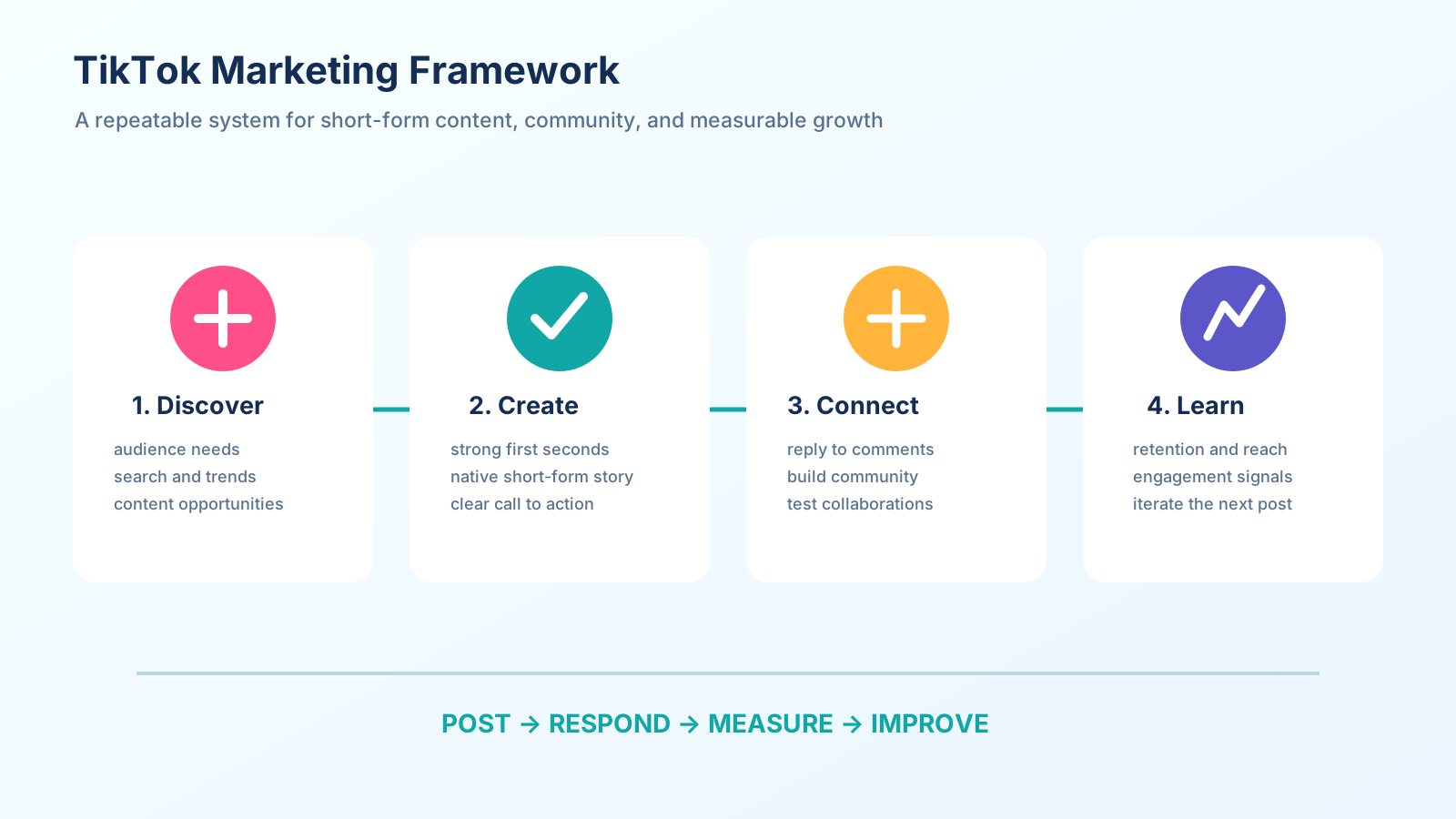
Below is an original infographic created specifically for this module, mapping out TikTok's marketing ecosystem across all seven areas covered: introduction to the platform, account setup and optimization, content creation and strategy, native marketing tools and features, community engagement, analytics, and legal and ethical considerations.
Module 10 Mega Guide Summary
In this module, we covered why TikTok's algorithm is fundamentally different from every other platform in this course — and why that difference makes equal distribution the defining opportunity for new accounts. We walked through the practical choices in account setup: Business Account vs. personal, username and bio optimization, and setting up for commerce through TikTok Shop. We spent significant time on content creation and strategy — the three-second hook, how the cascading algorithm actually works, which content types consistently earn completion, and how TikTok SEO differs from every other form of search optimization. We covered TikTok's native marketing tools in full: LIVE, Duet, Stitch, Green Screen, Ads Manager formats and targeting, Creator Marketplace, and TikTok Shop. We talked about community engagement as a creative act — Video Replies, niche-filtered trend participation, and how user-generated content outperforms produced content on this platform. We walked through the metrics that actually tell you what's working: completion rate, traffic source breakdown, follower activity timing, and the monthly review habit that compounds into a real data-driven strategy. And we closed with the legal and ethical landscape every TikTok marketer needs to take seriously: FTC disclosure requirements, Community Guidelines, music licensing for Business Accounts, privacy obligations around minors, and the platform-level risk management of not making TikTok your single audience home.
Practice exercise: Spend 30 minutes on TikTok's search bar today, searching for five questions or phrases your target audience might use to look for your content category. Write down every autocomplete suggestion you see. Then write a specific hook — the first three seconds of a video — for the single topic that appeared most often. Before you write any more of the video, check: would a completely new viewer, with no context about who you are, find this hook interesting enough to keep watching? If yes, plan the rest of the video. If no, rewrite the hook until the answer is yes.
Frequently Asked Questions
Do I need to show my face on TikTok to be successful?
Not necessarily, though personal face-to-camera content does tend to build follower loyalty faster than faceless content because of the parasocial connection it creates. Faceless formats — screen recordings, voiceover commentary, text-based video, product demonstrations — can absolutely build real audiences. The question is whether your specific content type benefits from a human face telling the story. For most educational and tutorial content, the answer is yes. For some product-focused and aesthetic content, the answer is no.
How soon can I expect to see growth on TikTok?
TikTok's algorithm can surface a video from a brand-new account to thousands of viewers as early as the first video, if that video earns strong completion rates in its initial test pool. That said, consistent account growth — where followers accumulate and compound over time — typically becomes visible after 4–8 weeks of consistent posting, and the curve tends to accelerate meaningfully after 20–30 videos as the algorithm builds a clearer audience profile for your account.
Can I repost content from Instagram Reels or YouTube Shorts on TikTok?
Technically yes, but TikTok's algorithm actively detects and de-prioritizes videos that contain Instagram's watermark or YouTube's watermark — so cross-posting raw exports from other platforms is consistently underperforming compared to content made natively for TikTok. If you want to repurpose content across platforms, remove platform watermarks (SnapTik and similar tools remove TikTok watermarks from TikTok downloads; for cross-posting in the other direction, export from your editing app rather than downloading from the platform) and re-export.
How important is posting timing on TikTok?
Less important than on other platforms, because TikTok's algorithm distributes content over a much longer window than Instagram or X — a video posted at an off-peak hour still gets evaluated and potentially amplified. That said, posting within two hours of your audience's peak activity period (visible in your Followers analytics) gives your video the maximum initial engagement environment, which does influence early algorithm signals. Think of timing as a marginal optimization, not a foundational strategy.
Is TikTok worth it for B2B businesses?
More than most B2B marketers assume, though the fit varies significantly by industry. B2B creators in technology, marketing, finance, and professional services have built substantial, commercially valuable audiences on TikTok by making genuinely educational content that helps their professional audience. The key is that TikTok users are people, not just their job titles — a purchasing manager watching TikTok after hours can absolutely discover and remember a B2B brand if the content serves them as a person trying to learn and do their job better. The content just needs to feel like TikTok, not like a LinkedIn post dropped into a short-form video.
What's Next?
In the next module, we continue building your digital marketing skill set. Take a moment to revisit the earlier lessons in this course if any concepts from this module would benefit from more context — each module builds on what came before:
- Importance of Digital Marketing — How It Works and Key Concepts Every Beginner Should Know
- Introduction to Online Digital Marketing: A Beginner's Guide
- Module 1: Basic Image and Video Editing — Complete Guide to Filmora and Canva for Beginners
- Module 3: Social Media Marketing (SMM) — Advertising Concepts and Platform Selection
- Module 4: Meta (Facebook) Marketing — The Complete A to Z Mega Guide
- Module 5: Instagram Marketing — The Complete A to Z Mega Guide
- Module 6: X (Formerly Twitter) Marketing — The Complete A to Z Mega Guide
- Module 7: LinkedIn Marketing — The Complete A to Z Mega Guide
- Module 8: Pinterest Marketing — The Complete A to Z Mega Guide
- Module 9: YouTube Marketing — The Complete A to Z Mega Guide
About the Author
Sayad Md Bayezid Hosan is the founder of SmartGen Tools and the creator of the SmartGen Digital Marketing Course. With over five years of experience in SEO, content strategy, social media marketing, and digital tool development, he writes these modules to give every beginner the same practical, honest foundation he wishes had existed when he started. He publishes new modules and free tools at smartgentools.com.
This article was written by Sayad Md Bayezid Hosan for the SmartGen blog. For free tools to support your digital marketing journey, visit smartgentools.com.
SmartGen · Digital Marketing · Digital Marketing Course · Module 10 · TikTok Marketing · TikTok SEO · TikTok Ads · Short-Form Video