
July 22, 2026 • General • By Sayad Md Bayezid Hosan
How to Do Keyword Research for SEO: The Complete Step-by-Step Guide
Ahrefs' own data puts it bluntly: roughly 90% of content gets zero traffic from Google. The single biggest reason isn't bad writing — it's that the keyword was never worth targeting in the first place. Either nobody searches for it, it's impossibly competitive, or it doesn't actually match what the searcher wanted.
Keyword research is the process that prevents that outcome. Done properly, it tells you exactly what your audience is typing into Google, how many of them are typing it, how hard it will be to rank for, and — most importantly — whether ranking for it would actually be worth anything to your business.
This guide walks through the complete picture: the different types of keywords you'll encounter, every major metric used to evaluate them, why "zero volume" doesn't mean zero opportunity, why long-tail keywords deserve more attention than most beginners give them, and a practical, step-by-step framework for deciding what to actually prioritize.
What You'll Learn in This Guide
- Types of Keywords
- Keyword SEO Metrics Explained
- Traffic Potential
- "Zero-Volume" Keywords
- Long-Tail Keywords
- Business Potential Score
- High-Volume Keywords
- How to Prioritize Keywords
- Step-by-Step Keyword Research Process
- Frequently Asked Questions
Types of Keywords {#types-of-keywords}
Before touching any metric, it helps to know what you're actually looking at. Keywords aren't one category — they fall into several distinct types, and mixing them up is one of the most common beginner mistakes.
Short-tail (head) keywords — One or two words, extremely broad, and enormous search volume. "Shoes" or "SEO" are head terms. They're the hardest to rank for and often the vaguest in terms of what the searcher actually wants.
Long-tail keywords — Three or more words, highly specific, lower individual volume, but far easier to rank for and much more likely to convert. Covered in full depth in its own section below.
Informational keywords — The searcher wants to learn something. "How does keyword difficulty work" or "what is CPC in SEO." These usually map to blog posts, guides, and tutorials.
Navigational keywords — The searcher already knows where they want to go and is using Google as a shortcut. "Gmail login" or "SmartGen tools" are navigational.
Commercial investigation keywords — The searcher is comparing options before buying. "Best keyword research tools" or "Ahrefs vs Semrush" fall here — not ready to buy yet, but close.
Transactional keywords — The searcher is ready to act right now. "Buy keyword research tool," "SEO agency pricing," or "sign up for [tool] free trial."
Branded vs. non-branded keywords — A branded keyword includes a company or product name ("SmartGen SEO tools"). A non-branded keyword describes the need without naming a specific brand ("free SEO tools online"). Non-branded keywords are almost always the priority for new sites, since branded search only exists once people already know you.
Local keywords — Tied to a specific geographic area, such as "SEO agency in Dhaka" or "plumber near me." If your business serves a specific location, local keywords deserve dedicated attention — our Local SEO and Google Business Profile guide covers this in full depth.
Most real keyword lists are a mix of several of these types at once. A single keyword can be simultaneously long-tail, non-branded, and commercial investigation — the categories aren't mutually exclusive, and the more of them you can identify in a single keyword, the clearer picture you get of what content will actually satisfy it.
Keyword SEO Metrics Explained {#keyword-metrics-explained}
Knowing what a keyword is only gets you halfway. To decide whether it's actually worth targeting, you need to read the metrics correctly — and just as importantly, know where each metric falls short. Every major keyword research tool (Ahrefs, Semrush, Google Keyword Planner, Ubersuggest) surfaces some version of the following seven metrics.
Search Volume
The estimated average number of monthly searches for a keyword in a given location. This is the number most beginners look at first — and lean on far too heavily. A keyword's search volume tells you demand, but says nothing about how much of that traffic you'd actually capture, since first-page results, paid ads, and — increasingly — AI-generated answers all split that demand before it ever reaches your site.
Keyword Difficulty (KD)
A 0–100 score estimating how hard it would be to rank in the top 10 for a keyword. Most tools calculate KD almost entirely from the backlink profiles of the pages currently ranking — more linking domains pointing at the top results means a higher KD score. It's worth being honest about what KD does not measure: content quality, topical depth, or how well a page actually satisfies search intent. Treat KD as a rough filter, not a verdict — always glance at the actual top 10 results yourself before ruling a keyword out.
Cost Per Click (CPC)
The average amount advertisers pay per click when bidding on that keyword in Google Ads. Even if you have zero interest in running paid ads, CPC is genuinely useful for organic keyword research: it's a direct signal of commercial value. A keyword with a $12 CPC tells you advertisers believe that traffic converts into real money — which means ranking for it organically, for free, carries real financial upside. A keyword with a $0.05 CPC is telling you the opposite.
Traffic Potential
Covered in full detail in its own section below — but in short, this metric estimates the total traffic a page could earn from ranking well, accounting for every related keyword variation it could also rank for, not just the one seed keyword you searched.
Business Potential Score
Also covered in depth below with a reference table — this score reflects how directly a keyword connects to what you specifically sell, separate from how many people search for it.
Search Trend (Growth)
Most keyword tools display a small trend indicator alongside volume — showing whether interest in a keyword is rising, flat, or declining over recent months and years. A keyword with modest current volume but a clear upward trend line is frequently a better long-term bet than a keyword with higher current volume that's been steadily declining. This is especially relevant right now, since AI-driven search behavior is actively reshaping which query types are growing and which are shrinking.
SERP Features & Click Potential
Search volume and actual clicks are no longer the same thing. In 2026, a large and growing share of Google searches — current estimates put it around 58–60% — end in zero clicks, because an AI Overview, featured snippet, or knowledge panel already answered the question directly on the results page. Before committing to a keyword, it's worth checking what currently occupies its search results page: if it's dominated by an AI Overview, a shopping carousel, or a featured snippet that fully answers the query, the realistic traffic ceiling is lower than the raw search volume number suggests, no matter how high that number looks.
Traffic Potential {#traffic-potential}
Search volume tells you how many people search for one specific phrase. Traffic Potential answers a more useful question: how much total organic traffic could this page realistically earn once it ranks well — accounting for the fact that a single well-optimized page usually ranks for dozens, sometimes hundreds, of related keyword variations, not just the one you typed into the research tool.
Here's why this distinction matters. Imagine a keyword with 200 monthly searches. Look unimpressive on its own. But if the pages currently ranking #1 for that keyword are also pulling in traffic from 80 other related search terms — synonyms, plurals, question variations, related subtopics — their combined organic traffic might be closer to 4,000 monthly visits. Judging that opportunity by the 200-search "seed" keyword alone would massively undersell it.
How to check it in practice: Look up the page currently ranking #1 for your target keyword in a keyword research tool, and check its estimated total organic traffic (not just its ranking position for your one keyword). That total is a far more honest picture of the opportunity than the seed keyword's volume alone — and it's exactly the gap this metric was built to close, since relying on a single keyword's volume to estimate traffic potential was, in the industry's own words, a long-standing "blunder" that better data has since corrected.
The practical takeaway: don't dismiss a keyword just because its own search volume looks small. Check what the current top-ranking page actually earns in total traffic — that number is what you're really competing for.
"Zero-Volume" Keywords: The Hidden Opportunity {#zero-volume-keywords}
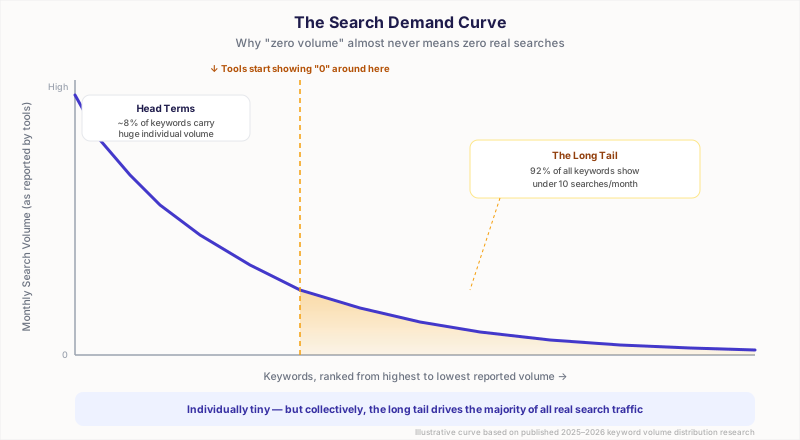
Here's a number worth sitting with: 92% of all keywords show fewer than 10 monthly searches, and a large share of those register in keyword tools as flat zero. If you filter those out automatically, you're ignoring the overwhelming majority of everything people actually type into Google.
Why Tools Show "Zero" When Real People Are Searching
Keyword volume isn't measured with perfect precision — it's modeled and sampled, and tools round very small, rare numbers down to zero rather than showing an unreliable "3" or "7." A query might get searched consistently, just not often enough, or not consistently enough month to month, for the tool's model to register it confidently. Newer queries, highly specific niche phrasing, and long conversational questions are especially likely to get flagged as zero, simply because the tool hasn't accumulated enough data on that exact phrasing yet.
This effect has gotten more pronounced, not less, as search behavior shifts toward natural, conversational phrasing — voice and AI-assistant queries average around 29 words, compared to just 3–4 words for a typical typed search, and long, highly specific phrasing like that is exactly what volume tools most often under-report.
Why "Zero" Doesn't Mean "Not Worth It"
A single zero-volume keyword won't move the needle. Dozens or hundreds of them, targeted consistently across a site, absolutely can — and individually, they tend to convert far better than head terms, precisely because the person searching that specific phrase knows exactly what they want. The chart below illustrates the shape of this: a small number of head terms carry enormous individual volume, while a vast, flat "long tail" of low- and zero-volume terms extends far beyond them — and that tail, in aggregate, is where most real search demand actually lives.
How to Actually Use Zero-Volume Keywords
Don't chase them as standalone targets — build them into topically comprehensive content instead. If you're writing a thorough, well-structured page around a real topic, you will naturally end up ranking for dozens of zero-volume variations of that topic without ever having deliberately targeted a single one of them by name. This is especially true for niche B2B and highly specific technical topics, where a handful of precisely-matched searchers is frequently worth more than thousands of generic visitors who never convert.
Long-Tail Keywords {#long-tail-keywords}
If zero-volume keywords are the extreme tail, long-tail keywords are the broader category they belong to — and they deserve deliberate strategic attention, not just leftover scraps.
What Makes a Keyword "Long-Tail"
Generally three or more words, highly specific, and narrowly focused on exactly one need. "Shoes" is head. "Running shoes" is mid-tail. "Best running shoes for flat feet marathon training" is long-tail — and it's also almost self-evidently transactional: whoever types that is close to buying.
Why Long-Tail Keywords Matter More Than Their Volume Suggests
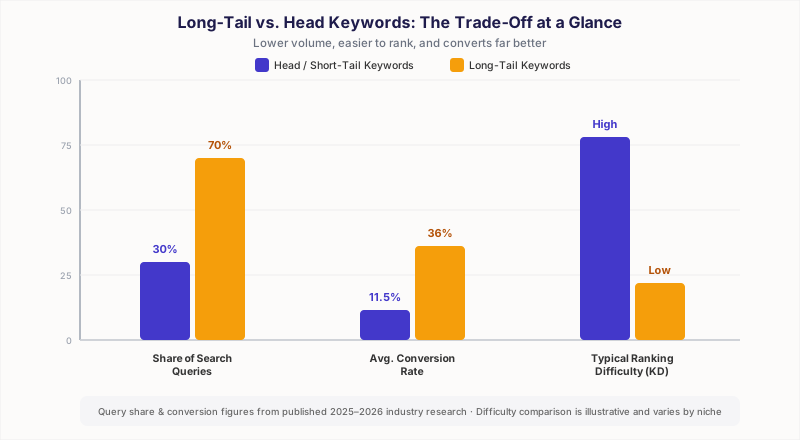
Individually, a long-tail keyword might only bring in a handful of visits a month. Collectively, they're doing most of the real work. Long-tail keywords are estimated to drive around 70% of all search traffic, and they convert dramatically better than generic terms — long-tail traffic converts at roughly 36% on average, compared to about 11.45% for a typical landing page targeting a broad, generic keyword. The chart below shows this trade-off at a glance.
Why This Matters Especially for Newer Sites
Competing head-on for "running shoes" against established retailers with years of backlinks is not a realistic starting strategy for a new site. Competing for "best running shoes for flat feet marathon training" is. Long-tail keywords are, in practice, the on-ramp that lets smaller or newer sites start earning real, qualified organic traffic long before they have the domain authority to compete for head terms — and once you've researched the right long-tail phrase, the natural next step is putting it to work correctly in your content and HTML, which is exactly what our On-Page SEO Optimization guide walks through step by step.
Business Potential Score {#business-potential-score}
Search volume, traffic potential, and KD all describe a keyword from the outside — how many people search it, and how hard it is to rank for. None of them answer the one question that actually matters most for your bottom line: if you ranked #1 for this keyword tomorrow, could you realistically turn that visitor into a customer?
That's what the Business Potential score measures — a simple 0 to 3 scale rating how naturally your specific product or service fits into content covering that keyword. It's entirely relative to your own business: the exact same keyword can score a 3 for one company and a 0 for a direct competitor selling something adjacent but different.
| Score | What It Means | Example |
|---|---|---|
| 3 | Content on this keyword lets you feature your product as the direct, obvious solution. | A site selling AeroPress accessories writing about "AeroPress filters" |
| 2 | Your product is a genuinely good fit, but the connection takes a little more framing to make. | A project-management SaaS tool writing about "how to run a remote standup meeting" |
| 1 | You can mention your product in passing, but it isn't the natural focus of the content. | A CRM company writing about "how to write a professional email" |
| 0 | There's no natural way to feature your product at all, even if the topic is loosely related. | An AeroPress accessories store writing about "best thermos for coffee" |
As a general rule, prioritize keywords scoring 2 or 3 — these are the ones most likely to actually generate leads or sales, not just traffic. It's a well-tested filter: one detailed industry analysis found that roughly 77% of a company's own highest-performing content scored a 2 or 3 on exactly this scale.
High-Volume Keywords: When and How to Target Them {#high-volume-keywords}
High search volume keywords aren't wrong to target — they're just a different kind of investment than long-tail keywords, with a different risk profile.
Characteristics: Broad, competitive, usually short-tail, and almost always backed by pages with substantial backlink profiles already occupying the top results.
The trade-off: High reward if you win, but a long timeline and heavy resource requirement to get there. Ranking for a high-volume head term typically demands significant content depth, strong topical authority across many related pages, and — critically — a substantial number of quality backlinks pointing at the page, which take real time to earn.
When they make sense: Cornerstone or pillar pages meant to anchor an entire content cluster, brand-authority content, and situations where you already have some domain strength to work with. They rarely make sense as the first content a brand-new site publishes, simply because the site has no existing authority to compete with what's already ranking.
A practical middle ground: many successful content strategies deliberately mix both — long-tail content for near-term, achievable traffic and conversions, alongside a smaller number of high-volume target pages built for the long run. Neither one alone is a complete strategy.
How to Prioritize Keywords {#how-to-prioritize-keywords}
With six-plus metrics and multiple keyword types in play, prioritization is where keyword research actually turns into a plan. A workable framework combines four questions for every keyword on your list: How much total traffic is realistically available (Traffic Potential)? How directly does it connect to what you sell (Business Potential)? How hard will it be to rank for (KD)? And how much is that traffic actually worth (CPC)?
Beyond that baseline framework, two specific, slightly counterintuitive strategies are worth calling out on their own.
Target High-KD Keywords Sooner, Not Later {#high-kd-sooner}
The instinct for most beginners is to avoid high-KD keywords entirely until the site is "strong enough." That instinct is usually backwards. High-KD keywords need a large number of backlinks to rank — and earning those backlinks takes real time, often many months, regardless of when you start. If you wait until your site feels "ready" before publishing on a competitive topic, you're simply delaying the point at which that content-and-backlink clock even starts ticking. Publishing genuinely strong content on a hard keyword today, then building links to it steadily over the following months, almost always beats waiting a year and starting the same process from scratch later.
Use High-KD Keywords as Link-Building Opportunities {#high-kd-link-opportunities}
There's a second, less obvious reason high-KD topics are worth attention early: competitive, high-KD topics are usually competitive precisely because they're genuinely valuable, widely-discussed subjects — which also makes them naturally more link-worthy. A truly comprehensive, well-researched resource on a hard, high-value topic is far more likely to earn natural backlinks from other sites than a thin page on an obscure long-tail phrase nobody else is writing about. In that sense, a handful of ambitious high-KD pages can function as linkable assets — content specifically built to attract external links — which then strengthens the authority of your entire site, not just that one page. For the full playbook on actually earning those links once the content exists, see our Off-Page Optimization guide.
Use CPC as a Commercial Value Tiebreaker
When two keywords look similar on volume, KD, and business potential, CPC is a clean tiebreaker. Higher CPC signals real advertiser demand and, by extension, real monetary value behind that search intent — a strong reason to prioritize it over a similarly-scored keyword with a near-zero CPC.
Step-by-Step Keyword Research Process {#step-by-step-process}
Bringing everything above together, here's a practical workflow to follow from a blank page to a prioritized keyword list ready to turn into content.
Step 1 — Brainstorm seed keywords. List 10–20 broad topics genuinely related to your business, products, or services. Don't filter yet — just capture the territory.
Step 2 — Expand each seed into a full keyword list. Run each seed through a keyword research tool to surface related terms, questions, and long-tail variations. Most tools organize these into topic groups and subgroups, which makes it far faster to spot clusters than scrolling one long flat list.
Step 3 — Pull the core metrics for every keyword. Search Volume, KD, CPC, and Traffic Potential for the top-ranking page, at minimum.
Step 4 — Score Business Potential. Go through the list and rate each keyword 0–3 using the table above. This step alone eliminates a large share of technically-high-volume keywords that would never realistically convert for your business.
Step 5 — Check search intent by actually looking at the SERP. For any keyword you're seriously considering, search it and look at what's currently ranking — and what's occupying the page above the organic results. If AI Overviews or a featured snippet already fully answer the query, or if the top 10 are dominated by a content type you can't realistically match (video, product listings, forums), that's a signal to adjust your target or your content format.
Step 6 — Prioritize using the combined framework. Favor keywords with strong Business Potential (2–3), reasonable Traffic Potential, and a KD your site can realistically compete for right now — while still reserving a portion of your roadmap for ambitious, high-KD linkable-asset content, per the strategy above.
Step 7 — Map keywords to content, not the other way around. Group related keywords into single, comprehensive pages rather than writing a separate thin page for every keyword variation — this is also how you naturally capture the zero-volume long tail without targeting it directly. Our Content Marketing guide covers how to plan and structure that content at scale.
Step 8 — Write titles and descriptions that reflect the actual keyword, then verify the snippet. Once the keyword is chosen, check how your title and meta description will actually appear in search results before publishing — our free SERP Preview Tool shows exactly this, so nothing gets cut off or misrepresented in the results page.
Step 9 — Write naturally, then verify keyword usage. Once a first draft is done, run it through a Keyword Density Checker to confirm your target keyword appears often enough to be clearly relevant, without tipping into stuffing.
Step 10 — Track and refine. Keyword research isn't a one-time task. Revisit your priority list every few months — search trends shift, new competitors enter the SERP, and keywords that looked unrealistic six months ago may now be within reach.
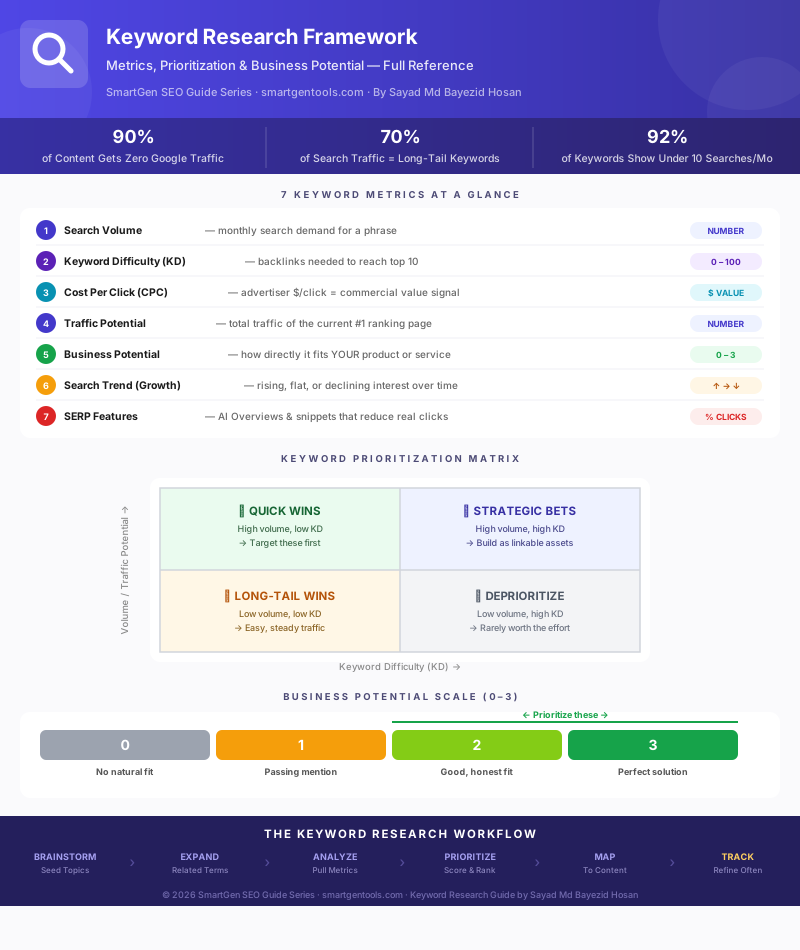
Visual Summary
The infographic below brings the full framework together — keyword metrics, the prioritization matrix, and the Business Potential scale, in one reference view.
Frequently Asked Questions {#faq}
How many keywords should I target on a single page?
One primary keyword per page, supported by as many closely related variations and long-tail phrases as fit naturally into comprehensive coverage of the topic. Trying to force multiple, distinct primary keywords onto one page usually dilutes its relevance for all of them rather than strengthening any single one.
What's a realistic KD range for a brand-new website?
There's no universal number, since it depends heavily on your niche's overall competitiveness — but as a general starting point, many new sites find early traction in the low-to-mid KD range while reserving very high-KD topics for later, better-linked pages, alongside the "sooner, not later" strategy described above for a select few ambitious targets.
Should I ignore zero-volume keywords completely?
No — but don't treat them as standalone targets either. Build comprehensive content around real topics, and you'll pick up dozens of zero-volume variations automatically without ever having to research them individually by name.
Is search volume or Traffic Potential more important?
Traffic Potential, in most cases — it reflects the realistic total opportunity of a topic rather than one narrow phrase's isolated number, and it's far less likely to make you dismiss a genuinely valuable topic because its seed keyword happened to look small.
If I don't run paid ads, does CPC still matter?
Yes. CPC is one of the clearest available signals of commercial intent and monetary value behind a search term, entirely independent of whether you personally advertise. High CPC on a keyword you can rank for organically is effectively free access to traffic advertisers are actively paying for.
Can a keyword have high Business Potential but low search volume?
Absolutely, and these are often some of the best keywords available — highly specific, highly relevant to exactly what you sell, and comparatively easy to rank for precisely because fewer competitors bother targeting them.
How often should I redo keyword research?
Revisit your core keyword list every few months at minimum, and any time you notice a meaningful shift in your traffic, your niche, or your competitors' content. Search behavior — especially with AI-driven search growing — is changing faster now than it has in years.
How has AI search changed keyword research in 2026?
Search behavior is shifting toward longer, more conversational, question-style queries rather than short two- or three-word phrases, and a growing share of searches are answered directly on the results page without a click at all. The practical response isn't to abandon keyword research — it's to focus more on building genuinely comprehensive, authoritative content around real topics, since that approach naturally captures both the traditional keyword and its many conversational, zero-volume variants at once.
Key Takeaways
- Keywords come in several overlapping types — short-tail, long-tail, informational, navigational, commercial, transactional, branded, and local — and knowing which type you're looking at shapes what content format actually fits.
- Search Volume, KD, CPC, Traffic Potential, Business Potential, Search Trend, and SERP Features together give a complete picture — no single metric should drive a decision alone.
- "Zero volume" is frequently a data limitation, not a real absence of demand — long-tail and zero-volume terms collectively make up the majority of all search traffic.
- The Business Potential score (0–3) is the fastest way to filter out keywords that would bring traffic but never convert.
- High-KD keywords are worth starting on early, not avoiding — both because ranking takes time regardless of when you start, and because they can function as link-attracting assets for your whole site.
— Written by Sayad Md Bayezid Hosan for the SmartGen blog
 ✓
✓
Sayad Md Bayezid Hosan
Founder & Tech Entrepreneur | Full-Stack Developer
Full-stack Web Developer, Digital Marketing Strategist, and Tech Entrepreneur with 5+ years of experience delivering innovative digital solutions. Specializing in web development, AI integration, strategic digital marketing, and tech entrepreneurship. As a leading Tech Provider, I help audiences navigate digital platforms safely through permission-based technical solutions and digital business asset management.
Credentials & Expertise:
- Founder of CWB Agency & GenZFrontier
- Final-year English Student at Northern University Bangladesh
- Specialized in AI-powered web development & content strategy
- Published author on tech, digital marketing & entrepreneurship
What's Next?
Continue building your SEO skills with the rest of the SmartGen SEO guide series:
- Search Engine Optimization (SEO) — The Complete A to Z Mega Guide
- On-Page SEO Optimization — The Complete A to Z Mega Guide
- Off-Page Optimization — The Complete A to Z Mega Guide
- Technical SEO Optimization — The Complete A to Z Mega Guide
- Local SEO and Google Business Profile — The Complete A to Z Mega Guide
- Content Marketing — The Complete A to Z Mega Guide
- Algorithm Updates and Analysis — The Complete A to Z Mega Guide
Good keyword research is the foundation everything else in SEO gets built on — get this part right, and every guide above gets easier to apply.
This article was written by Sayad Md Bayezid Hosan for the SmartGen blog. All SmartGen tools mentioned are free with no registration required. SmartGen Privacy Policy · Browse All SmartGen Tools