
July 02, 2026 • General • By Sayad Md Bayezid Hosan
MODULE 12: Content Marketing — The Complete A to Z Mega Guide for Beginners
A complete, practical A to Z guide to content marketing for beginners — what content marketing actually is and how it differs from advertising, how to build a real content marketing strategy, the proven strategies and formulas that structure genuinely effective content, how to write content that is both optimized and actually engaging, how to organize your content using content bucketing, and how to measure whether any of it is truly working.
Welcome to Module 12: Content Marketing
Look back across every module in this course so far, and a pattern becomes obvious. Pinterest Pins need something to link to. SEO rankings need something worth ranking. Keyword research (Module 11) tells you what to write about — but says nothing about how to actually write it well. Every platform, every technical skill, every piece of research covered up to this point has been building toward the same unavoidable question: what are you actually going to say?
That question is what content marketing answers.
Content marketing is the discipline of creating and distributing genuinely valuable material — articles, guides, videos, infographics, tools — with the deliberate goal of attracting, engaging, and eventually converting an audience, without directly advertising at them. It is, in a real sense, the substance that everything else in this course exists to deliver. A perfectly optimized WordPress site, a flawless Pinterest strategy, and impeccable keyword research all amount to very little if the content sitting underneath them isn't genuinely worth a person's time.
Before diving in, if you haven't already gone through the earlier modules in this course, I'd recommend starting there, since each module builds on the concepts that came before:
- Introduction to Online Digital Marketing: A Beginner's Guide
- Module 1: Basic Image and Video Editing — Complete Guide to Filmora and Canva for Beginners
- Module 3: Social Media Marketing (SMM) — Advertising Concepts and Platform Selection
- Module 5: Instagram Marketing — The Complete A to Z Mega Guide
- Module 6: X (Formerly Twitter) Marketing — The Complete A to Z Mega Guide
- Module 7: LinkedIn Marketing — The Complete A to Z Mega Guide
- Module 9: Creating a WordPress Website — The Complete A to Z Mega Guide
- Module 10: Search Engine Optimization (SEO) — The Complete A to Z Mega Guide
- Module 11: Analysis and Keyword Research — The Complete A to Z Mega Guide
Why I'm Writing This Guide the Way I Am
Content marketing has a habit of being reduced, in a lot of beginner material, to "just post helpful stuff regularly." That advice isn't wrong, exactly, but it's dangerously incomplete. Posting helpful stuff without a strategy behind it produces a scattered pile of disconnected articles that individually might be fine but collectively build nothing — no clear authority, no compounding traffic, no obvious next step for a reader to take.
Real content marketing is closer to publishing than to posting. A serious publication knows exactly who its reader is, what promise it's making to them issue after issue, how its different pieces connect and reinforce each other, and how it measures whether it's actually serving its audience. This guide treats content marketing with that same seriousness — strategy first, formulas and writing craft second, organization third, and honest measurement running underneath all of it.
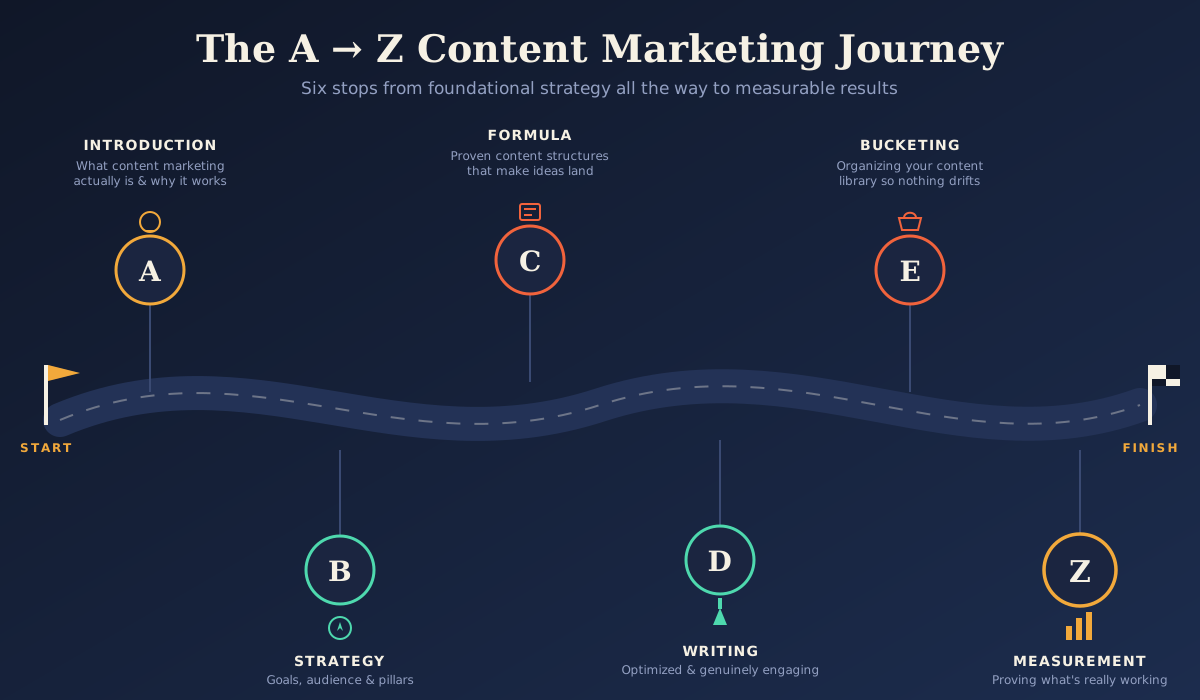
The A→Z Journey at a Glance
Before going section by section, here's the whole route this module covers, laid out as one continuous journey — six stops from foundational understanding all the way to measurable, provable results.
1. Introduction to Content Marketing
What Content Marketing Actually Is
Content marketing is the practice of creating and distributing valuable, relevant content — consistently, and without directly selling — in order to attract and retain a clearly defined audience, and ultimately drive profitable action from that audience over time.
The key phrase in that definition is "without directly selling." Content marketing's core mechanism is different from advertising. An ad interrupts someone's attention to make a direct pitch. A piece of content marketing earns someone's attention by being genuinely useful, informative, or entertaining first — the business benefit comes later, as a natural consequence of the trust and authority that useful content builds over time, not as the immediate ask.
How Content Marketing Differs From Advertising
It's worth being precise about this distinction, because beginners frequently blur the two. An ad says, in effect, "buy this." A piece of content marketing says, in effect, "here's something genuinely useful," and lets the reader arrive at a favorable impression of the brand behind it on their own terms. A skincare brand running an ad might say "40% off our new serum." The same brand doing content marketing might publish a genuinely thorough guide to understanding your skin type — no discount code in sight, but a reader who finishes that guide trusting the brand's expertise, and who is now meaningfully more receptive to that brand's products down the line.
Neither approach is inherently superior — they serve different purposes and different stages of a customer's journey, and the strongest marketing strategies, including the ones implied throughout this course, use both. But content marketing specifically earns attention through value rather than purchasing it through interruption, and that's the specific discipline this module covers.
Why Content Marketing Works
It builds trust before it asks for anything. By the time a piece of genuinely useful content has actually helped someone, that person has formed a real impression of your expertise and credibility, entirely without a sales pitch — which makes any future, more direct ask land far better than it would have cold.
It compounds, much like the SEO and Pinterest strategies covered in earlier modules. A single well-built piece of content can continue attracting new readers, and new customers, for years after it was published, off the back of one initial investment of effort.
It's what search engines actually reward. Every ranking signal covered in Module 10 — relevance, depth, authority, usefulness — is, at its core, a search engine trying to identify genuinely strong content marketing and rank it accordingly. SEO and content marketing aren't two separate disciplines; SEO is largely the technical and strategic layer that makes content marketing findable.
It builds an owned audience. A newsletter list, a loyal blog readership, or a community built around genuinely valuable content is an asset a business owns and controls directly — unlike an audience built entirely on a social platform, which can vanish overnight due to an algorithm change or account issue.
The Content Marketing Funnel
Most content marketing efforts are best understood in relation to a funnel — the stages a person moves through on the way from first discovering a business to eventually becoming a customer or loyal advocate.
Top-of-funnel (awareness) content reaches people who don't yet know your business, and often don't yet fully understand their own problem — broad, informational content that answers a genuine question, much like the informational keyword content described in Module 11.
Middle-of-funnel (consideration) content reaches people who now understand their problem and are actively comparing possible solutions — comparison guides, case studies, and deeper explainer content that helps someone evaluate options.
Bottom-of-funnel (decision) content reaches people close to making a decision — product pages, testimonials, detailed how-to-buy or how-to-use content that removes the last remaining friction before a purchase or sign-up.
A genuinely effective content marketing plan deliberately produces content for all three stages, rather than accidentally clustering everything at just one — a mistake surprisingly common among beginners who either write exclusively broad, top-of-funnel blog posts that never convert, or exclusively narrow, sales-focused content that never attracts anyone new in the first place.
2. Content Marketing Strategy
A content marketing strategy is the deliberate plan that determines why you're creating content, who it's for, what you'll cover, and how you'll know it's working — built before a single piece of content gets written, not figured out reactively after the fact.
Start With a Genuinely Clear Goal
Every strategy needs a real, specific goal behind it — more website traffic, more email subscribers, more qualified leads, stronger brand authority in a specific niche, or direct sales. Vague goals like "get more engagement" or "build our brand" are difficult to actually plan around or measure against. A useful test: could you look back in six months and clearly say whether you succeeded or failed at this specific goal? If not, the goal needs sharpening before you plan anything else.
Define Your Audience With Real Specificity
Content aimed at "everyone" tends to genuinely resonate with no one. Building even a simple audience profile — who they are, what problems or aspirations they have, what questions they're actually asking (the keyword research from Module 11 is directly useful here), and where they currently spend their attention — gives every subsequent content decision a real anchor. When you're deciding whether a topic, tone, or format is right, you're checking it against this specific person, not against a vague general public.
Audit What Already Exists
If your business already has any content — old blog posts, existing social content, past email newsletters — review it honestly before planning new work. A content audit answers a few practical questions: what's already performing well and could be updated or expanded rather than replaced? What topics are already thoroughly covered, and what's genuinely missing? What's outdated, inaccurate, or simply no longer representative of the business? Skipping this step commonly leads to unknowingly duplicating effort or missing an obvious opportunity to improve something that already exists rather than starting from zero.
Choose Your Core Content Pillars
Content pillars are the small number of broad themes — typically three to five — that your content strategy will consistently return to. A personal finance business, for example, might settle on pillars like budgeting, investing basics, debt payoff, and saving for major life goals. Every individual piece of content you create should trace back to one of these pillars. This keeps a content strategy coherent and focused rather than sprawling into every tangentially related topic that comes to mind, and it directly sets up the content bucketing approach covered later in this module.
Decide on Format and Channel Before Volume
Before deciding how much content to produce, decide what kind. Will your strategy center on long-form blog articles, video, downloadable guides, email newsletters, or some deliberate mix? And which channels — your own WordPress blog, YouTube, the social platforms covered earlier in this course, or a combination — will actually carry that content to your audience? These decisions should follow directly from where your specific audience already spends attention and what format best serves the goal you defined at the outset, rather than defaulting to whatever format feels easiest to produce.
Build a Realistic, Sustainable Cadence
A content strategy needs an honest publishing rhythm attached to it — one you can actually sustain for months, not a burst of enthusiasm that collapses after three weeks. As both the Pinterest and WordPress modules in this course emphasized, consistency at a sustainable pace consistently outperforms intensity that can't be maintained. Decide on a cadence that fits your actual available time and resources, and build the rest of the strategy around that honest constraint.
3. Content Marketing Strategies & Formula
With a strategic foundation in place, it helps to have a toolkit of proven structural approaches — formulas, in effect — that make individual pieces of content more consistently effective, rather than reinventing the format from scratch every time.
The Pillar-and-Cluster Model
This model, a direct extension of the content pillars introduced in Section 2, involves building one comprehensive, authoritative "pillar" piece of content on a broad topic, then surrounding it with several more specific "cluster" pieces that each cover a narrower sub-topic and link back to the pillar (and to each other). This mirrors the topic clustering approach introduced in Module 11's keyword research section, and it builds concentrated topical authority in the eyes of both readers and search engines far more effectively than scattered, disconnected posts on loosely related subjects.
The Skyscraper Formula
Popularized broadly across the SEO and content marketing world, this approach involves finding existing content that already performs well and already attracts real search traffic or engagement, and then deliberately creating something noticeably more thorough, more current, or more genuinely useful on that same topic — the content equivalent of building a taller building next to an existing one. This connects directly back to the competitor keyword analysis covered in Module 11: identify a validated opportunity, then execute on it more completely than what currently exists.
The Problem-Agitate-Solve (PAS) Formula
A classic formula, especially effective for content aimed at the consideration and decision stages of the funnel: first clearly state the reader's problem, then genuinely explore the real cost or frustration of that problem (not manipulatively, but honestly, so the reader feels understood), and then present your content's actual solution or guidance. This structure works because it mirrors how a person actually experiences a real problem — recognition, frustration, and then genuine relief at finding a workable answer.
The AIDA Formula
Borrowed from classic advertising and still genuinely useful for content, particularly for more persuasion-oriented pieces: capture Attention with a strong opening, build Interest by expanding on why the topic matters, create Desire by painting a clear picture of the better outcome your content or offering makes possible, and prompt Action with a clear next step. Used thoughtfully rather than mechanically, this formula gives naturally meandering content a tighter, more purposeful shape.
The How-To / Tutorial Formula
A straightforward, evergreen, and consistently high-performing structure: state the specific outcome the reader will achieve, list what they'll need, and walk through clear, sequential steps to get there. This format performs particularly well in search (it directly matches a common and highly specific type of informational search intent) and translates naturally across formats, from a blog post to a video to the kind of visual tutorial content covered in the Pinterest module.
The Listicle Formula
A curated list of items, tips, tools, or examples around a shared theme — genuinely effective for topics that are naturally enumerable, and valuable specifically because the format itself sets clear reader expectations about scope and length before they even click. The formula's effectiveness depends entirely on the quality and specificity of each individual item; a listicle padded with vague, interchangeable entries undermines the format's core appeal.
Choosing the Right Formula for the Right Content
None of these formulas is universally superior — the right choice depends on the funnel stage, topic, and format you're working with, and many strong pieces of content genuinely blend more than one. The value of knowing several formulas isn't picking one and using it forever; it's having a deliberate structural starting point for each new piece, rather than starting from a blank page every single time.
A Mid-Guide Reality Check — What I Actually Want You to Walk Away Understanding
Halfway through a guide like this, it's worth naming the trap that swallows an enormous amount of otherwise well-intentioned content marketing effort.
The trap is mistaking formula for substance. A piece of content can follow the Problem-Agitate-Solve structure perfectly, hit every beat of AIDA, and still fail completely if the underlying idea is thin, the research is shallow, or the writing doesn't actually respect the reader's time and intelligence. Formulas are a scaffold for organizing genuine substance — they are not a substitute for having something real to say in the first place.
The other thing worth naming clearly, heading into the next section: a strategy and a formula only produce results once they're translated into actual sentences on an actual page, read by an actual person who is deciding, within the first few seconds, whether to keep reading or leave. That translation — the actual craft of writing content that is both genuinely optimized for search and genuinely engaging for a real human reader — is exactly where this guide turns next.
4. Writing Optimized and Engaged Content
This is the point where strategy, keyword research, and formula all have to come together into an actual piece of writing — one that satisfies a search engine's evaluation of quality (Module 10) and a real reader's attention and interest at the same time. Neither goal should be sacrificed for the other; genuinely strong content marketing achieves both simultaneously, because a search engine's evaluation of quality is, at its core, an attempt to predict exactly what a real reader will find valuable.
Write for the Reader First, the Algorithm Second (But Don't Ignore Either)
The most reliable content in the world consistently starts from a genuine, specific reader need and works outward from there — never starting from a keyword and trying to stretch it into something that resembles helpful content. At the same time, ignoring the practical, well-understood mechanics of on-page optimization — using your target keyword naturally in your title and early paragraphs, structuring content with clear headings, and answering the query as directly and completely as possible — leaves genuinely excellent content invisible to the exact audience keyword research proved was searching for it. The two goals aren't in tension; the discipline is holding both simultaneously.
Structure for Both Scanners and Deep Readers
Real readers, overwhelmingly, scan a piece of content before deciding whether to read it in depth. That means headings (as covered in the WordPress and SEO modules) need to work as a standalone outline a scanner can skim and immediately understand, while the body text beneath each heading needs to reward the reader who does slow down and actually read closely. Short paragraphs, clear topic sentences, and a logical, honestly signposted progression from section to section serve both kinds of readers at once.
Open With Genuine Value, Not a Slow Windup
The opening lines of a piece of content are where most readers decide, often unconsciously, whether to keep going. State clearly and quickly what the reader will get from continuing, and avoid long throat-clearing introductions that delay the actual substance. This isn't about being abrupt or losing personality — it's about respecting that a reader's attention, particularly online, is earned continuously, not owed to you simply because they clicked.
Write With a Real, Consistent Voice
Content that reads like it was assembled from a formula with no human perspective behind it is easy for both readers and, increasingly, search engines to recognize as generic. A genuine point of view, real specific examples drawn from actual experience, and a consistent, recognizable voice across your content are what separate content that a reader remembers and returns for from content that's technically correct but instantly forgettable.
Optimize the Technical On-Page Elements Deliberately
A handful of specific elements deserve deliberate attention on every piece of content, connecting directly back to Modules 10 and 11: a clear, keyword-relevant page title that also genuinely entices a click; a concise meta description that accurately previews the content's value; one clear H1 heading with a logical H2/H3 structure beneath it; a natural, non-forced use of your primary keyword and relevant secondary or LSI keywords throughout; and genuine internal links to other relevant content on your own site, reinforcing the topic clusters described earlier in this module.
Edit for Clarity, Then Edit Again
The gap between a rough first draft and genuinely strong content is almost always closed in editing, not in the initial writing. Read your own draft as if you were the specific reader you defined in Section 2 — cut anything that doesn't serve that reader's actual need, simplify any sentence that requires rereading to understand, and remove filler phrases that add length without adding value. Strong content marketing is very rarely a first draft published as-is.
5. Content Bucketing
As a content library grows, an unorganized pile of individual articles becomes difficult to manage, plan around, or maintain a healthy balance within. Content bucketing is the practice of deliberately sorting your content into a defined set of categories — buckets — so you can see, at a glance, whether your overall content mix is actually balanced and aligned with your strategy.
Why Bucketing Matters
Without a deliberate bucketing system, content strategies tend to drift, often without anyone noticing, toward whatever's easiest or most immediately interesting to write in the moment — which can quietly leave entire important topics or funnel stages neglected for months. Bucketing makes that drift visible. If you can look at a simple breakdown of your last twenty pieces of content and immediately see that eighteen of them fall into a single bucket while two entire pillars have been neglected, that's an actionable, concrete signal you'd likely miss without the structure in place.
Common Ways to Build Buckets
There's no single correct bucketing system — the right one depends on your specific strategy — but a few common approaches are worth knowing.
Bucketing by content pillar directly mirrors the core themes defined in Section 2, letting you track whether content is genuinely balanced across all your major topics rather than clustering around just one or two.
Bucketing by funnel stage sorts content into awareness, consideration, and decision buckets (as introduced in Section 1), letting you check whether you're genuinely serving readers across the entire journey rather than only the very top or very bottom of it.
Bucketing by content format sorts by type — written guides, video, downloadable tools, case studies — useful for businesses deliberately diversifying format to reach audiences with different preferences or to repurpose the same core idea across multiple formats.
Bucketing by audience segment is useful for businesses serving genuinely distinct audience groups with different needs — a business software company, for instance, might maintain separate buckets for content aimed at end users versus content aimed at the executives who make the actual purchasing decision.
Using Buckets for Actual Planning, Not Just Retroactive Labeling
The real value of bucketing shows up before content is created, not just after. When planning a content calendar for an upcoming month or quarter, deliberately checking your bucket balance — and consciously choosing which underrepresented bucket the next few pieces should come from — turns bucketing into a genuine planning tool rather than a filing exercise applied after the fact. A simple spreadsheet or even a basic tagging system inside your WordPress categories (covered in Module 9) is usually sufficient to maintain this kind of visibility; the discipline matters far more than the sophistication of the tool.
6. Measuring and Analyzing Content Performance
A content strategy without measurement is simply a set of assumptions. This final section closes the loop by connecting content marketing back to real evidence of what's actually working — echoing the same measurement discipline the Pinterest module (Module 8) applied to Pins and boards, now applied to your broader content library.
Choose Metrics That Actually Match Your Original Goal
Revisit the specific goal you defined back in Section 2, and choose metrics that genuinely reflect progress toward that goal rather than metrics that are simply easy to look at. If your goal was brand awareness, traffic and reach metrics are directly relevant. If your goal was lead generation, conversion and email sign-up metrics matter far more than raw pageviews. A common measurement mistake is defaulting to whichever numbers are most visible on a dashboard rather than the ones that actually answer whether the original goal was achieved.
The Core Metrics Worth Tracking
Traffic and pageviews tell you how many people are actually reaching your content — a basic but essential reach signal, most easily tracked through Google Analytics on your WordPress site.
Engagement signals — average time on page, scroll depth, and bounce rate — tell you whether people who arrive are actually reading and finding the content valuable, or leaving almost immediately, which often points to a mismatch between what a title or meta description promised and what the content actually delivers.
Search rankings and organic visibility for your target keywords, trackable through Google Search Console (introduced in Module 10), tell you whether your content is genuinely succeeding at the SEO goals covered in that module.
Conversions — email sign-ups, form submissions, sales, or whatever specific action matters to your business — are, for most content marketing efforts with a genuine business goal attached, the metric that matters most, since traffic and engagement without eventual conversion rarely translate into real business value on their own.
Backlinks and shares indicate whether other sites and audiences consider your content valuable enough to reference or pass along, which connects back to the off-page SEO signals introduced in Module 10.
Understanding Cost and Return, Not Just Raw Performance
Raw traffic and engagement numbers only tell part of the story. Understanding what your content actually costs to produce and distribute against what it returns in real business value is what turns content marketing from a creative exercise into a genuinely accountable business activity — the same logic that governs every paid advertising decision covered elsewhere in this course. If you're running any paid promotion behind your content, or want a quick, practical way to sanity-check your cost-per-impression against your actual return, you can use our free tool, the CPM & ROI Calculator, to work through those numbers directly.
Build a Simple, Repeatable Review Habit
As with Pinterest analytics in Module 8, the discipline of reviewing content performance regularly and consistently matters more than obsessively checking numbers daily. A practical monthly habit: identify your top three performing pieces of content by your primary goal metric and note what they share — topic, format, length, funnel stage — since that pattern is a direct, evidence-based signal for what to create more of. Identify your weakest performers and diagnose honestly whether the problem is visibility (nobody's finding it), engagement (people find it but don't stay), or conversion (people read it but don't act) — since each of those three problems has a genuinely different fix. And check whether your content bucket balance from Section 5 still matches your actual strategic priorities, adjusting your next month's plan accordingly.
Treat Underperforming Content as Data, Not Failure
Not every piece of content will perform well, and that's a normal, expected part of a healthy content strategy rather than a sign that the whole approach is broken. Underperforming content is genuinely useful information — it tells you something real about a mismatched topic, a weak title, poor keyword targeting, or an underserved funnel stage — and that information is exactly what should shape your next round of planning, closing the loop back to the strategy work in Section 2 and starting the entire cycle again.
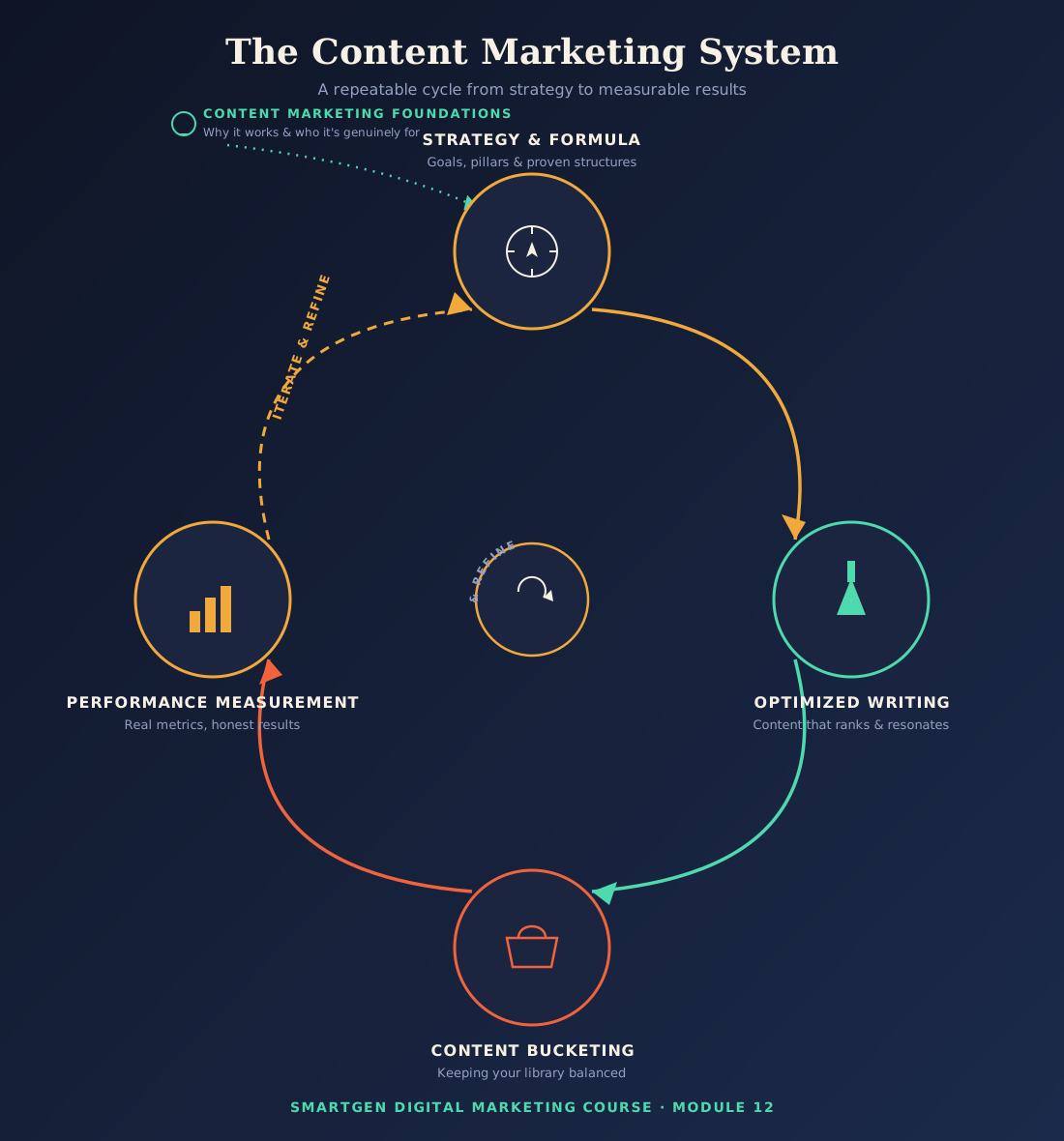
Visual Summary
Below is an original infographic built specifically for this guide, mapping out the content marketing system from strategy and formula through writing, bucketing, and performance measurement.
Module 12 Mega Guide Summary
In this module, we covered what content marketing actually is and how it differs fundamentally from advertising by earning attention through genuine value rather than direct interruption, how to build a real content marketing strategy grounded in a specific goal, a specific audience, and clear content pillars, the proven strategies and formulas — pillar-and-cluster, skyscraper, PAS, AIDA, how-to, and listicle — that give individual pieces of content a deliberate, effective structure, how to write content that satisfies both search engine optimization and genuine human engagement at the same time, how content bucketing keeps a growing content library balanced and strategically aligned rather than drifting, and how to measure and analyze content performance honestly, using the right metrics for your actual goal and treating underperformance as useful data rather than failure.
Practice exercise: Define one specific, measurable content marketing goal for your business or the WordPress site built in Module 9, along with three to five content pillars that support it. Choose one pillar and draft a single piece of content using one of the formulas from Section 3, applying the optimized-and-engaging writing principles from Section 4. Log it into a simple bucket tracker as described in Section 5, and set a calendar reminder for 30 days out to review its performance using the metrics and review habit described in Section 6 — using the CPM & ROI Calculator if any paid promotion is involved.
Frequently Asked Questions
How is content marketing different from just blogging?
Blogging is one common format content marketing can take, but content marketing is the broader strategic discipline — it can include video, email newsletters, downloadable guides, infographics, and more, all guided by the same underlying strategy, audience focus, and measurement discipline covered in this module, whether or not a blog is involved at all.
How much content do I need to publish to see real results?
There's no universal number, but consistency at a sustainable pace, as emphasized throughout Section 2, matters far more than raw volume. A smaller number of genuinely thorough, well-targeted pieces published consistently over months will consistently outperform a large volume of thin, rushed content.
Do I need a big team to do content marketing properly?
No. Many of the strongest examples of content marketing are produced by a single dedicated person or a very small team, particularly in the early stages of a business. What matters far more than team size is the discipline of following an actual strategy rather than publishing reactively.
Should every piece of content be written for SEO?
Not necessarily every single piece, but the majority of your content should be genuinely discoverable, which means at least considering the keyword and on-page principles from Modules 10 and 11 for most of what you publish. Some content — a timely announcement, a piece written purely for an existing email list — can reasonably deprioritize SEO in favor of a different, more immediate goal.
What's the single most common content marketing mistake beginners make?
Skipping the strategy work in Section 2 entirely and moving straight to writing individual pieces of content reactively, based on whatever feels timely or interesting in the moment. This produces a scattered content library that rarely compounds into the kind of real authority or measurable business results a genuine strategy makes possible.
What's Next?
In the next module, we'll continue building on this content foundation. Take a moment to revisit the earlier lessons in this course if you need a refresher, since each module builds on what came before it:
- Introduction to Online Digital Marketing: A Beginner's Guide
- Module 1: Basic Image and Video Editing — Complete Guide to Filmora and Canva for Beginners
- Module 3: Social Media Marketing (SMM) — Advertising Concepts and Platform Selection
- Module 5: Instagram Marketing — The Complete A to Z Mega Guide
- Module 6: X (Formerly Twitter) Marketing — The Complete A to Z Mega Guide
- Module 7: LinkedIn Marketing — The Complete A to Z Mega Guide
- Module 9: Creating a WordPress Website — The Complete A to Z Mega Guide
- Module 10: Search Engine Optimization (SEO) — The Complete A to Z Mega Guide
- Module 11: Analysis and Keyword Research — The Complete A to Z Mega Guide
This article was written by Sayad Md Bayezid Hosan for the SmartGen blog. For free tools to support your digital marketing journey, including our CPM & ROI Calculator, visit SmartGen.