
Algorithms and Optimization Explained: A Complete Guide to Theory, Research and Real-World Systems
Every time a map app picks your route, an ad auction clears in milliseconds, or a phone photo turns into a 3D scan, an algorithm is quietly solving an optimization problem you never see. This guide is a walk through what that actually means — from the plain-language basics up through five real research papers Google published in 2025 and 2026 — written so that a beginner can follow it start to finish, and a working developer can still find something worth their time.
One quick disambiguation before we start, because the word "algorithm" gets used two very different ways online. If you came here hoping to read about Google's search-ranking algorithm updates — Panda, Penguin, BERT, and the rest — that's a digital marketing topic, and a completely different thing from what this guide covers. SmartGen has a dedicated guide to those if that's what you're after. This guide is about algorithms in the computer-science sense: the mathematical methods used to search, decide, and optimize — the subject Google Research calls "Algorithms and Theory." Different Google, same word, unrelated topic.
With that cleared up, let's start at the beginning.
What Is an Algorithm, Really?
Strip away the jargon and an algorithm is just this: a precise, finite sequence of steps that takes some input, applies a transformation, and produces an output — reliably, and in a way someone else could follow and get the same result.
That "someone else could follow it" part matters more than it sounds. A vague plan ("find a good route") isn't an algorithm. A concrete procedure ("check every neighboring intersection, keep the one that reduces total distance, repeat until no intersection is left to check") is. The difference is correctness (does it actually produce a valid answer?) and efficiency (how much time and memory does it cost to get there?) — two questions you'll see come up constantly through the rest of this guide.
Take something as ordinary as planning a drive. The inputs are your start point, destination, and the road network. The constraints are which roads exist and which ways they run. The objective is usually "minimize time" or "minimize distance." The algorithm — something like Dijkstra's shortest-path method or the A* search that most modern map apps actually use — systematically explores possible routes according to that objective, and the output is the route you're handed. Every piece of that pipeline is doing real work; change any one piece and you get a different answer, even with the exact same road network.
Algorithms come in more flavors than "step-by-step recipe," too:
- Deterministic algorithms always produce the same output for the same input.
- Randomized algorithms deliberately use randomness partway through, often to avoid worst-case traps or to solve otherwise-intractable problems faster on average.
- Approximation algorithms don't promise the exact best answer — they promise an answer provably close to it, in exchange for running far faster.
- Heuristics are practical rules of thumb with no formal guarantee at all, used because they tend to work well in practice.
- Optimization algorithms, the focus of most of this guide, search a space of possible solutions for the one (or a good one) that best satisfies some goal.
- Learning-based algorithms don't have their behavior fully hand-written by a programmer — they adjust their own behavior based on data, which is what powers most of modern machine learning.
An algorithm, in other words, is a lot more than "a set of coding instructions." It's a specific claim about how to reliably get from a well-defined problem to a well-defined answer — and that claim can be checked, measured, and compared against other claims. That's exactly what the next section is about.
Why Efficiency Matters: Algorithm Complexity
Two algorithms can produce the exact same correct answer and still be worlds apart in practice, because one of them scales and the other one doesn't. This is what computer scientists mean by complexity — a way of describing how the work an algorithm requires grows as the input gets bigger, independent of any particular computer's speed.
The shorthand for this is Big-O notation. You don't need the formal math to get the intuition — you just need to see how differently these curves behave as n (the input size) grows:
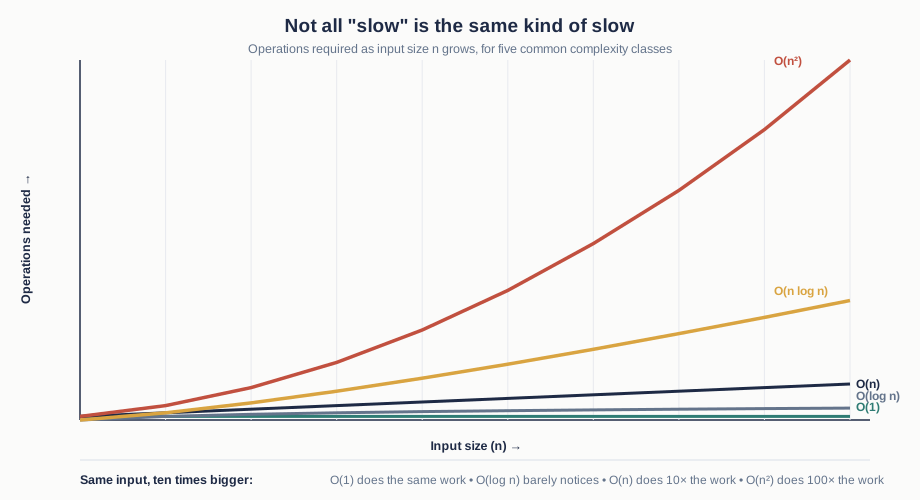
- O(1) — constant time. Looking up a value by its exact address. Doesn't care how big the dataset is.
- O(log n) — logarithmic. Binary search: repeatedly cutting the remaining space in half. Barely notices growth.
- O(n) — linear. Checking every item once. Doubling the input roughly doubles the work.
- O(n log n) — the complexity of most efficient general-purpose sorting algorithms. Grows a bit faster than linear.
- O(n²) — quadratic. Comparing every item against every other item. Doubling the input roughly quadruples the work — and this is where naive algorithms quietly become unusable at scale.
Here's why this isn't academic trivia: the difference between O(n log n) and O(n²) is invisible on a list of 50 items and catastrophic on a list of 50 million. A sorting step that takes a fraction of a second on your laptop's test data can take hours or simply never finish on production-scale data, purely because of which complexity class it falls into — no bug required, just an algorithm that was the wrong shape for the job.
This is also where worst case versus average case matters. An algorithm might behave beautifully on typical inputs and catastrophically on a rare, adversarial one — which is a real concern if your system is public-facing and someone could deliberately feed it that worst case. Understanding an algorithm's complexity, in both senses, is how you predict whether it will hold up before you find out the hard way in production.
What Are We Actually Trying to Optimize?
"Optimization" gets used loosely, so let's define it precisely: optimization is the process of choosing the values of some decision variables — the things you actually get to control — so as to make an objective function as good as possible (typically minimized, like cost, or maximized, like revenue), while respecting a set of constraints — the rules you're not allowed to break.
A few core ideas recur across almost every optimization problem you'll encounter:
Feasible region and optimal solutions. The feasible region is simply every combination of decision-variable values that satisfies all your constraints at once. The optimal solution is the best point within that region — not the best point in the abstract, which is a distinction that trips up a lot of beginners. A solution that ignores a constraint isn't a better answer; it's not an answer at all.
Local versus global optima. A local optimum is the best solution in its immediate neighborhood — nothing nearby is better — but somewhere else entirely in the feasible region, a genuinely better solution might exist. A global optimum is the best solution, full stop, anywhere in the feasible region. Many real-world optimization algorithms can only guarantee they've found a local optimum, because searching for a provable global one can be far more computationally expensive — sometimes prohibitively so. A concrete picture: imagine adjusting a delivery route by swapping two stops at a time. You might reach an arrangement where no single swap improves it — a local optimum — while a completely different route structure, reachable only by rearranging several stops at once, would have been shorter. The algorithm never sees that better route because it only ever looked one swap away.
Convex versus non-convex optimization. A convex problem is, loosely, one shaped like a single smooth bowl — any local optimum you find is automatically the global optimum, which makes convex problems reliably solvable. Most real engineering, machine-learning, and logistics problems are non-convex — bumpy, with many local dips — which is precisely why so much of applied optimization research is about managing that difficulty rather than eliminating it. Picture the difference physically: a convex problem is a marble rolling in a single mixing bowl — wherever it settles is the lowest point, guaranteed. A non-convex problem is a marble rolling across an egg carton — it settles into a dip reliably, but has no way of knowing whether a deeper dip exists three cups over.
Where variables live shapes which family of tools even applies:
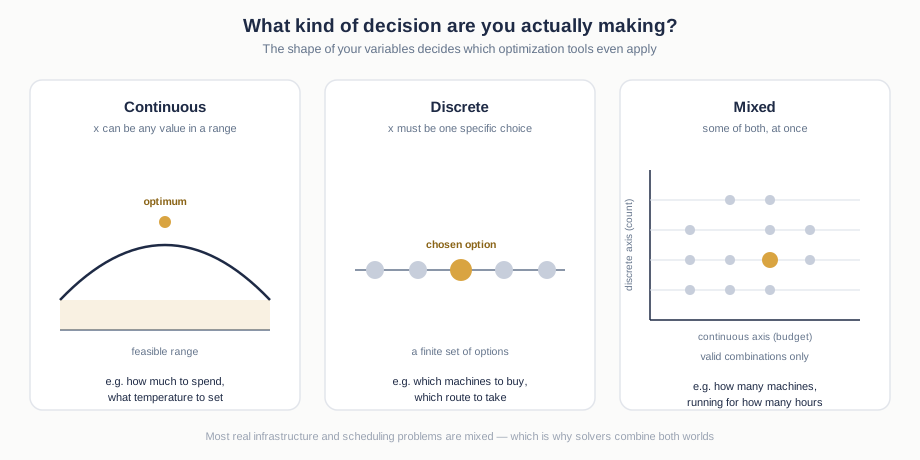
- Linear programming (LP) handles continuous variables with a linear objective and linear constraints — the most tractable, best-understood corner of optimization.
- Integer programming (IP) restricts some or all variables to whole numbers — how many trucks, how many servers, which route — which is a small-sounding change that makes the problem dramatically harder to solve in general.
- Mixed-integer programming (MIP) combines both: some variables continuous, some restricted to integers, in the same problem. Most real infrastructure, scheduling, and design problems are secretly mixed-integer problems.
- Multi-objective optimization drops the assumption that there's one thing to optimize at all — cost and board area, speed and safety — which is where the idea of a Pareto frontier comes in, and we'll spend real time on that in the capacitor case study below.
- Stochastic and simulation-based optimization accept that some inputs are uncertain or that the "objective" can only be evaluated by running a simulation rather than plugging into a clean formula — which is exactly the situation in the traffic-demand case study later in this guide.
- Robust optimization goes a step further and optimizes for the worst case an uncertain parameter could realistically take, rather than its expected value — trading away some average-case performance for a guarantee that things don't fall apart if reality deviates from the forecast.
None of these families is "better" in the abstract. Each is the right tool for a specific shape of problem, and picking the wrong one is one of the most common and most expensive mistakes in applied optimization work — something Section "Common Algorithm and Optimization Mistakes" below comes back to directly.
Where Continuous and Discrete Optimization Actually Meet
It's tempting to think of continuous and discrete optimization as two separate toolkits you pick between. In practice, the more interesting engineering happens at the seam between them — and that seam is exactly what a 2025 Google Research talk by researcher Thibaut Cuvelier addresses directly.
The problem: most real optimization software has to model both continuous quantities (a budget, a weight) and discrete choices (which machine, how many units) in the same problem, and historically, the tooling for each side has been built by different communities with different assumptions.
The key idea: the talk walks through how JuMP.jl and MathOptInterface.jl — modeling libraries in the Julia programming language, a language chosen for scientific and numerical computing partly for its combination of expressiveness and execution speed — were originally built for classical mathematical optimization (linear, mixed-integer, conic problems), but have become general enough to also express constraint programming, a different paradigm more associated with scheduling and combinatorial puzzles than with continuous math. The genuinely interesting technical point is the reverse direction too: constraint-programming solvers can themselves be implemented using linear programming underneath, which the talk illustrates with Google's own CP-SAT solver — an open-source, competition-winning constraint solver, part of the OR-Tools suite, that uses linear-programming techniques internally as part of how it searches for solutions.
What to take away: this isn't a new algorithm so much as a map of how two optimization worlds that look unrelated from the outside are, underneath, built from a lot of shared machinery. If you only remember one thing from this section, make it this: whenever a real-world problem mixes "how much" decisions with "which one" decisions — a delivery budget and a fleet size, staffing hours and which employees — you are very likely looking at a mixed-integer problem in disguise, and the tools to solve it well already exist.
Five Live Research Case Studies (2025–2026)
Theory is easier to hold onto once you've seen it solve an actual problem. What follows are five research efforts — four papers and one technical talk, all from Google Research, all published in 2025 or 2026 — walked through in the same consistent way: what the problem was, why it was genuinely hard, the key idea that made progress possible, what was actually tested, and what to take away, limitations included. (Notice the pattern — it's the same one the "How to Read a Research Paper" section further down teaches you to look for on your own.)
A word on how these are framed: a "Technical Report" is Google's own internal-review publication track, not the same thing as a peer-reviewed conference paper; an arXiv preprint is a paper posted publicly before or alongside peer review, and this guide names which is which throughout, rather than treating all research writing as equivalent.
Case Study 1: A Proactive AI Concierge for Internal Support
The problem. Large organizations write extensive internal documentation, and employees still flood support queues with questions that documentation technically already answers. A 2026 Google Research technical report by Neeraj Choudhary and Dónal Doyle names this gap "knowledge latency" — the lag between how fast operational reality changes and how fast static documentation can be updated to keep up, especially across different regions and contexts.
Why it's hard. Traditional knowledge-management search is reactive: it waits for someone to type a question, then retrieves a matching document. That does nothing about the fact that documentation itself may be thin, outdated, or missing exactly the context a specific person in a specific situation needs — and by the time someone's stuck enough to open a support ticket, the cheap moment to have helped them has already passed.
The key idea. The paper proposes a framework called SENTINEL, built around two engines working together:
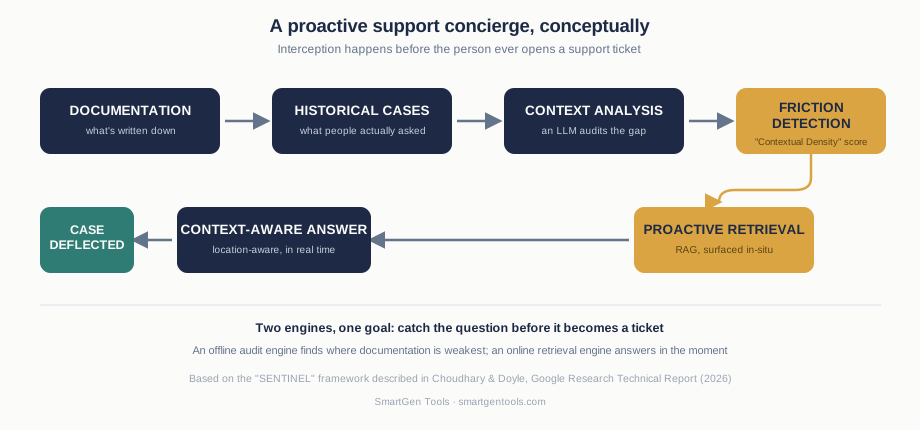
The first engine runs offline, using a large language model to audit documentation against real historical support cases, producing what the paper calls a "Contextual Density" score that flags exactly where documentation is thin relative to what people actually ask. The second engine runs in real time: a retrieval-augmented generation (RAG) system — meaning it looks up relevant information and grounds its answer in that retrieved content, rather than answering purely from what it learned during training — surfaced through a location-aware assistant window that appears at the point someone is actually stuck, before they've decided the problem is bad enough to escalate.
What they tested. This is described in the paper as a research framework demonstrating the architecture and mechanism of proactive interception, not a production deployment case study — an important distinction the paper itself is careful about, and one this guide preserves rather than upgrading to a stronger claim than what was published.
What to take away. The genuinely useful idea here, independent of any specific product, is the shift from reactive retrieval (wait for a search query) to proactive interception (use context and history to answer before the question is even fully formed). The open questions that come with any system like this are the honest ones: hallucination risk if the retrieval grounding is weak, privacy considerations around using location and historical case context, and the real engineering cost of deploying something like this cleanly across a large, messy enterprise environment.
Case Study 2: Turning Ordinary Photos Into a 3D Scene
The problem. Structure-from-Motion (SfM) is the classical computer-vision task of reconstructing a 3D scene and figuring out where each camera was standing, purely from a set of overlapping 2D photos. It's the backbone of everything from 3D mapping to camera relocalization (figuring out exactly where a new photo was taken relative to a scene you've already reconstructed).
Why it's hard. Classical SfM relies on triangulating a sparse set of matched points across images — reliable, but limited to the relatively few points that can be confidently matched between photos. Modern deep learning has made Monocular Depth Estimation (MDE) — estimating a full depth map from a single image, no camera motion required — surprisingly good, which is tempting because it offers dense 3D information for every pixel, not just a sparse set of matched points. The catch, as a 2026 paper by Shengjie Zhu, Ahmed Abdelkader, Mark J. Matthews, Xiaoming Liu, and Wen-Sheng Chu (a Google and Michigan State University collaboration) lays out, is that MDE depth values are noisy in a fundamentally different way than sparse triangulated points — much higher error variance, pixel by pixel. Classical bundle adjustment, the standard optimization step that refines camera poses and 3D points together, wasn't built to trust data that noisy.
The key idea. The paper's proposed method, Marginalized Bundle Adjustment (MBA), takes inspiration from RANSAC — a classical, decades-old technique for fitting a model to data that contains a lot of outliers, by repeatedly testing small random subsets rather than trusting every point equally.
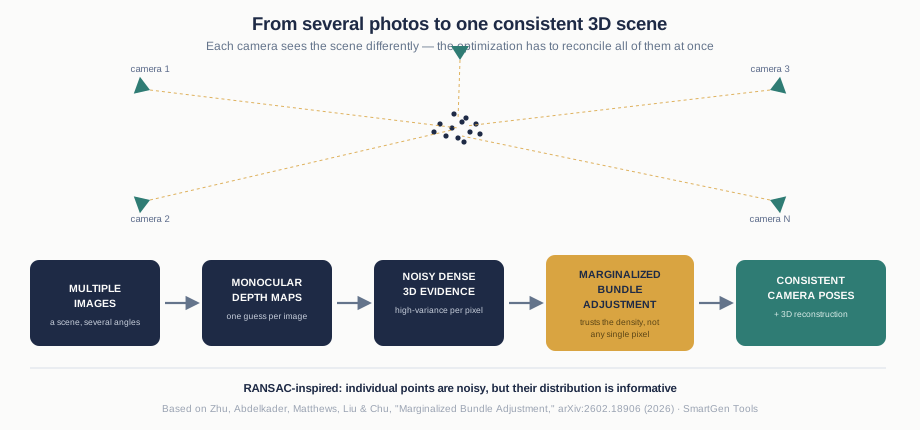
The insight is that even though any single pixel's depth estimate can't be fully trusted, the distribution of depth estimates across many pixels and many images carries real signal. Technically, the method treats the projective error at each point as part of a residual error distribution, and optimizes camera poses to maximize the area under that distribution's cumulative curve — a way of leaning on the density and shape of the noisy evidence as a whole, rather than any individual noisy measurement.
What they tested. The paper reports results across a genuinely wide range of scales — from two-view and small few-frame setups up to large multi-view collections running into the thousands of images — and states that with this method, monocular depth maps prove accurate enough to produce state-of-the-art or competitive results on both Structure-from-Motion and camera-relocalization benchmarks. The paper is accepted at 3DV 2026, a peer-reviewed computer vision conference, and is also available as an arXiv preprint (arXiv:2602.18906).
What to take away. The transferable lesson goes beyond 3D vision: when a data source is individually noisy but abundant, the right move is often to model the noise itself explicitly, rather than filtering the source out or treating every measurement as equally reliable. That's a pattern worth recognizing well outside computer vision.
Case Study 3: Estimating Real Traffic Demand From Partial Data
The problem. Transportation planners rely on an origin-destination (OD) matrix — essentially, a table of how many trips are made from every starting zone to every ending zone across a city or highway network — to run traffic simulations for planning, congestion analysis, and infrastructure decisions. The problem is that the true OD matrix is never directly observable; it has to be estimated, or "calibrated," from indirect signals.
Why it's hard. This is a classic underdetermined problem: the number of unknowns (every possible origin-destination pair) vastly exceeds the number of independent signals you can actually observe. A 2025 paper by Arwa Alanqary and coauthors, published at the 12th Triennial Symposium on Transportation Analysis (TRISTAN XII) in Okinawa, Japan, points out the specific failure mode this causes — very different underlying demand patterns can produce nearly identical path-level travel times, which is the signal most calibration methods have historically leaned on most heavily. When your main observation can't tell two very different realities apart, no amount of additional optimization effort fixes that on its own.
The key idea. The paper's contribution is to bring in a second, different kind of signal: sparse segment counts — partial, sampled vehicle counts on individual road segments, distinct from complete, exhaustive traffic counts — used not as the primary fitting target, but as a regularization term folded into the optimization.
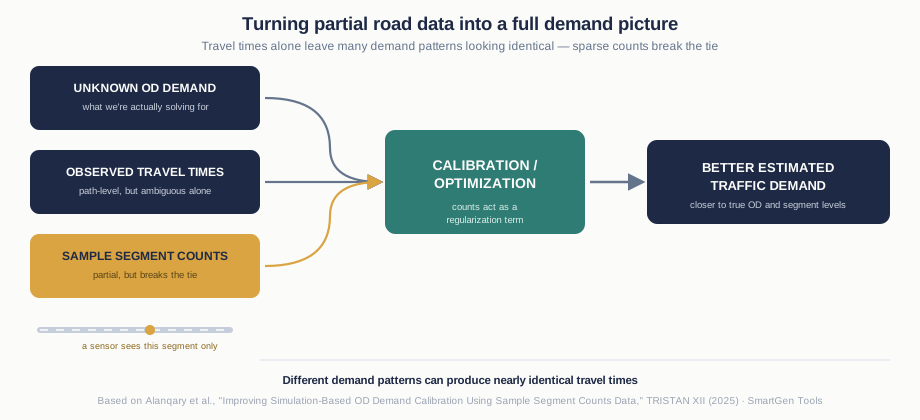
Regularization, in plain terms, is the practice of adding an extra term to an optimization problem specifically to rule out solutions that technically fit the main data but are implausible for some other reason — here, plausibility relative to the sampled counts. The formulation is built to preserve the distribution of the observed segment counts while still optimizing demand to match observed path-level travel times, giving the optimizer a second, independent axis of evidence to disambiguate between demand patterns that travel-time data alone can't tell apart.
What they tested. The method was tested on Seattle's highway network — 1,820 highway segments and 305 ramp-to-ramp OD pairs — across three synthetic scenarios representing low, medium, and high congestion (total demand of 20,000, 35,000, and 50,000 trips respectively), with ground-truth demand matrices generated and simulated for comparison. The paper reports meaningful improvements in solution quality, specifically in how accurately the calibrated result recovers the true demand pattern at both the overall OD level and the individual segment level — without citing a specific numerical improvement figure in the abstract, which this guide isn't inventing on the paper's behalf.
What to take away. This is a clean, general lesson in optimization under uncertainty: when a problem is underdetermined, the fix usually isn't a cleverer algorithm applied to the same data — it's finding any additional, genuinely independent signal, even a sparse and partial one, and using it to narrow the space of plausible answers.
Case Study 4: Automating a Genuinely Tedious Hardware Decision
The problem. Multi-layer ceramic capacitors (MLCCs) are small components used constantly in power, RF, and analog circuit design — and the market offers a huge range of package sizes, voltage ratings, and performance characteristics to choose from. A 2025 paper by Luke Brantingham and Jason Grover (Google) tackles the very concrete, very unglamorous problem of picking the right combination of capacitors for a design.
Why it's hard. Capacitor selection isn't one decision, it's dozens of interacting ones, and it's a genuine multi-objective problem: you generally want to minimize both cost and the board area the components occupy, and those two goals are frequently in direct tension — a cheaper combination often needs more physical space, and a compact combination often costs more. On top of that, the electrical requirements aren't simple either: designs need to satisfy a minimum derated capacitance (capacitance actually drops under real operating conditions, particularly under DC voltage bias, so raw rated capacitance overstates what a part delivers), and in some formulations, an impedance target across a frequency range, sometimes combined with a full power-distribution-network (PDN) model. Traditional manual selection, done by an engineer working through catalogs and spreadsheets, doesn't reliably find the genuinely best combinations in a space this large and this interdependent.
The key idea. The paper frames this explicitly as a multi-objective, constrained optimization problem — some variables continuous, some inherently discrete (you can't buy half a capacitor), which places it squarely in the mixed-integer territory introduced earlier in this guide. Rather than looking for one "best" answer, the framework surfaces the Pareto frontier — the set of combinations where no other option is strictly better on both cost and board area at once.
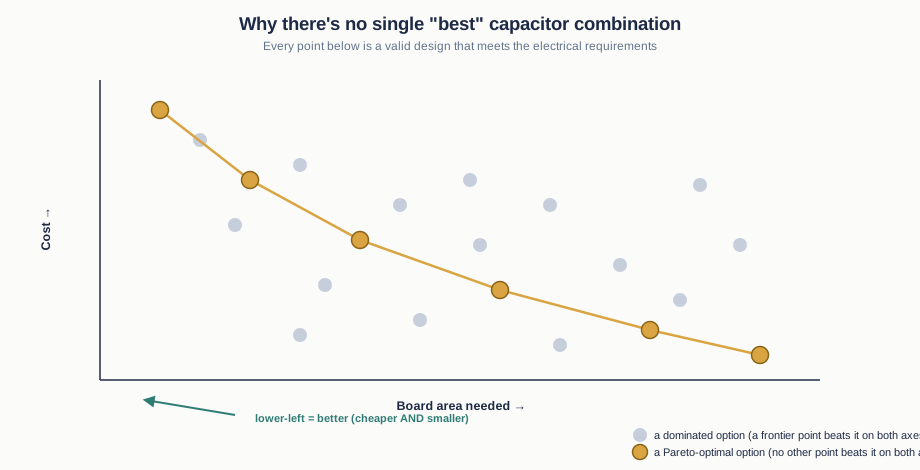
This is worth sitting with, because the Pareto-frontier idea shows up constantly once you know to look for it: a point is "dominated" if some other option beats it on every objective simultaneously — that dominated point is never worth choosing. A point is "Pareto-optimal" if no such better-on-every-axis alternative exists; improving it on one objective necessarily costs you on the other. The frontier is the full set of those Pareto-optimal points, and the paper's honest framing is that the tool narrows an enormous catalog down to that frontier and hands the trade-off decision to the human designer — it doesn't pretend to remove the judgment call, just to make sure the designer is choosing among the options that are actually worth choosing among.
What they tested. The paper demonstrates the optimization framework across the described design settings — minimum derated capacitance, impedance-envelope targets, and a combined power-distribution-network model — and explicitly frames the tool as assisting rather than fully replacing a human designer, noting that simpler capacitor-selection tasks can be solved outright while more complex ones are meaningfully sped up as a starting point. It also extends the framework toward an economic model of capacitor utilization across a design or multiple designs at once. No specific cost-savings percentage is stated in what's publicly available, so none is claimed here.
What to take away. Multi-objective optimization done honestly doesn't produce a single "optimal" answer — it produces a menu of legitimately different, legitimately correct trade-offs, and hands the value judgment between them back to a human. That's a more useful mental model for a huge share of real engineering decisions than "find the best option" ever was.
The Research Ecosystem Behind These Papers
All five case studies above sit inside Google Research's "Algorithms and Theory" research area — but that area doesn't operate as an island. It's one node in a genuinely interconnected map of teams, and understanding the shape of that map explains why research this different in surface topic (enterprise support, 3D vision, traffic simulation, hardware design, programming-language tooling) keeps coming from the same broad research tradition.
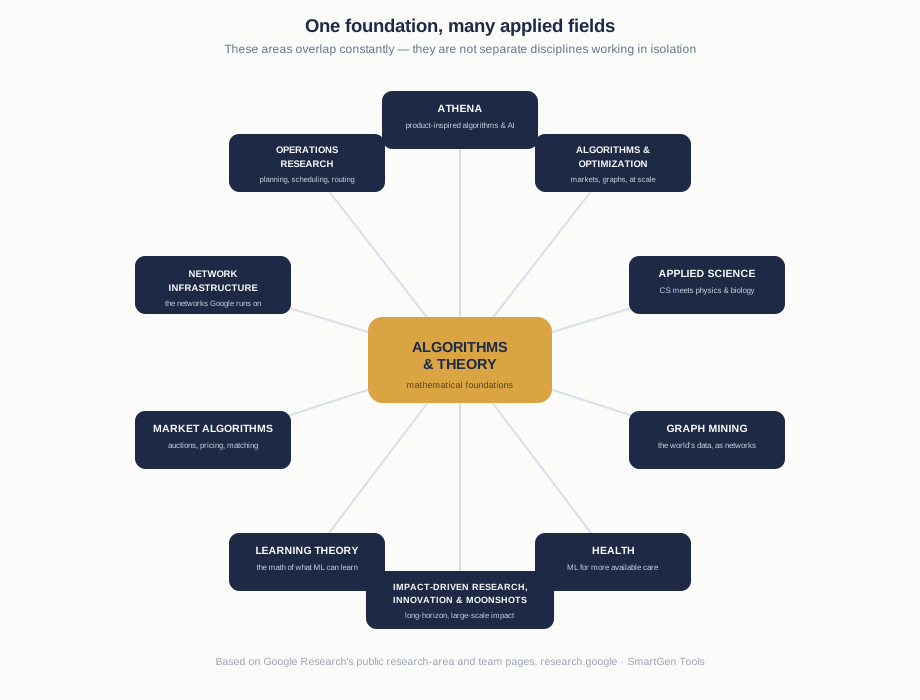
A few of these connections are worth spelling out rather than just naming:
Athena is best understood as a broad, international team applying algorithms, AI, and language understanding to product-facing problems — and it's structured around several overlapping focus areas, including graph-based learning, market algorithms, and operations research, which is part of why you'll see people and publications shared across what look like separate team pages.
Algorithms & Optimization performs foundational research spanning algorithms, markets, optimization, and graph analysis, and is itself composed of overlapping groups working on large-scale optimization, graph mining, and market algorithms — the throughline being that a single hard combinatorial or optimization problem often needs contributions from all three angles at once.
Applied Science sits at the deliberate intersection of computer science with physics and biology — climate and energy modeling, biodiversity mapping, genomics — where the algorithmic and optimization tools developed elsewhere in this map get pointed at scientific rather than purely product problems.
Graph Mining builds scalable libraries for analyzing graphs — networks of connected entities — at a scale running into the billions or trillions of edges, powering everything from clustering to similarity search across Google's products.
Health applies machine learning and, increasingly, the same optimization thinking used elsewhere in this map to the specific goal of making healthcare more available and more accurate, through an embedded research model working directly alongside clinical and product teams.
Impact-Driven Research, Innovation and Moonshots is explicitly a longer-horizon, higher-risk research effort — spanning climate resilience and health, among other areas — sitting at the far end of the spectrum from "ship this quarter" applied work.
Learning Theory asks the more foundational mathematical question underneath machine learning itself: not just "does this model work" but "what, provably, can a learning algorithm learn at all, and under what guarantees" — statistical learning theory, optimization theory, and decision-making under uncertainty.
Market Algorithms designs the economics side of algorithmic systems — auction theory and mechanism design for ad auctions and other marketplace products, where the "optimization" is happening inside a system with other self-interested participants, not just a fixed environment.
Network Infrastructure brings networking, distributed systems, and advanced algorithms together to build and run the datacenter, wide-area, and edge networks Google's other products depend on — routing and capacity problems that are optimization problems at a genuinely planetary scale.
Operations Research works with integer programming, linear programming, constraint programming, and graph algorithms to solve concrete problems at scale — transportation, scheduling, logistics, robotics — and not just internally: Google's open-source OR-Tools suite, including the CP-SAT solver mentioned in the Julia case study above, is used well outside Google, including in aviation and healthcare applications.
The point of laying all of this out isn't that these are ten separate specialties to memorize — it's the opposite. A single research paper on, say, traffic demand calibration draws on optimization theory, simulation, and transportation-specific domain knowledge simultaneously; that's normal, not an exception, in how this research actually gets done.
How to Read an Algorithms Research Paper Without Getting Lost
Once you've read a handful of papers the way this guide just walked through five, a pattern becomes visible — and you can use it yourself on the next paper you encounter, in this field or any technical field. Look for these pieces, roughly in this order:
- The problem the paper is actually trying to solve — stated plainly, before any method is introduced.
- The existing limitation — why current approaches fall short specifically for this problem.
- The proposed method and its key idea — usually one core insight the rest of the paper elaborates on.
- The objective and constraints — what, precisely, is being optimized, and what rules bound the solution.
- The dataset or benchmark used to test the method, and the experimental setup around it.
- Evaluation metrics — how "better" is actually being measured.
- Results — what the numbers or findings actually showed.
- Limitations — what the authors themselves flag as unresolved, untested, or out of scope.
- Future work — what the authors think comes next.
The single most valuable habit you can build from this list is separating what the authors propose from what the experiments actually prove. A paper can propose an elegant, compelling method and still only demonstrate it on a narrow set of benchmarks under specific conditions — that's not a flaw in the paper, it's just the honest scope of what was tested, and it's your job as a reader to notice the difference rather than mentally rounding "worked well on our benchmark" up to "solves the problem in general." Every case study above was deliberately written to model that same discipline — naming what was tested, and being explicit about what wasn't.
A Step-by-Step Framework for Understanding Any Optimization Problem
Whether you're reading a paper or facing your own real optimization problem at work, the same repeatable sequence of questions gets you from confusion to a workable formulation:
- Define the decision. What, concretely, are you choosing?
- Identify the variables. What values can you actually control?
- Define the objective. What does "better" mean here, precisely enough to measure?
- Identify the constraints. What rules, limits, or requirements can't be violated?
- Determine variable type. Continuous, discrete, or a mix of both?
- Determine whether uncertainty exists. Are any inputs noisy, unknown, or only knowable via simulation?
- Choose an appropriate optimization family. Linear, integer, convex, stochastic, multi-objective — based on everything above.
- Solve. Apply the chosen method or solver.
- Validate. Does the solution actually satisfy every real-world constraint, not just the ones you formalized?
- Run a sensitivity analysis. How much does the answer change if your assumptions or inputs shift slightly?
- Check practical usefulness. Is this solution something a real person or system can actually act on?
Steps 9 and 11 are the ones beginners skip most often, and they're arguably the most important two on the list. A mathematically optimal solution that ignores a real constraint you forgot to formalize, or that no one can actually implement, isn't a useful answer — it's an elegant answer to a subtly wrong question.
A Worked Example: Formulating a Real Problem
Frameworks click faster with a concrete run-through, so here's a small one, worked all the way to a checked answer.
A bakery makes two products: sourdough loaves and baguettes. Each sourdough loaf needs 2 hours of oven time and 3 units of flour, and earns $8 profit; each baguette needs 1 hour of oven time and 1 unit of flour, and earns $3 profit. The bakery has 20 oven-hours and 24 units of flour available today. How many of each should it bake?
Running this through the framework above: the decision is how many of each to bake; the variables are S (sourdough) and B (baguettes), both non-negative; the objective is to maximize 8S + 3B; the constraints are 2S + B ≤ 20 (oven capacity) and 3S + B ≤ 24 (flour supply). Because you can't bake a fraction of a loaf, S and B have to be whole numbers — which quietly makes this an integer program, not a plain linear one, exactly the distinction covered earlier in this guide.
For a problem this small, you can solve it by checking the corners of the feasible region — the points where constraints intersect. Baking only baguettes maxes out at 20 of them ($60 profit); baking only sourdough maxes out at 8 loaves ($64 profit); but baking 4 sourdough loaves and 12 baguettes uses the oven and the flour completely (2×4+12=20, 3×4+12=24) and earns $68 — better than either extreme, and in fact the optimal answer.
Validating it is quick: both constraints are satisfied exactly, and neither variable is negative. A one-line sensitivity check matters too — if a flour delivery fell a few units short, this exact plan would become infeasible, which is worth knowing before committing the day's schedule to it. And the practical usefulness check is the one a formula can't answer for you: can the bakery actually sell 12 baguettes and 4 sourdough loaves today, and does it have the staff-hours to bake that specific mix? The optimization gives you the best answer to the problem as stated — it's still on you to make sure the problem was stated completely.
That's the entire discipline this guide has been building toward, worked from a blank page to a checked answer in eleven small steps.
Comparing the Major Optimization Approaches
| Approach | Main idea | Strength | Limitation | Typical use |
|---|---|---|---|---|
| Linear programming | Optimize a linear objective under linear constraints | Fast, reliably solvable at large scale | Can't express integer or logical decisions | Resource allocation, blending problems |
| Integer / mixed-integer programming | Some or all variables restricted to whole numbers | Models real discrete decisions (how many, which one) | Dramatically harder to solve than pure LP | Scheduling, routing, network design |
| Nonlinear optimization | Objective or constraints are curved, not straight lines | Captures realistic physical/economic relationships | Harder to guarantee global optimality | Engineering design, physics-based models |
| Convex optimization | A special, well-behaved case where any local optimum is global | Strong theoretical guarantees, efficient solvers | Many real problems aren't naturally convex | Machine learning training, control systems |
| Stochastic optimization | Explicitly accounts for random or uncertain inputs | More realistic under genuine uncertainty | More complex to formulate and solve | Finance, inventory planning |
| Robust optimization | Optimizes against the worst case an uncertain input could take | Guards against bad surprises | Can be overly conservative if worst case is rare | Safety-critical or high-stakes systems |
| Simulation-based optimization | Objective can only be evaluated by running a simulation | Handles problems too complex for a closed-form objective | Each evaluation is computationally expensive | Traffic calibration, complex system design |
| Multi-objective optimization | Optimizes several competing goals at once, via a Pareto frontier | Reflects real trade-offs honestly | No single "best" answer — a human still decides | Hardware design, portfolio construction |
| Constraint programming | Models a problem as variables, domains, and constraints; searches systematically | Excellent for scheduling and combinatorial puzzles | Less suited to continuous, numeric objectives | Scheduling, timetabling, configuration |
| Heuristic / metaheuristic methods | Practical search strategies (genetic algorithms, simulated annealing, etc.) with no optimality guarantee | Can tackle problems too large for exact methods | No guarantee the answer found is truly optimal | Very large-scale or NP-hard problems |
No single row in that table is the "advanced" or "correct" choice — each is a legitimate answer to a different shape of problem, and picking the row before understanding the problem's actual shape is exactly backwards.
Common Algorithm and Optimization Mistakes
A handful of conceptual mistakes account for a disproportionate share of real-world optimization failures — worth knowing by name so you can catch them in your own work:
Optimizing the wrong objective. This happens when the metric you can easily measure quietly replaces the outcome you actually care about — optimizing for click-through rate when the real goal was long-term user satisfaction, for instance. It matters because the algorithm will faithfully, relentlessly pursue exactly what you told it to, even when that's not what you meant.
Ignoring constraints during formulation. A solution that's mathematically optimal but operationally impossible isn't a partial success — it's a wasted optimization run. Avoid it by writing down every hard constraint before solving, not after the "optimal" answer turns out to be unworkable.
Reaching for a complex method on a simple problem. A sophisticated metaheuristic applied to a problem simple enough for exact linear programming usually costs more time and yields a worse, less certain answer than the simple tool would have.
Treating correlation as causation in the data feeding an optimization model. If the relationship the model is exploiting is coincidental rather than causal, the "optimal" decision can actively make things worse the moment conditions shift.
Ignoring uncertainty entirely. Treating a noisy or uncertain input as if it were a known, fixed constant produces solutions that look precise and perform poorly the moment reality doesn't match the point estimate exactly.
Overfitting to a benchmark. A method tuned aggressively to perform well on one specific benchmark dataset can quietly stop generalizing to the real conditions that benchmark was only ever meant to approximate.
Ignoring computational cost. An algorithm that finds a marginally better answer but takes ten times longer isn't automatically the right choice — especially in a system that needs to run repeatedly, in real time, or at scale.
Assuming a local optimum is the global one. In a non-convex problem, this assumption can leave real, meaningfully better solutions completely unexplored, often without any obvious sign that it happened.
Ignoring data quality. An elegant optimization built on biased, stale, or incomplete data produces confidently wrong answers — the algorithm has no way to know the data itself is the problem.
Trusting an algorithm's output without validation. This is the single most avoidable mistake on this list, and it's exactly why "Validate" and "Check practical usefulness" appear explicitly as their own steps in the framework above.
How Algorithms Actually Produce Better Decisions
It's tempting to think of "add an algorithm" as a step that automatically produces a good decision. It doesn't — an algorithm is only ever as good as everything feeding into it:
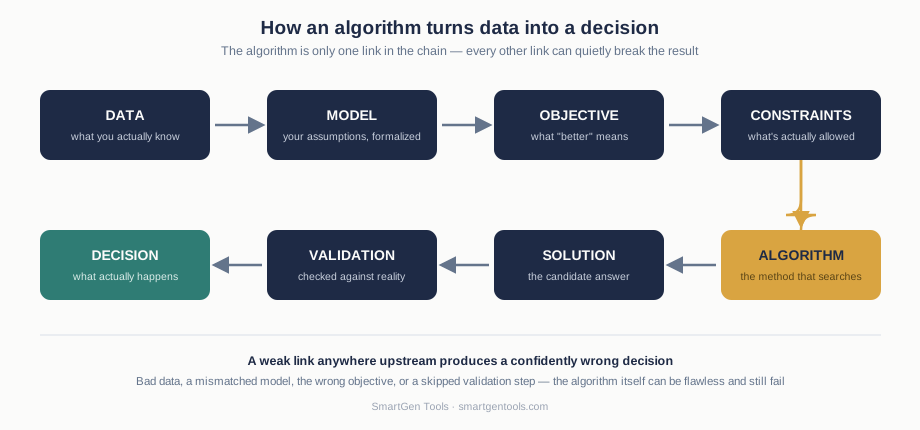
Every one of those links can independently break the final outcome. Bad or biased data produces a confidently wrong answer from a perfectly correct algorithm. A model that doesn't actually reflect how the real system behaves gets optimized beautifully — for the wrong reality. The wrong objective optimizes for the wrong thing, exactly as described in the mistakes section above. Missing constraints produce solutions that are mathematically valid and practically unusable. Even a genuinely excellent algorithm only searches within the space that the model, objective, and constraints defined for it — it cannot correct for a flaw upstream of itself. And a solution that skips validation carries every one of those earlier flaws straight through into a real decision, undetected.
This is the single most important mental model in this entire guide: when an "AI-optimized" or "algorithmically-driven" decision turns out badly, the algorithm itself is often the least likely place the real problem lives.
Real-World Applications
The same pattern — problem, algorithmic formulation, objective, constraints, result — shows up across an enormous range of fields once you know to look for it. Two are worth walking through end-to-end, since they connect straight back to the case studies above:
Transportation, concretely: the problem is estimating how many people are actually traveling between each pair of zones in a city — recognizable from Case Study 3. The algorithmic formulation treats this as a demand-calibration problem; the objective is matching observed travel times and segment counts as closely as possible; the constraints are the physical road network and the requirement that estimated trip counts stay non-negative; the result is a calibrated OD matrix planners can actually simulate against.
Hardware design, concretely: the problem is choosing a combination of components — recognizable from Case Study 4. The algorithmic formulation is a multi-objective, mixed-integer optimization; the objective is minimizing cost and board area at the same time; the constraints are the electrical requirements the design has to meet; the result isn't one single answer but a Pareto frontier, handed to an engineer to make the final trade-off call.
The rest of the table below follows that identical shape — only the specific nouns change:
| Domain | Problem | What's typically optimized | Typical constraints |
|---|---|---|---|
| Search & ads | Rank or place the most relevant result/ad | Relevance, expected value | Latency, budget, policy rules |
| Transportation | Route vehicles or estimate demand | Travel time, cost, coverage | Road network, capacity, fleet size |
| Robotics | Plan motion or actions | Task completion, safety | Physical limits, collision avoidance |
| Computer vision | Reconstruct scenes or detect objects | Reconstruction accuracy | Sensor noise, computation budget |
| Hardware design | Select or place components | Cost, board area, performance | Electrical requirements, catalog availability |
| Logistics & supply chains | Plan inventory and shipping | Cost, service level | Warehouse capacity, delivery windows |
| Healthcare | Screen, diagnose, or allocate resources | Accuracy, availability | Clinical validity, fairness, privacy |
| Finance | Allocate a portfolio or price risk | Return, risk-adjusted value | Regulatory limits, risk tolerance |
| Market allocation | Clear an auction or marketplace | Efficiency, revenue | Incentive compatibility, budgets |
| Network routing | Move data or traffic efficiently | Latency, throughput | Bandwidth, reliability requirements |
| Scheduling | Assign tasks to time and resources | Completion time, utilization | Dependencies, availability |
| Recommendation systems | Suggest the most relevant item | Predicted relevance/engagement | Diversity, freshness, privacy |
Where Algorithms Are Heading in 2026
A few directions are genuinely active right now, worth separating clearly by how established each one actually is:
Established, already in wide production use: classical linear, integer, and mixed-integer programming; constraint programming for scheduling and combinatorial problems; convex optimization as the backbone of most machine-learning training. None of this is going anywhere — it's the stable foundation the newer work below builds on top of.
Active, maturing research (the kind reflected directly in the case studies above): AI-assisted and learning-augmented optimization, where models learn to guide or accelerate a classical solver rather than replace it outright; retrieval-augmented, context-aware AI systems applied to real operational problems like enterprise support; robust optimization specifically built for genuine real-world uncertainty rather than idealized conditions; and deeper integration between simulation and optimization, needed anywhere the objective can't be written down as a clean closed-form equation.
Earlier-stage and more speculative: fully differentiable optimization pipelines that let gradient-based learning and classical solvers train jointly end-to-end; large-scale agentic systems that plan and act using optimization as one internal tool among several; and graph-based reasoning systems that combine the structural strengths of graph algorithms with the flexibility of learned models.
The honest throughline across all three tiers, worth restating plainly: none of this is replacing the fundamentals covered earlier in this guide. It's building on top of them. A foundation model that helps guide a search is still, underneath, searching a feasible region for a solution to an objective function subject to constraints — the vocabulary this entire guide has been building toward the whole way through.
Glossary
Algorithm — a precise, finite sequence of steps that turns an input into an output.
Optimization — choosing decision-variable values that make an objective as good as possible while respecting constraints.
Objective function — the specific thing being minimized or maximized.
Constraint — a rule a solution is not allowed to violate.
Feasible region — every combination of variable values that satisfies all constraints at once.
Local optimum — the best solution in its immediate neighborhood, though a better one may exist elsewhere.
Global optimum — the best solution across the entire feasible region.
Convex optimization — a class of problems shaped so that any local optimum is automatically the global one.
Integer programming — optimization where some or all variables must be whole numbers.
Mixed-integer optimization — optimization combining both continuous and integer-restricted variables.
Regularization — an extra term added to an optimization problem to rule out technically-fitting but implausible solutions.
Bundle adjustment — the optimization step in 3D vision that jointly refines camera positions and 3D point locations.
Structure-from-Motion (SfM) — reconstructing 3D scene geometry and camera positions from multiple 2D images.
Monocular depth estimation — estimating a full depth map from a single image, without needing camera motion.
RANSAC — a classical technique for fitting a model to data containing many outliers by testing random subsets.
Residual — the gap between a model's prediction and the actual observed value.
Origin-Destination (OD) matrix — a table describing how many trips are made between every pair of zones in a network.
Simulation-based optimization — optimization where the objective can only be evaluated by running a simulation, not a closed-form formula.
Pareto frontier — the set of solutions where improving one objective necessarily makes another objective worse.
Constraint programming — a modeling approach that expresses a problem as variables, their domains, and constraints, then searches systematically.
Heuristic — a practical, often fast problem-solving rule with no formal guarantee of optimality.
Complexity — how the work an algorithm requires grows as its input size grows.
Scalability — how well a system or algorithm continues to perform as its workload grows.
Frequently Asked Questions
What is algorithms and optimization?
It's the branch of computer science and applied mathematics concerned with designing reliable step-by-step methods (algorithms) and, within that, methods specifically for choosing the best possible option under a defined goal and a set of rules (optimization). Together they underpin everything from route planning to ad auctions to 3D reconstruction.
What is optimization in computer science?
Optimization is the process of finding the values of controllable variables that make some objective — cost, time, accuracy, revenue — as good as possible, without violating a defined set of constraints.
What is the difference between continuous and discrete optimization?
In continuous optimization, decision variables can take any value within a range (like a budget amount). In discrete optimization, variables are restricted to a specific, separate set of choices (like which of five machines to buy). Many real problems are mixed, combining both kinds of variables at once.
What is mixed-integer optimization?
It's an optimization problem where some decision variables must be continuous and others must be whole numbers, combined in a single formulation — common in scheduling, logistics, and hardware design, where you're deciding both "how much" and "which one" simultaneously.
What is bundle adjustment?
It's the optimization step in 3D computer vision that jointly refines estimated camera positions and 3D point locations so that they're mutually consistent with what was actually observed across a set of images.
What is monocular depth estimation?
It's the task of estimating how far away every part of a scene is using just a single 2D image, with no need for multiple camera angles or camera movement — a capability that's become dramatically more accurate with modern deep learning.
How is AI changing optimization?
Mainly by learning to guide, accelerate, or contextualize classical optimization methods rather than replacing them outright — for example, using a language model to detect where documentation is weak before a formal retrieval step runs, or using learned depth estimates as informative (if noisy) input to a classical bundle-adjustment optimization.
What is simulation-based optimization?
It's optimization used when there's no clean mathematical formula for the objective — instead, you have to actually run a simulation to find out how good a candidate solution is, which is common in traffic, logistics, and complex systems modeling.
Why are algorithms important in real-world decision-making?
Because most decisions worth automating — routing, pricing, scheduling, resource allocation — involve too many possibilities for a person to evaluate by hand. A well-designed algorithm searches that space systematically and reliably; a poorly matched one can produce a confidently wrong answer just as fast.
How do researchers evaluate optimization algorithms?
Typically against benchmark datasets or synthetic test cases with a known ground truth, using metrics matched to the specific problem (accuracy, solution quality, computation time), and — critically — by being explicit about what was and wasn't tested, which is exactly what separates a rigorous paper from an overstated one.
What is a Pareto frontier?
It's the set of solutions to a multi-objective problem where no option is strictly better than another on every objective at once — improving one goal necessarily costs you on another. It represents legitimate trade-offs, not one single best answer.
What's the difference between an algorithm and a model?
An algorithm is the step-by-step method itself. A model is the simplified representation of a real system that the algorithm operates on or is trained against — the road network a routing algorithm searches, or the mathematical relationship a machine-learning algorithm fits to data. A good algorithm applied to a bad model still produces an unreliable answer, which is the same lesson the decision-pipeline section above makes in more general terms.
Is optimization the same as machine learning?
No, though they're closely linked. Machine learning typically uses optimization internally — training a model usually means optimizing its parameters to minimize an error function — but optimization is the older, broader field, and most classical optimization (routing, scheduling, resource allocation) doesn't involve any learning from data at all.
How can beginners learn algorithm theory?
Start with the foundational vocabulary this guide builds — complexity, objective functions, constraints, feasible regions — before jumping into any specific algorithm family. Once those concepts are solid, reading real research papers (using the framework in this guide) becomes a genuinely learnable habit rather than an intimidating wall of notation.
Conclusion
Everything in this guide — Big-O notation, objective functions, Pareto frontiers, RANSAC-inspired robustness, regularization as a way to break a tie — is really one idea wearing a lot of different outfits: define precisely what you're choosing, define precisely what "better" means, respect the rules you're actually bound by, and be honest about what your solution has and hasn't proven. The five papers this guide walked through solve wildly different problems — enterprise support, 3D reconstruction, city traffic, circuit boards, programming-language tooling — using exactly that same underlying discipline. That discipline, more than any single algorithm, is the actual skill worth taking away.
Written for the SmartGen Tools blog by Sayad Md Bayezid Hosan.
— Written by Sayad Md Bayezid Hosan for the SmartGen blog
 ✓
✓
Sayad Md Bayezid Hosan
Founder & Tech Entrepreneur | Full-Stack Developer
Full-stack Web Developer, Digital Marketing Strategist, and Tech Entrepreneur with 5+ years of experience delivering innovative digital solutions. Specializing in web development, AI integration, strategic digital marketing, and tech entrepreneurship. As a leading Tech Provider, I help audiences navigate digital platforms safely through permission-based technical solutions and digital business asset management.
Credentials & Expertise:
- Founder of CWB Agency & GenZFrontier
- Final-year English Student at Northern University Bangladesh
- Specialized in AI-powered web development & content strategy
- Published author on tech, digital marketing & entrepreneurship