
✅ Written by Sayad Md Bayezid Hosan — Founder of SmartGen Tools | Last Updated: August 17, 2026
Quick Answer
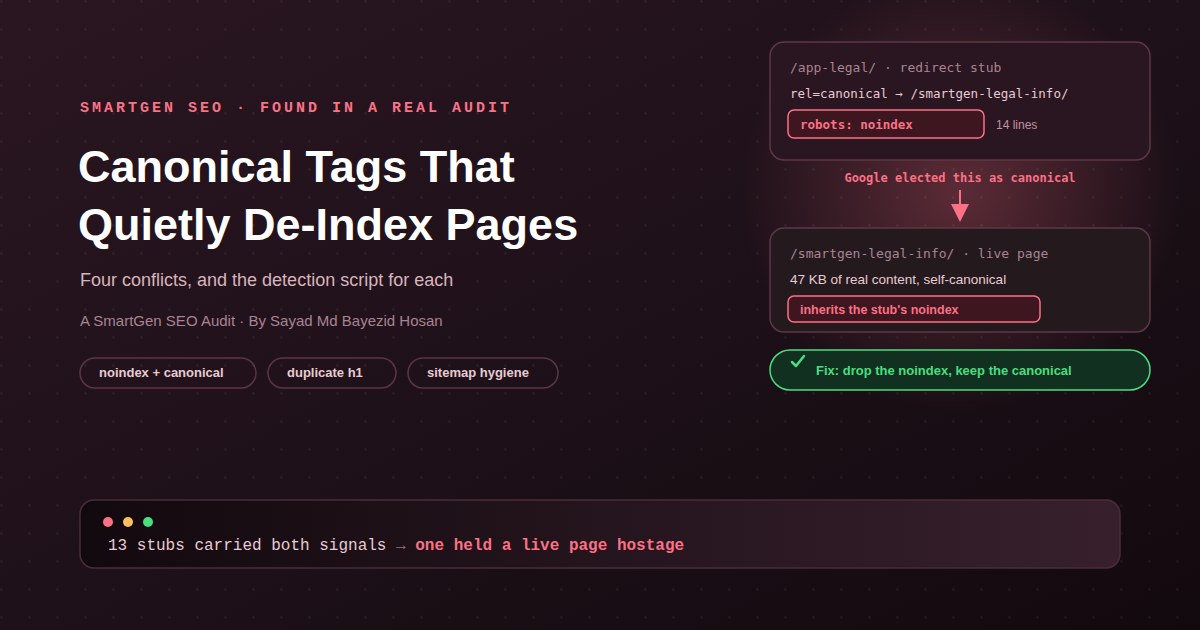
A canonical tag is a hint, not an instruction — and when it conflicts with another signal on the page, Google resolves the conflict in ways that can drop a working page out of the index. The most dangerous version: a redirect stub carrying both a canonical tag and noindex. If Google elects that stub as the canonical for the cluster, it applies the stub's noindex to every page in the cluster, including the real one.
We found four distinct canonical conflicts in a single audit of our own site. One of them had a 47 KB legal page hanging off a fourteen-line redirect stub marked noindex. This article walks through all four — what each looks like in Search Console, why it happens, and the detection query for finding it on your own site.
📖 Table of Contents
- Why canonical bugs are so hard to notice
- Conflict 1: noindex on the URL Google elected
- Conflict 2: a self-canonical pointing at index.html
- Conflict 3: two self-canonical pages, one h1
- Conflict 4: canonicalised pages sitting in the sitemap
- The detection script
- The regex trap that cost us a day
- Reading Search Console's canonical verdicts
- A canonical does nothing until the next crawl
- FAQ
Why canonical bugs are so hard to notice
Every other technical SEO fault announces itself. A broken link 404s. A slow page shows up in Core Web Vitals. A missing title is visible in the browser tab.
A canonical conflict does none of that. The page loads perfectly. It looks right to every visitor. It passes most automated audits, because the tag is present and syntactically valid — the audit has no opinion on whether the URL inside it is the right one, or whether it contradicts a noindex three lines above.
You find out when traffic to a page quietly stops, or when you inspect the URL and Google tells you it picked something else. Which is exactly what happened to us.
Conflict 1: noindex on the URL Google elected
Search Console reports: Duplicate, Google chose different canonical than user
Our page /smartgen-legal-info/ is a real 47 KB legal and trust page. It declares itself canonical. Straightforward.
Then the URL Inspection API said this:
url:                /smartgen-legal-info/
coverage:           Duplicate, Google chose different canonical than user
Google's canonical: /app-legal/
User canonical:     /smartgen-legal-info/
last crawled:       2026-08-17
Google picked /app-legal/ — the old address. And here is what /app-legal/ contained:
<title>Page moved | SmartGen</title>
<meta http-equiv="refresh" content="0; url=https://smartgentools.com/smartgen-legal-info/">
<link rel="canonical" href="https://smartgentools.com/smartgen-legal-info/">
<meta name="robots" content="noindex, follow">
<script>location.replace("https://smartgentools.com/smartgen-legal-info/");</script>
Read that carefully. The stub is textbook-correct on its own terms — meta refresh, canonical pointing forward, JS redirect. Every signal says "the real page is over there."
But it also says noindex. And Google chose this URL as the cluster's canonical.
Why that is dangerous
When Google elects a canonical for a group of duplicate URLs, it treats that URL as the representative of the whole group — including its indexing directives. A noindex on the elected canonical is therefore a noindex on the cluster. Google's own documentation is explicit that noindex and rel=canonical are contradictory signals and should not be combined: one says "do not index this," the other says "consolidate this into that." You are asking for two incompatible things.
The realistic worst case is not that the stub gets indexed. It is that a 47 KB page you care about disappears because of a fourteen-line file you forgot existed.
The fix
Remove the noindex. Keep everything else.
<title>Page moved | SmartGen</title>
<meta http-equiv="refresh" content="0; url=https://smartgentools.com/smartgen-legal-info/">
<link rel="canonical" href="https://smartgentools.com/smartgen-legal-info/">
<script>location.replace("https://smartgentools.com/smartgen-legal-info/");</script>
Three unambiguous "go elsewhere" signals remain, and none of them needed noindex to work. The worst outcome now is Google indexing a stub that says "this page has moved" — mildly untidy, and infinitely better than losing the real page.
We found 13 stubs in this exact shape across the site. If you serve from a static host and cannot issue real 301s, you almost certainly have some too.
Rule: on a redirect stub, use
rel=canonicalornoindex— never both. If the page redirects, the canonical is the right tool, because you want the signals consolidated rather than discarded.
Conflict 2: a self-canonical pointing at index.html
Search Console reports: usually nothing — Google silently overrules you
Our library hub at /html-code-library/ declared:
<link rel="canonical" href="https://smartgentools.com/html-code-library/index.html">
Both addresses serve the same file. But they are two different URLs, and the page was telling Google to prefer the uglier one — the one nothing links to, that no visitor ever types, and that appears nowhere in the sitemap.
Google had already overridden it and picked the clean directory form. The inspection showed the disagreement plainly:
Google's canonical: /html-code-library/
User canonical:     /html-code-library/index.html
No error, no warning. Just Google quietly deciding you were wrong.
Why it still matters even when Google guesses right: you are relying on Google to correct you. Consolidation is slower and less certain when the strongest signal on the page contradicts every other signal. And on a page where Google has less context, it may not correct you.
The fix is a one-line change to match the URL your links and sitemap actually use:
<link rel="canonical" href="https://smartgentools.com/html-code-library/">
Pick one form site-wide — trailing slash or index.html, www or bare, http or https — and make the canonical, the sitemap, and your internal links all agree.
Conflict 3: two self-canonical pages sharing one h1
Search Console reports: nothing at all. This one is invisible.
We ran a duplicate sweep across all 412 HTML files. Titles: zero duplicates. Meta descriptions: zero. Body content: zero. But <h1> turned up one pair:
"CSS Gradient Generator"
   /css-gradient-generator/
   /html-code-library/gradient-generator.html
Two pages, same heading, same job, both declaring themselves canonical. Nothing in Search Console flags this, because from Google's perspective nothing is wrong — you have simply published two pages competing for one query and told Google to treat both as originals.
The performance data settled which one to keep:
| URL | Impressions | Clicks | Avg. position |
|---|---|---|---|
/css-gradient-generator/ |
15 | 1 | 50.3 |
/html-code-library/gradient-generator.html |
0 | 0 | — |
Let the data pick the winner, not your intuition about which page is "better." The library version had the nicer interface. It also had nothing to show for it after 90 days. The library copy now canonicalises to the standalone tool.
To find these on your own site, compare <h1> text — not titles. Titles are usually written with enough variation to look unique while the pages underneath target the identical query. The <h1> is where cannibalisation shows itself honestly.
Conflict 4: canonicalised pages sitting in the sitemap
Search Console reports: Alternate page with proper canonical tag
This one is not harmful so much as wasteful, and it inflates your not-indexed count until you cannot see the real problems.
Your sitemap is a list of URLs you are asking Google to index. A page that canonicalises elsewhere is a URL you have already told Google not to index. Submitting it asks Google to crawl a URL so it can be told to go somewhere else. Google files the result under "Alternate page with proper canonical tag," and your report fills with entries that look like failures but are working as designed.
We also found six standalone redirect stubs in our sitemap. Our generator did check for redirects — but only on paths ending in /index.html, so a standalone .html redirect walked straight through:
# The bug: only folder-style URLs were checked
if relative_path.endswith('/index.html') and relative_path != 'index.html':
    if 'http-equiv="refresh"' in head:
        continue

# The fix: check every .html file, then check the canonical too
if 'http-equiv="refresh"' in head:
    continue

if declared_canonical and declared_canonical.rstrip('/') != own_url.rstrip('/'):
    continue
Two rules for a clean sitemap: every URL in it returns 200, and every URL in it is self-canonical. Nothing else belongs there. Removing seven URLs from ours cost nothing — every canonical target was already listed.
The detection script
Here is the checker we now run before every deploy. It finds all four conflicts in one pass, needs only Python's standard library, and runs against your built files.
import re, glob, os

SITE = 'https://smartgentools.com'

def canonical_of(html):
    """Find rel=canonical without assuming attribute order."""
    for tag in re.findall(r'<link\b[^>]*>', html):
        if re.search(r'rel\s*=\s*["\']canonical["\']', tag, re.I):
            href = re.search(r'href\s*=\s*["\']([^"\']+)["\']', tag)
            return href.group(1) if href else None
    return None

problems, h1_map = [], {}

for path in sorted(glob.glob('**/*.html', recursive=True)):
    if 'node_modules' in path:
        continue
    html = open(path, encoding='utf-8', errors='ignore').read()

    own = f"{SITE}/" + path.replace('index.html', '')
    canon      = canonical_of(html)
    is_noindex = bool(re.search(r'name="robots"[^>]*noindex', html, re.I))
    redirects  = 'http-equiv="refresh"' in html[:3000]

    # 1. noindex + canonical on the same page
    if is_noindex and canon:
        problems.append(('noindex + canonical', path, canon))

    # 2. self-canonical naming a different spelling of itself
    if canon and canon.rstrip('/').endswith('/index.html'):
        if canon.rstrip('/')[:-len('/index.html')] == own.rstrip('/'):
            problems.append(('canonical points at own index.html', path, canon))

    # 3. duplicate h1 among self-canonical pages
    if not redirects and not is_noindex and (not canon or canon.rstrip('/') == own.rstrip('/')):
        h1 = re.search(r'<h1[^>]*>(.*?)</h1>', html, re.S)
        if h1:
            text = re.sub(r'\s+', ' ', re.sub(r'<[^>]+>', '', h1.group(1))).strip()
            h1_map.setdefault(text, []).append(own)

    # 4. in the sitemap but canonicalising elsewhere
    if canon and canon.rstrip('/') != own.rstrip('/') and os.path.exists('sitemap.xml'):
        if own.rstrip('/') in open('sitemap.xml', encoding='utf-8').read():
            problems.append(('in sitemap but canonicalises away', path, canon))

for kind, path, canon in problems:
    print(f'{kind:<38} {path}\n{"":<38} -> {canon}')

for text, urls in h1_map.items():
    if len(urls) > 1:
        print(f'duplicate h1: "{text}"')
        for u in urls:
            print(f'{"":<38} {u}')
Run it from your project root after a build. On a clean site it prints nothing.
The regex trap that cost us a day
This deserves its own section, because it is the single most likely reason your canonical audit is lying to you.
Our first version of the checker reported 78 pages with no canonical tag at all. We nearly spent a day adding tags to all of them. Every one of those pages already had a correct canonical.
The bug was in the pattern:
# WRONG — assumes rel comes before href
re.search(r'<link[^>]*rel="canonical"[^>]*href="([^"]+)"', html)
That matches only when rel appears before href. Many build tools, formatters and CMS templates emit attributes alphabetised, which puts href first:
<link href="https://example.com/page/" rel="canonical">
Both forms are equally valid HTML. Attribute order carries no meaning. But the regex above matches the first and silently misses the second — and "silently" is the problem, because a zero result reads like a clean bill of health.
Parse the tag first, then read its attributes, exactly as canonical_of() above does. Any checker that assumes attribute order will eventually lie to you, and it will lie in the direction that looks like good news.
Reading Search Console's canonical verdicts
Four coverage states relate to canonicals. They mean genuinely different things:
| Search Console says | What it means | Action |
|---|---|---|
| Duplicate, Google chose different canonical than user | Google saw your canonical and overruled it | Check the elected URL for noindex first, then work out why Google prefers it |
| Alternate page with proper canonical tag | Working correctly — this is a duplicate consolidating properly | None. Remove it from your sitemap if it is in there |
| Duplicate without user-selected canonical | You never declared one, so Google picked | Add a self-referencing canonical |
| Duplicate, submitted URL not selected as canonical | You put it in the sitemap and Google chose another | Either fix the sitemap or accept Google's choice |
The first and the last are the ones to investigate. The second is a healthy state that people routinely "fix" into a problem.
When Google overrules you, it is often right. Before forcing your preference, ask whether the URL Google chose has more internal links, more external links, or an older history. Sometimes the correct fix is to adopt Google's choice as your declared canonical.
A canonical does nothing until the next crawl
The last thing worth understanding, because it explains why your fixes appear not to work.
One of our pages had a canonical added on 7 August. Google's inspection of it, run on 17 August, reported:
Google's canonical: itself
User canonical:     (empty)
Last crawled:       2026-07-02
Google reports no user canonical because at the last crawl there was none. The tag is correct in the HTML and completely invisible to Google until it fetches the page again.
There is a nasty second-order effect here. That page is excluded from the sitemap — correctly, because it canonicalises elsewhere. But being out of the sitemap means Google has less reason to re-crawl it, so the canonical takes longer to register. Deliberately de-prioritising a page slows down every future change you make to it.
Practical consequences:
- Fix canonicals before you remove pages from the sitemap, not after.
- After a canonical change, check
lastCrawlTimebefore concluding the fix failed. - On a low-authority site, expect weeks. Ours had gone six weeks without a re-crawl on some URLs.
FAQ
Is a canonical tag a directive or a hint?
A hint. Google weighs it against internal links, external links, sitemap membership, redirects and content similarity, then picks. noindex and robots.txt, by contrast, are directives. That difference is why a canonical can be overruled and a noindex cannot.
Can I use noindex and canonical together?
You should not. They ask for contradictory outcomes — one says do not index this page, the other says fold this page's signals into another. Google's documentation advises against combining them, and the failure mode is exactly the one in Conflict 1: if Google elects the noindex URL as canonical, the whole cluster can be suppressed.
Should every page have a self-referencing canonical?
Yes, as a default. It costs nothing and removes ambiguity when a page is reachable through tracking parameters, alternate casing, or both slash forms. Every page on our site is either self-canonical or deliberately canonicalised elsewhere; none is left undeclared.
Trailing slash or index.html?
Whichever you pick, be consistent. /page/ and /page/index.html are different URLs to Google even though the server returns identical bytes. The trailing-slash form is the more common convention and the one visitors and links actually use.
Does a canonical pass link equity?
Yes — consolidating signals is the whole point. A canonicalised duplicate passes its accumulated signals to the target, which is precisely why canonical beats noindex for duplicate handling: noindex discards those signals instead.
How long until a canonical change takes effect?
Until the next crawl of the source page, then a further re-evaluation. On a well-crawled site, days. On a low-authority site, weeks — one of ours went six weeks between crawls. Check lastCrawlTime before assuming the change did not work.
Can two pages both canonicalise to each other?
They can be written that way, and Google will disregard the loop and choose one itself. Cross-canonicals are a bug, not a strategy. Pick a single target and point everything at it.
Key Takeaways
- Never combine
noindexwithrel=canonical. If Google elects thenoindexURL as the cluster canonical, it can suppress the live page. We found 13 stubs in this shape. - Canonicalise to the URL your links actually use. A self-canonical naming your own
index.htmlvariant invites Google to treat two spellings as two URLs. - Compare
<h1>text, not titles, to find cannibalisation. Titles get varied enough to look unique while the pages underneath fight for one query. - A sitemap holds self-canonical, 200-returning URLs only. Anything else fills your coverage report with entries that look like failures.
- Parse the tag before reading its attributes. A regex assuming
relprecedeshrefreports a clean site that is not clean. - Nothing takes effect until the next crawl, and pages you hide from the sitemap get re-crawled last.
Further Reading
- Google: Consolidate duplicate URLs
- Google: Block indexing with noindex
- Google Search Central: Page indexing report
- SmartGen SEO Audit Tool — checks canonicals, titles and headings free, no signup
- SmartGen SERP Preview Tool — see the snippet Google will actually show for the URL you kept
— Written by Sayad Md Bayezid Hosan for the SmartGen blog
 ✓
✓
Sayad Md Bayezid Hosan
Founder & Tech Entrepreneur | Full-Stack Developer
Full-stack Web Developer, Digital Marketing Strategist, and Tech Entrepreneur with 5+ years of experience delivering innovative digital solutions. Specializing in web development, AI integration, strategic digital marketing, and tech entrepreneurship. As a leading Tech Provider, I help audiences navigate digital platforms safely through permission-based technical solutions and digital business asset management.
Credentials & Expertise:
- Founder of CWB Agency & GenZFrontier
- Final-year English Student at Northern University Bangladesh
- Specialized in AI-powered web development & content strategy
- Published author on tech, digital marketing & entrepreneurship
Read related :
- Discovered — Currently Not Indexed: What 314 Inspected URLs Showed
- Technical SEO Optimization: The Complete Guide
- On-Page SEO Optimization: The Complete Guide
- The Ultimate Guide to Sitemaps
Every conflict in this article was found on smartgentools.com and fixed in this pull request. Part of the SmartGen SEO series.