
July 19, 2026 • General • By Sayad Md Bayezid Hosan
AEO, GEO & AI Overviews: The Real 2026 Guide
Most "AEO" and "GEO" guides published this year are built on guesswork — tactics repeated from blog to blog with no actual source behind them. On July 10, 2026, Google Search Central quietly published something different: an official, direct guide on optimizing for its generative AI search features, including a section specifically debunking several of the most common tactics circulating online. This guide walks through what that official documentation actually says, why AI-driven search has become impossible to ignore in 2026, and exactly what to do about it — separated clearly from what you can stop worrying about.
What You'll Cover
- What Are AEO, GEO, and AI Overviews?
- Why This Matters Right Now
- Where Do You Actually Stand? A 60-Second Self-Check
- What Google Actually Says: RAG and Query Fan-Out
- The Content Principle That Matters Most
- Technical Requirements for AI Eligibility
- Myths vs. Reality: What You Can Stop Worrying About
- How to Measure Your AI Search Visibility
- Your First 30 Days: A Sequenced Action Plan
What Are AEO, GEO, and AI Overviews? {#definitions}
Answer Engine Optimization (AEO) and Generative Engine Optimization (GEO) are the two terms the industry uses to describe the practice of shaping content so it gets surfaced, summarized, or cited by AI-powered search experiences — Google's AI Overviews and AI Mode, plus AI assistants like ChatGPT, Perplexity, and Gemini. The two terms are used almost interchangeably across the industry, with no settled distinction between them.
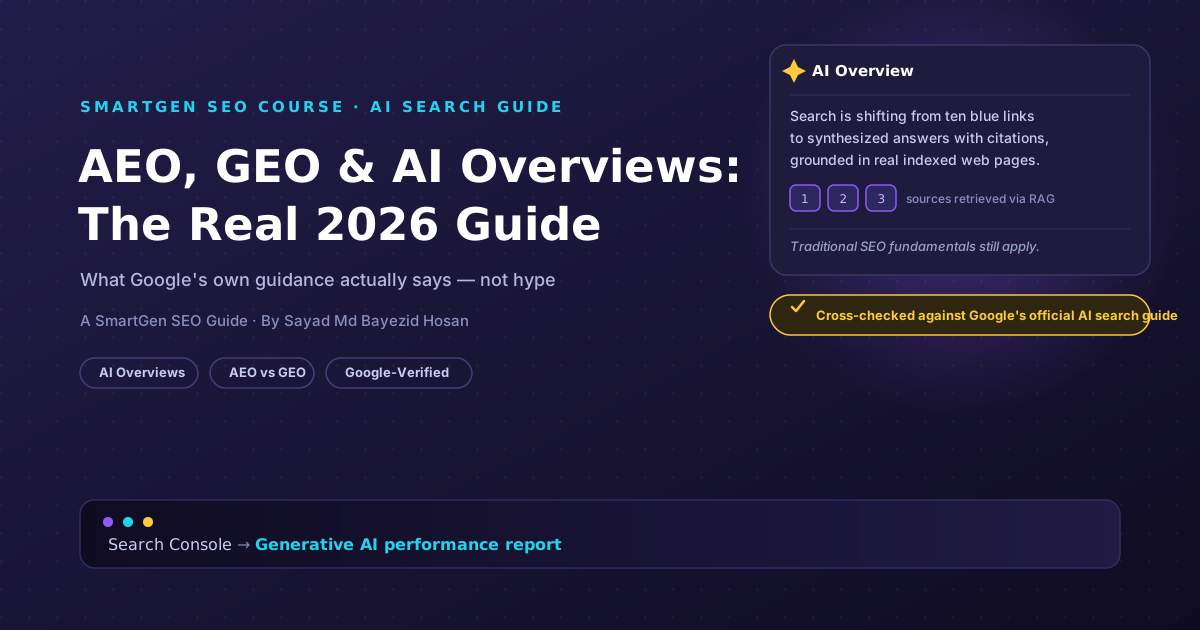
AI Overviews are the AI-generated summary boxes Google now shows directly on the search results page for a large share of queries, synthesizing information from multiple sources into a single answer with citation links, positioned above the traditional list of ranked web pages.
Here's the detail most third-party guides leave out: Google's own developer documentation states plainly that from its perspective, optimizing for these AI features is simply optimizing for the search experience — in other words, it's still the same discipline covered in our Search Engine Optimization guide, not a separate rulebook with its own rules. That single distinction is the foundation this entire guide is built on.
Why This Matters Right Now {#why-it-matters}
The numbers explain why every SEO conversation in 2026 eventually turns to this topic. AI Overviews now appear in roughly one in every four Google searches overall, and on more than half of longer, more specific search queries. Separately reported analysis has found that when an AI Overview appears above a page that would otherwise rank first, that page's click-through rate can fall dramatically compared to a normal top-ranking result. On top of that, a meaningful share of research and comparison-shopping activity has simply moved to AI assistants directly — ChatGPT alone reportedly processes billions of prompts daily, a large share of which function as search queries in their own right.
None of this means organic search traffic is disappearing. It means the destination for a click has multiplied: a well-optimized page can now earn visibility through a traditional ranking, an AI Overview citation, or a direct mention inside an AI assistant's answer — three distinct opportunities that used to be one.
Where Do You Actually Stand? A 60-Second Self-Check {#self-check}
Before working through the rest of this guide, answer these five questions honestly about your best-performing page. This takes less time than reading the next section, and it tells you exactly where to focus first.
- Your top page includes at least one detail — a number, an outcome, a specific decision — that only comes from actually doing the thing, not from reading three competitor articles. (Yes / No)
- You've personally checked that page's index status in Search Console within the last month, rather than assuming it's fine because it was fine once. (Yes / No)
- You can name two realistic follow-up questions a reader would have right after reading your main topic — and your site answers them somewhere, even briefly. (Yes / No)
- You've opened the Generative AI performance report in Search Console at least once. (Yes / No)
- If your brand name were removed from the page, a reader could still tell it was written by someone who's actually done this — not summarized from elsewhere. (Yes / No)
Scoring:
| "Yes" answers | What it means |
|---|---|
| 4–5 | You're ahead of most sites already. Skip straight to the technical audit and measuring visibility — that's where your remaining gains are. |
| 2–3 | Solid foundation, real gaps. Start with the non-commodity rewrite exercise below — it's almost certainly your highest-leverage fix. |
| 0–1 | Start with The Content Principle That Matters Most before anything else in this guide. Everything downstream of content quality is optimization on a weak foundation otherwise. |
What Google Actually Says: RAG and Query Fan-Out {#how-it-works}
Understanding two mechanisms from Google's own documentation makes the rest of this guide make sense.
Retrieval-Augmented Generation (RAG), sometimes called grounding, is the technique Google's AI features use to stay accurate and current. Rather than generating an answer purely from what the underlying model already "knows," the system retrieves relevant, up-to-date pages from Google's actual search index first, then builds its response from that specific retrieved content — which is also why AI Overviews show clickable source links: the answer is built directly from those pages, not invented independently of them.
Query fan-out is what happens before that retrieval step. Rather than searching only the exact words someone typed, Google's systems generate several related sub-queries around the original question and search each one. Google's own example is a search for how to deal with a weed-filled lawn: the system might separately search for the best herbicides, chemical-free removal methods, and prevention techniques, then pull relevant results from each. The practical implication is significant — a page doesn't need to rank first for a broad head term to get cited; it can earn a citation by being the best answer to one of the several sub-questions the system generates around a topic.
Try It Yourself: Manual Fan-Out in 5 Minutes
Take your own main keyword and do this exercise on paper before reading further. Using "best free SEO tools" as a worked example, a system generating fan-out queries around it would plausibly search things like:
- "free SEO tools vs paid SEO tools"
- "are free SEO tools accurate enough for real use"
- "free SEO tools with no sign-up required"
- "free SEO tools for a small business with no budget"
Now open your own top-ranking page for your main keyword and check, honestly: does it answer any of these adjacent questions, or does it only address the exact head term it was written for? If it only covers the head term, it's invisible to every one of these nearby variations — even though a reader typing any of them is looking for essentially the same thing you already wrote about. This is usually the fastest content gap to find and the fastest one to close, often with a single added section rather than a whole new page.
The Content Principle That Matters Most {#non-commodity-content}
If there's one idea from Google's official guidance worth remembering above everything else in this article, it's the distinction between commodity content and non-commodity content.
Commodity content is built from common knowledge — information that could have come from anywhere, written by anyone, adding no real new insight. Google's own example contrasts a generic "7 Tips for First-Time Homebuyers" listicle against a much narrower, experience-based piece about waiving a home inspection and what that decision actually revealed once the sale closed. The second version reflects a genuine, specific point of view; the first could be produced by nearly any writer, including an AI model itself.
This matters enormously for AEO and GEO specifically, because retrieval-based AI systems are pulling from a huge pool of competing pages that all say roughly the same thing. A page with a first-hand perspective, direct experience, or a genuinely distinct angle has something to actually retrieve and cite. A page that restates widely available information has nothing unique to offer the system — it's redundant with dozens of other sources saying the same thing.
Beyond originality, Google's guidance also emphasizes writing for human readers first: organizing content into clear paragraphs and sections with headings that make the structure easy to follow, and supporting text with genuinely relevant images or video where they add real value. None of this is new SEO advice — it's the same "helpful, reliable, people-first content" standard Google has emphasized for years, now confirmed as directly relevant to AI-driven search as well.
A Real Before/After: Turning Commodity Into Non-Commodity
Abstract advice is hard to apply. Here's the actual transformation, using a topic close to home — choosing a WordPress SEO plugin.
Before (commodity — could be written by anyone who's never installed either plugin):
Choosing the right SEO plugin for WordPress is important for your site's visibility. Popular options include Yoast SEO and Rank Math. Both offer features like XML sitemaps, meta tag editing, and readability analysis. Install the plugin, run the setup wizard, and connect it to Google Search Console.
After (non-commodity — reflects actual use):
We moved roughly 40 client sites from Yoast to Rank Math between 2024 and 2026, and the feature that actually mattered wasn't on either plugin's marketing page: Rank Math's built-in redirect manager meant we stopped needing a second plugin just to handle URLs breaking after a site restructure. The one place Yoast still wins outright — its readability check catches passive-voice patterns that Rank Math's version regularly misses, which matters if you're training junior writers. Stable URL structure and a solo workflow: the difference won't matter. Restructure content often or manage a team: that redirect manager alone justifies switching.
Notice exactly what changed: a specific number (40 sites) and timeframe, a genuine tradeoff explained with reasoning instead of a feature list, a detail that's only demonstrable through direct use (the readability check nuance), and a conditional recommendation based on the reader's actual situation instead of one answer for everyone.
Run this against your own top three pages right now:
- Does it contain a number, outcome, or detail that only exists because you actually did the thing?
- Could a competitor who never touched your product write this exact paragraph from three other articles?
- Does it tell a reader what to do differently depending on their situation, or does it give one generic answer to everyone?
If most of your answers point toward "generic," that page is commodity content today — and it's the single highest-leverage fix available anywhere in this guide.
Technical Requirements for AI Eligibility {#technical-requirements}
Before content can earn an AI citation, it has to clear the same technical bar as ordinary search visibility, since generative AI features draw from Google's regular search index rather than a separate system. A page needs to be properly indexed and eligible to display with a normal search snippet, which comes down to the same fundamentals covered in a complete technical SEO walkthrough: crawlable content, a clean site structure, solid page experience, and minimal duplicate content.
A few specifics worth calling out directly: content needs to be publicly crawlable, since Google's AI systems learn from and cite publicly accessible pages rather than anything gated or blocked. Semantic HTML is worth using where practical — not because imperfect code disqualifies a page (Google is explicit that the web at large isn't perfectly valid HTML and that's fine), but because well-structured markup helps other readers too, including assistive technology like screen readers. Sites built with JavaScript should still follow standard JavaScript SEO practices, since generative features rely on the same crawling and rendering pipeline as everything else in Search.
A 10-Minute Technical Self-Audit You Can Run Right Now
- Search
site:yourdomain.complus the exact title of your page in Google. If it doesn't show up, indexing — not content quality — is your actual first problem, and no amount of rewriting fixes that until it's resolved. - Open Search Console → URL Inspection, paste the URL, and read the coverage status literally. "Indexed" means it's eligible to appear. "Discovered — currently not indexed" or "Crawled — currently not indexed" both mean Google has seen it but chosen not to include it — usually a quality or duplication signal worth investigating, not a technical bug to just resubmit past.
- Check for near-duplicate pages on your own site. Two posts quietly targeting almost the same keyword don't double your chances — they split signals between two competing pages and often weaken both. Search your own site for your main keywords and see what comes up.
- Run the page through PageSpeed Insights and note the actual Core Web Vitals scores, not just a pass/fail glance. A page that "loads fine" to you on a fast connection can still fail these thresholds for a meaningful share of real visitors.
Myths vs. Reality: What You Can Stop Worrying About {#myths-vs-reality}
This is where Google's official guidance breaks most sharply from what circulates in AEO and GEO advice online, and it's worth going through each one directly, since these misconceptions are genuinely widespread.
Myth: You need an llms.txt file to be cited by AI. Reality: Google Search does not use llms.txt files or any comparable special AI markup file at all. Creating one won't help or hurt visibility in Google Search — it's simply not part of how the system works, whatever value it might have for other individual AI tools that do choose to read it.
Myth: Content needs to be "chunked" into small pieces for AI to understand it. Reality: there's no requirement to break content apart this way. Google's systems are described as capable of understanding multiple topics within a single page and surfacing the specific relevant portion to a user — meaning page length should be driven by what serves the actual audience, not by a formatting theory about AI comprehension.
Myth: Content has to be rewritten in a special style specifically for AI systems. Reality: these systems are described as understanding synonyms and general meaning well enough that exact keyword phrasing matching every possible way someone might ask a question isn't necessary. Writing naturally, for actual readers, remains the guidance — not writing for a hypothetical AI-parsing checklist.
Myth: Structured data (schema markup) is required to appear in AI features. Reality: it isn't required for generative AI search specifically, and there's no dedicated schema type needed for it. It remains genuinely worth using as part of a broader SEO strategy, since it supports eligibility for other rich results — the point is that it isn't the AI-visibility silver bullet some guides present it as.
Myth: Chasing brand mentions anywhere you can get them boosts AI citations. Reality: seeking out inauthentic mentions across the web for their own sake isn't described as an effective strategy. The same quality and spam systems that govern the rest of Search apply here — genuine, high-quality content and coverage matters; volume of scattered mentions does not.
The throughline across every one of these corrections is the same: there is no special technical trick that substitutes for genuinely good, structurally sound, technically accessible content. That's a less exciting answer than a listicle of "AI hacks," but it's the one actually coming from the source that controls the system in question.
How to Measure Your AI Search Visibility {#measuring-visibility}
Google Search Console includes a dedicated Generative AI performance report, built specifically to show how content is being discovered through AI Overviews and other generative features on Search and Discover — giving a genuine, first-party way to see this data rather than guessing at it.
Third-party AEO and GEO tracking tools exist and can be useful for workflow purposes, but it's worth treating any tool that claims to have special access to Google's internal ranking or AI systems with real skepticism — no outside tool actually has that access. The same standard for evaluating third-party SEO advice generally applies here too: use tools that genuinely help, and weigh their recommendations against official guidance rather than the reverse.
Reading the Report Step by Step
- Go to Search Console → Performance, and use the Search appearance filter to isolate the AI surface data from your regular blue-link performance — this keeps you from misreading one for the other.
- The fields are the same ones you already know: Queries, Pages, Impressions, Clicks, CTR — just scoped specifically to how content is surfacing inside generative features.
- Pattern to watch for — high impressions, near-zero clicks: your content is being retrieved and cited, but the AI answer is already satisfying the reader without a click-through. Sometimes that's simply the nature of the query; sometimes it means the page needs a sharper, more specific reason to click through — the same title-and-snippet discipline covered in our SERP snippet optimization guide applies just as directly here.
- Pattern to watch for — a query you never intentionally targeted: that's a genuine fan-out discovery showing up in real data, not a hypothetical one. Treat it as a validated content gap worth its own section or page.
- Compare month over month, not week over week. This report is newer and the data is noisier at short intervals — a single slow week rarely means anything on its own.
Your First 30 Days: A Sequenced Action Plan {#action-checklist}
Working through every section above in order builds toward this. Rather than a flat list, here's the order that actually compounds:
Week 1 — Audit
- Run the 60-second self-check above
- Run the 10-minute technical audit on your top 3 pages
- Open the Generative AI performance report and record your current baseline numbers
Week 2 — Rewrite One Page
- Pick your single highest-traffic page that scored as "commodity" in the audit
- Apply the before/after rewrite framework to it directly
- Add at least one detail, number, or outcome only you could actually know
Week 3 — Close a Fan-Out Gap
- Run the 5-minute fan-out exercise on your top 3 keywords
- Identify one or two adjacent questions your content currently doesn't answer
- Add a section (or a short new page) that closes that specific gap
Week 4 — Re-Measure and Repeat
- Re-check the Generative AI performance report against your Week 1 baseline
- Note what actually moved — impressions, clicks, or a new query appearing
- Pick your next page and start the cycle again
Two things this plan deliberately does not include: llms.txt files and content "chunking." Skipping both isn't an oversight — it's the direct result of everything Section 6 covered.
Frequently Asked Questions
Is AEO or GEO the "correct" term to use?
There's no settled answer — usage varies by publisher and practitioner, and Google's own documentation treats both as informal labels for the same underlying work, which it simply considers part of SEO.
Do I need a completely separate content strategy for AI search versus regular Google rankings?
No. Based on Google's own guidance, the same foundational practices — genuine expertise, clear structure, technical accessibility — support both traditional rankings and AI feature visibility at the same time, since both draw from the same underlying index and ranking systems.
Will AI Overviews eventually replace traditional search results entirely?
There's no indication of that from Google's own materials. AI features currently sit alongside traditional results rather than replacing them, and traditional ranking eligibility remains a prerequisite for AI feature eligibility in the first place.
Should small websites even bother with this, or is it only relevant for large publishers?
It applies at any size. Since query fan-out means a page can be cited for answering one specific sub-question well rather than needing to dominate a broad head term, a smaller, genuinely specific site can realistically earn a citation that a broader competitor misses.
Are paid AEO/GEO consulting services worth it?
That depends entirely on what they're actually proposing. If a service is promising special access to AI ranking systems or pushing tactics like llms.txt files as essential, that's a clear mismatch with what Google's own documentation says — a reasonable litmus test before paying for any third-party advice in this space.
Everything in this guide traces back to one source that actually controls how AI search visibility works — not another recycled AEO listicle. Apply the fundamentals, skip the manufactured tactics, and keep checking the actual data as it comes in.
— Written by Sayad Md Bayezid Hosan for the SmartGen blog
 ✓
✓
Sayad Md Bayezid Hosan
Founder & Tech Entrepreneur | Full-Stack Developer
Full-stack Web Developer, Digital Marketing Strategist, and Tech Entrepreneur with 5+ years of experience delivering innovative digital solutions. Specializing in web development, AI integration, strategic digital marketing, and tech entrepreneurship. As a leading Tech Provider, I help audiences navigate digital platforms safely through permission-based technical solutions and digital business asset management.
Credentials & Expertise:
- Founder of CWB Agency & GenZFrontier
- Final-year English Student at Northern University Bangladesh
- Specialized in AI-powered web development & content strategy
- Published author on tech, digital marketing & entrepreneurship