
✅ Fact-Checked by Sayad Md Bayezid Hosan — Health & Fitness Researcher, Digital Tool Developer & Founder of SmartGen Tools | Last Updated: June 27, 2026
⚠️ Medical Disclaimer: The information in this article is for educational and informational purposes only. It does not constitute medical advice, diagnosis, or treatment. Always consult a qualified healthcare provider, registered dietitian, or certified fitness professional before making decisions about your diet, exercise, or health. BMI and BMR are screening tools, not diagnostic instruments.
📖 Table of Contents
- What Is BMI? — Complete Definition
- What Is BMR? — Complete Definition
- Why BMI and BMR Are the Two Most Important Health Numbers to Know
- Introducing SmartGen's Free BMI & BMR Calculator
- How to Use the Tool — Step-by-Step
- BMI Formula: How It Is Calculated
- BMI Categories Explained in Depth
- BMR Formula: The Mifflin-St Jeor Equation
- TDEE: From BMR to Your Daily Calorie Target
- How to Use Your BMR for Weight Loss
- How to Use Your BMR for Muscle Gain
- BMI Limitations: What It Does Not Tell You
- Ideal Body Weight Charts by Height
- Common Mistakes When Interpreting BMI & BMR
- FAQ — BMI & BMR Calculator
- Final Health Checklist
🔍 What Is BMI? {#what-is-bmi}
Definition: BMI (Body Mass Index) is a numerical value calculated from a person's height and weight that is used as a screening tool to categorize body weight into ranges associated with health risk. It was developed by Belgian statistician Adolphe Quetelet in the 1830s and was formally adopted by the World Health Organization (WHO) as a population health indicator in the 1990s.
BMI does not directly measure body fat. Instead, it provides an indirect estimate of whether a person's weight is appropriate for their height — and whether that weight may be associated with increased health risks.
In plain terms: BMI is a simple number that tells you whether you weigh too little, an appropriate amount, or too much relative to your height.
The BMI Scale at a Glance
| BMI Range | Category | Health Risk Level |
|---|---|---|
| Below 18.5 | Underweight | Increased risk (nutritional deficiency, bone loss) |
| 18.5 – 24.9 | Normal / Healthy Weight | Lowest risk |
| 25.0 – 29.9 | Overweight | Moderate increased risk |
| 30.0 – 34.9 | Obese — Class I | High risk |
| 35.0 – 39.9 | Obese — Class II | Very high risk |
| 40.0 and above | Obese — Class III (Severe) | Extremely high risk |
Source: World Health Organization (WHO) BMI Classification Standards
🔍 What Is BMR? {#what-is-bmr}
Definition: BMR (Basal Metabolic Rate) is the number of calories your body burns at complete rest over a 24-hour period — the minimum energy required to keep your vital organs functioning. This includes breathing, blood circulation, cell production, temperature regulation, and brain activity.
Think of BMR as your body's idle engine speed — the fuel it consumes just to stay alive, even if you lay in bed and did nothing all day.
Why BMR matters: Every calorie-based health and fitness goal — weight loss, weight gain, maintenance, athletic performance — must be calculated relative to your BMR. Without knowing your BMR, calorie targets are guesswork.
What BMR Includes
Your BMR accounts for energy used by:
- 🫀 Heart — pumping blood continuously
- 🫁 Lungs — breathing automatically
- 🧠 Brain — maintaining consciousness and organ coordination
- 🧬 Cells — producing, repairing, and replacing billions of cells daily
- 🌡️ Thermoregulation — maintaining constant body temperature (37°C / 98.6°F)
- 🔬 Liver and kidneys — filtering blood and processing nutrients
What BMR Does NOT Include
BMR does not account for:
- Physical activity (walking, exercise, sports)
- Digestion and food processing (Thermic Effect of Food — adds ~10% to daily burn)
- Stress, illness, or hormonal fluctuations
- Sleep (slightly lower than waking BMR)
💡 Why BMI and BMR Are the Two Most Important Health Numbers to Know {#why-they-matter}
Most people track their weight on a scale. But your raw weight number tells you almost nothing useful on its own.
- A 180 lb (81 kg) person who is 5'2" (157 cm) has a very different health profile than a 180 lb person who is 6'4" (193 cm).
- Two people with identical weights can have completely different metabolisms, requiring different calorie intakes.
BMI and BMR together give you two critical data points:
- BMI — Am I at a healthy weight for my height right now?
- BMR — How many calories does my body actually need to function?
With these two numbers, you can:
- Set a science-based daily calorie target
- Determine whether a calorie deficit or surplus is appropriate
- Track progress toward a healthy BMI zone
- Plan a diet strategy that is sustainable long-term
- Understand why your current eating habits may or may not be working
The SmartGen BMI & BMR Calculator gives you both numbers instantly, for free, with complete privacy.
🛠️ Introducing SmartGen's Free BMI & BMR Calculator {#introducing-tool}
Tool URL: https://smartgentools.com/bmi-bmr-calculator/
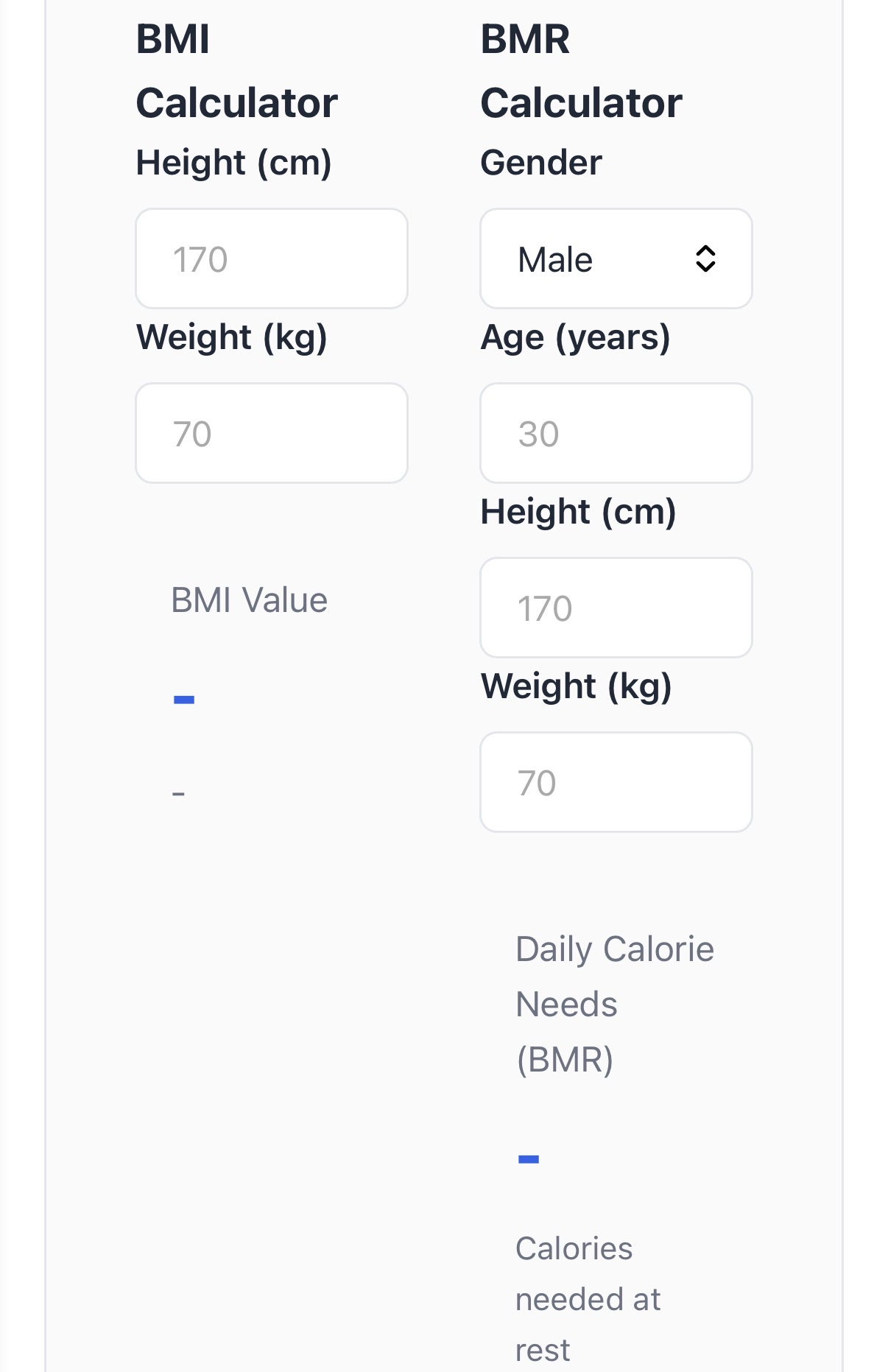
SmartGen's BMI & BMR Calculator is a free, browser-based health tool that calculates your Body Mass Index and Basal Metabolic Rate simultaneously — using clinically accepted formulas — with results delivered instantly and zero data transmission.
What the Tool Calculates
BMI Calculator inputs:
- Height (in centimeters)
- Weight (in kilograms)
kilograms)
BMR Calculator inputs:
- Gender (Male / Female)
- Age (in years)
- Height (in centimeters)
- Weight (in kilograms)
Outputs provided:
- Your exact BMI value
- Your BMI category (Underweight / Normal / Overweight / Obese)
- Your daily calorie needs at rest (BMR in kilocalories)
Why SmartGen's Tool Stands Out
🔒 Zero Data Storage — Your height, weight, age, and gender are never sent to any server. All calculations happen locally in your browser. Medical data privacy is not a feature — it is the architecture.
⚡ Instant Results — No loading spinners. No "calculating..." screens. Results appear the moment you enter your values.
🆓 Permanently Free — No premium features, no subscription, no account. Open and use, always.
📱 Works on All Devices — Phone, tablet, laptop, desktop. The interface adjusts perfectly to every screen size.
✅ Clinically Accepted Formulas — The tool uses the Mifflin-St Jeor Equation for BMR (the most accurate formula for the general population according to the American Dietetic Association) and the standard WHO BMI formula.
🚀 How to Use the SmartGen BMI & BMR Calculator {#how-to-use}
Calculating Your BMI (3 Steps)
Step 1 — Enter your height in centimeters
If you know your height in feet and inches, convert it first:
| Height (ft & in) | Height (cm) |
|---|---|
| 5'0" | 152.4 cm |
| 5'2" | 157.5 cm |
| 5'4" | 162.6 cm |
| 5'6" | 167.6 cm |
| 5'8" | 172.7 cm |
| 5'10" | 177.8 cm |
| 6'0" | 182.9 cm |
| 6'2" | 187.9 cm |
Step 2 — Enter your weight in kilograms
If you know your weight in pounds, divide by 2.205:
- 120 lbs ÷ 2.205 = 54.4 kg
- 150 lbs ÷ 2.205 = 68.0 kg
- 180 lbs ÷ 2.205 = 81.6 kg
- 200 lbs ÷ 2.205 = 90.7 kg
Step 3 — Read your BMI result
The tool instantly displays your BMI value and your category label with a color indicator (underweight, normal, overweight, or obese).
Calculating Your BMR (5 Steps)
Step 1 — Select your gender (Male or Female)
Step 2 — Enter your age in years
Step 3 — Enter your height in centimeters
Step 4 — Enter your weight in kilograms
Step 5 — Read your BMR result, shown in kilocalories per day — this is your body's minimum daily calorie requirement at complete rest.
📐 BMI Formula: How It Is Calculated {#bmi-formula}
The BMI Formula (Metric):
BMI = Weight (kg) ÷ Height (m)²
Step-by-step example:
Person: 70 kg weight, 175 cm height
- Convert height to meters: 175 cm ÷ 100 = 1.75 m
- Square the height: 1.75 × 1.75 = 3.0625
- Divide weight by height squared: 70 ÷ 3.0625 = 22.9
- BMI = 22.9 → Normal / Healthy Weight ✅
The BMI Formula (Imperial — Pounds and Inches):
BMI = (Weight in lbs × 703) ÷ Height in inches²
Step-by-step example:
Person: 154 lbs, 5'9" (69 inches)
- Square the height: 69 × 69 = 4,761
- Multiply weight by 703: 154 × 703 = 108,262
- Divide: 108,262 ÷ 4,761 = 22.7
- BMI = 22.7 → Normal / Healthy Weight ✅
The SmartGen tool handles this calculation automatically — no math required on your part.
📊 BMI Categories Explained in Depth {#bmi-categories}
🔵 Underweight — BMI Below 18.5
A BMI below 18.5 indicates that a person weighs less than what is generally considered healthy for their height.
Potential health implications of being underweight:
- Nutritional deficiencies (iron, vitamin D, calcium, B12)
- Weakened immune system (more frequent illness)
- Reduced bone density and increased fracture risk
- Muscle loss and fatigue
- Hormonal disruptions (particularly in women — irregular menstrual cycles)
- Increased risk during surgery or illness recovery
Important note: Being underweight can result from genetics, eating disorders (anorexia, bulimia), malabsorption conditions (celiac disease, Crohn's), or medical conditions (hyperthyroidism, cancer). A BMI below 17.5 warrants medical evaluation.
🟢 Normal / Healthy Weight — BMI 18.5 to 24.9
A BMI within this range is associated with the lowest overall risk of weight-related health problems in population studies. This is the target zone most health guidelines aim to maintain.
What "normal BMI" does NOT guarantee:
- It does not mean you are physically fit (a sedentary person can have a normal BMI)
- It does not mean your body fat percentage is healthy (see BMI Limitations section)
- It does not eliminate risk of other health conditions unrelated to weight
🟡 Overweight — BMI 25.0 to 29.9
A BMI in this range indicates body weight moderately above the healthy range. Research consistently associates sustained overweight BMI with:
- Elevated LDL cholesterol and triglycerides
- Increased blood pressure risk
- Higher likelihood of developing Type 2 diabetes
- Increased joint stress (particularly knees and hips)
- Elevated risk of sleep apnea
However, BMI in the overweight range does not automatically mean poor health — context matters greatly (see limitations section below).
🟠 Obese Class I — BMI 30.0 to 34.9
At this range, the association between BMI and chronic disease risk strengthens significantly. Research links Class I obesity to:
- 2–4× higher risk of Type 2 diabetes
- Increased cardiovascular disease risk
- Non-alcoholic fatty liver disease (NAFLD)
- Elevated cancer risk (certain types including colorectal and breast)
- Reduced life expectancy (on average 3–10 years, varying by study)
🔴 Obese Class II — BMI 35.0 to 39.9
Class II obesity is associated with substantially elevated risk across nearly all chronic disease categories, and is often the threshold at which healthcare providers discuss medical intervention alongside lifestyle changes.
🔴 Obese Class III (Severe/Morbid Obesity) — BMI 40.0 and Above
Class III obesity carries the highest weight-associated disease burden and significantly elevated mortality risk. It is associated with:
- Severe cardiovascular complications
- Uncontrolled Type 2 diabetes
- Respiratory failure risk
- Significantly reduced mobility and quality of life
At this range, medical supervision for weight management is strongly recommended.
🧮 BMR Formula: The Mifflin-St Jeor Equation {#bmr-formula}
Definition: The Mifflin-St Jeor Equation is the most widely accepted formula for calculating Basal Metabolic Rate in healthy adults. It was developed and validated in 1990 by Mifflin and St Jeor and was endorsed by the American Dietetic Association as the most accurate BMR predictor for both obese and non-obese individuals.
The Formula
For Men:
BMR = (10 × weight in kg) + (6.25 × height in cm) − (5 × age in years) + 5
For Women:
BMR = (10 × weight in kg) + (6.25 × height in cm) − (5 × age in years) − 161
Worked Example — Male
Person: Male, 30 years old, 175 cm, 80 kg
BMR = (10 × 80) + (6.25 × 175) − (5 × 30) + 5
BMR = 800 + 1,093.75 − 150 + 5
BMR = 1,748.75 calories/day
This man needs approximately 1,749 calories per day just to maintain basic organ function at rest.
Worked Example — Female
Person: Female, 28 years old, 162 cm, 60 kg
BMR = (10 × 60) + (6.25 × 162) − (5 × 28) − 161
BMR = 600 + 1,012.5 − 140 − 161
BMR = 1,311.5 calories/day
This woman needs approximately 1,312 calories per day at complete rest.
Why Different Formulas Give Different Results
Several BMR formulas exist. Here is how the most common ones compare:
| Formula | Year | Best Used For | Accuracy |
|---|---|---|---|
| Mifflin-St Jeor | 1990 | General adult population | Highest — ±10% for most people |
| Harris-Benedict (Revised) | 1984 | General population | Slightly less accurate than Mifflin |
| Katch-McArdle | 1975 | Athletes with known body fat % | Most accurate when body fat is known |
| Schofield | 1985 | Children and adolescents | Best for under-18 |
SmartGen uses the Mifflin-St Jeor formula — the gold standard for general-population accuracy.
📈 TDEE: From BMR to Your Real Daily Calorie Need {#tdee}
Your BMR is your calorie need at complete rest. But almost nobody is completely at rest all day. Your TDEE (Total Daily Energy Expenditure) adjusts your BMR for your actual activity level.
TDEE Formula:
TDEE = BMR × Activity Multiplier
Activity Multipliers
| Activity Level | Description | Multiplier |
|---|---|---|
| Sedentary | Desk job, little or no exercise | BMR × 1.2 |
| Lightly Active | Light exercise 1–3 days/week | BMR × 1.375 |
| Moderately Active | Moderate exercise 3–5 days/week | BMR × 1.55 |
| Very Active | Hard exercise 6–7 days/week | BMR × 1.725 |
| Extremely Active | Physical job + twice-daily training | BMR × 1.9 |
Worked Example — TDEE Calculation
Person: The 30-year-old male from above — BMR = 1,749 cal/day
He works at a desk but goes to the gym 3 times per week → Moderately Active
TDEE = 1,749 × 1.55 = 2,711 calories/day
He must eat approximately 2,711 calories per day to maintain his current weight. Eating below this number causes weight loss; eating above it causes weight gain.
⬇️ How to Use Your BMR for Weight Loss {#bmi-weight-loss}
The fundamental rule of weight loss:
Calorie Intake < TDEE = Caloric Deficit = Weight Loss
A caloric deficit of 500 calories per day below TDEE results in approximately 0.45 kg (1 lb) of fat loss per week — a rate considered safe and sustainable by most health authorities.
Step-by-Step Weight Loss Calorie Plan
Using the example above (TDEE = 2,711 cal/day):
| Goal | Daily Calories | Expected Loss |
|---|---|---|
| Slow loss (sustainable) | 2,711 − 300 = 2,411 | ~0.27 kg/week |
| Moderate loss (recommended) | 2,711 − 500 = 2,211 | ~0.45 kg/week |
| Aggressive loss | 2,711 − 750 = 1,961 | ~0.68 kg/week |
| Extreme (not recommended) | Below 1,500 | Muscle loss risk |
Critical Weight Loss Rules
Never eat below your BMR — Consuming fewer calories than your BMR causes your body to break down muscle tissue for energy. This lowers your BMR further, making future weight loss harder.
Prioritize protein — During a caloric deficit, protein intake (1.6–2.2g per kg of body weight) helps preserve muscle mass.
Combine deficit with exercise — A 300-calorie diet reduction plus a 200-calorie exercise burn achieves the same 500-calorie deficit with less dietary restriction.
Recalculate every 4–6 weeks — As your weight decreases, your BMR decreases too. Recalculate using the SmartGen tool to adjust your targets.
Do not chase rapid loss — Losing more than 1 kg/week consistently is associated with gallstone formation, nutrient deficiency, and muscle loss.
⬆️ How to Use Your BMR for Muscle Gain {#bmi-muscle-gain}
Building muscle requires a caloric surplus — consistently eating more than your TDEE so your body has excess energy available for muscle protein synthesis.
The fundamental rule of muscle gain:
Calorie Intake > TDEE = Caloric Surplus = Muscle & Weight Gain
Recommended Surplus for Muscle Building
| Goal | Daily Surplus | Expected Gain |
|---|---|---|
| Lean bulk (minimize fat gain) | +200–300 calories above TDEE | ~0.25 kg/week |
| Standard bulk | +400–500 calories above TDEE | ~0.45 kg/week |
| Aggressive bulk | +700+ calories above TDEE | Fat gain increases significantly |
For the example above (TDEE = 2,711):
- Lean bulk target: 2,711 + 250 = 2,961 calories/day
Muscle Gain Nutrition Tips
Protein is non-negotiable — Aim for 1.8–2.2g of protein per kg of body weight daily. Muscle protein synthesis requires adequate amino acid availability.
Strength training is required — A caloric surplus without resistance training primarily produces fat gain, not muscle gain.
Track progress with BMI — Recalculate your BMI every month. If BMI rises too quickly, reduce your surplus.
Allow recovery — Muscle is built during rest, not during exercise. Sleep and rest days are not optional.
⚠️ BMI Limitations: What It Does Not Tell You {#bmi-limitations}
BMI is a useful population-level screening tool, but it has well-documented limitations at the individual level. Understanding these is essential for interpreting your BMI result accurately.
Limitation 1 — BMI Cannot Distinguish Fat from Muscle
A professional bodybuilder with 8% body fat and 100 kg of mass will have the same BMI as a sedentary person of the same height and weight who carries most of that mass as fat. Both would be classified as "obese" by BMI — but only one actually is.
Athletes, weightlifters, and physically active individuals should not rely on BMI alone to assess health.
Limitation 2 — BMI Does Not Reflect Fat Distribution
Where fat is stored on your body matters more than how much you have. Visceral fat (fat stored around internal organs in the abdomen) is far more metabolically dangerous than subcutaneous fat (fat stored under the skin on hips and thighs).
Two people with the same BMI can have drastically different health profiles based on fat distribution. Waist circumference is often a better predictor of metabolic risk than BMI.
- High risk waist circumference: >88 cm (35 inches) for women, >102 cm (40 inches) for men
Limitation 3 — BMI Varies in Accuracy Across Ethnicities
Research has shown that the standard WHO BMI thresholds were developed primarily using data from European populations and may not accurately reflect disease risk in:
- South Asian and East Asian populations — Higher metabolic risk appears at lower BMI values (risk increases at BMI >23 rather than >25)
- Black and African-American populations — BMI tends to underestimate body fat percentage
Limitation 4 — BMI Changes with Age
Older adults naturally lose muscle mass (sarcopenia) and gain fat tissue even when weight remains stable. An older adult can have a "normal" BMI while actually having a high body fat percentage.
Limitation 5 — BMI During Pregnancy
BMI is not applicable during pregnancy. Weight gain during pregnancy is expected and necessary for fetal development. Pregnant individuals should work with an OB-GYN for appropriate weight guidance.
Better Measurements to Use Alongside BMI
| Measurement | What It Adds | How to Measure |
|---|---|---|
| Waist Circumference | Visceral fat indicator | Tape measure at navel level |
| Waist-to-Height Ratio | Cardiovascular risk | Waist (cm) ÷ Height (cm) — healthy: below 0.5 |
| Body Fat Percentage | Actual fat vs muscle ratio | DEXA scan, hydrostatic weighing, calipers |
| Resting Heart Rate | Cardiovascular fitness | Count beats per minute on waking |
| Blood Pressure | Hypertension risk | Medical cuff measurement |
📏 Ideal Body Weight Ranges by Height {#ideal-body-weight}
The table below shows the weight ranges corresponding to a Normal BMI (18.5–24.9) for each height — your target zone for healthy weight.
| Height | Healthy Weight Range (BMI 18.5–24.9) |
|---|---|
| 150 cm (4'11") | 41.6 – 56.2 kg (92 – 124 lbs) |
| 155 cm (5'1") | 44.4 – 59.9 kg (98 – 132 lbs) |
| 160 cm (5'3") | 47.4 – 63.9 kg (105 – 141 lbs) |
| 165 cm (5'5") | 50.4 – 67.9 kg (111 – 150 lbs) |
| 170 cm (5'7") | 53.5 – 72.1 kg (118 – 159 lbs) |
| 175 cm (5'9") | 56.7 – 76.4 kg (125 – 168 lbs) |
| 180 cm (5'11") | 59.9 – 80.8 kg (132 – 178 lbs) |
| 185 cm (6'1") | 63.3 – 85.3 kg (140 – 188 lbs) |
| 190 cm (6'3") | 66.8 – 90.0 kg (147 – 198 lbs) |
Use this table alongside the SmartGen BMI Calculator to understand exactly how far your current weight is from the healthy range — and how many kilograms of change would move you to the next category.
❌ Common Mistakes When Interpreting BMI & BMR {#common-mistakes}
Mistake 1 — Treating BMI as the Sole Health Indicator
BMI is one data point, not a complete health assessment. A person with BMI 26 (slightly overweight) who exercises regularly, has normal blood pressure, healthy cholesterol, and good blood sugar may be in better health than someone with BMI 22 who is sedentary and eats poorly.
Fix: Use BMI alongside waist circumference, blood work results, fitness level, and your doctor's assessment for a complete picture.
Mistake 2 — Eating Below BMR to Lose Weight Faster
Cutting calories aggressively below your BMR feels logical — fewer calories in means more fat burned, right? In reality, severe restriction triggers your body's starvation response: metabolism slows, muscle is broken down for energy, and cortisol rises, making future fat loss harder.
Fix: Use TDEE as your starting point, create a moderate deficit (300–500 calories), and be patient. Sustainable loss preserves muscle and metabolic rate.
Mistake 3 — Calculating BMR Once and Never Updating
Every kilogram of weight you lose reduces your BMR because a lighter body requires fewer calories to maintain. Many people plateau because they are eating the calories that matched their starting weight — not their current weight.
Fix: Recalculate your BMR and TDEE using the SmartGen tool every 4–6 weeks or after every 5 kg of change.
Mistake 4 — Using the Wrong Activity Multiplier
Most people overestimate their activity level. "I go to the gym 3 times a week" does not make you "Very Active" if you sit at a desk for 8 hours otherwise. Overestimating leads to eating above TDEE thinking you are at maintenance.
Fix: Be conservative. If between two levels, choose the lower multiplier and adjust based on real-world weight changes over 4 weeks.
Mistake 5 — Ignoring BMR Changes with Age
BMR naturally declines by approximately 1–2% per decade after age 30, primarily due to muscle mass loss. A 50-year-old using the same calorie intake they had at 30 will gradually gain weight even if their habits seem identical.
Fix: Recalculate annually and increase resistance exercise to preserve muscle mass — the most effective way to slow BMR decline with age.
❓ FAQ — BMI & BMR Calculator {#faq}
Q1: What is a healthy BMI for adults?
According to the World Health Organization, a BMI between 18.5 and 24.9 is classified as "Normal" or "Healthy Weight" for adults aged 18–65. This range is associated with the lowest risk of weight-related health complications. Note that optimal BMI ranges vary by ethnicity — South and East Asian adults may face elevated metabolic risk at BMI values above 23.
Q2: What is a good BMR number?
There is no single "good" BMR — it varies significantly by height, weight, age, and sex. A typical BMR for an adult woman is 1,200–1,600 calories/day and for an adult man is 1,500–2,000 calories/day. A higher BMR generally reflects a larger body or more muscle mass (muscle is metabolically active tissue). You can use your BMR as a floor — never eat below it without medical supervision.
Q3: Can I lose weight by eating at my BMR?
Eating exactly at your BMR — with no activity — would produce very slow weight loss because your TDEE (including activity) is always higher than your BMR. However, eating at BMR consistently risks muscle loss. The safe approach is to calculate your TDEE and create a 300–500 calorie deficit below TDEE.
Q4: How accurate is the BMI calculator for athletes and bodybuilders?
BMI is generally inaccurate for athletes because it cannot distinguish muscle mass from fat mass. A muscular athlete may be classified as "overweight" or "obese" by BMI when their body fat percentage is actually very low. Athletes should use body fat percentage measurements (DEXA scan, hydrostatic weighing) rather than BMI to assess body composition.
Q5: Is BMI accurate for children?
Standard adult BMI thresholds do not apply to children and adolescents (under 18). For individuals under 18, BMI-for-age percentiles (from the CDC or WHO growth charts) are used instead, comparing BMI against other children of the same age and sex. The SmartGen calculator is designed for adults aged 18 and above.
Q6: My BMI is normal but I feel unhealthy. Why?
A normal BMI does not automatically mean good health. Factors like physical fitness, diet quality, sleep, stress, blood pressure, cholesterol, and blood sugar all influence health independently of weight. Normal BMI with poor diet and no exercise is less healthy than slightly elevated BMI with regular exercise and good nutrition. Use BMI as one data point among many.
Q7: How often should I recalculate my BMI and BMR?
For most people, recalculating every 4–8 weeks is ideal — or whenever your weight changes by more than 3–5 kg. If you are actively working toward a fitness goal (weight loss or muscle gain), monthly recalculation ensures your calorie targets remain accurate as your body changes.
Q8: Does the SmartGen tool store my health data?
No. The SmartGen BMI & BMR Calculator operates entirely client-side — all calculations happen in your browser, and no data (height, weight, age, gender) is transmitted to or stored on any server. Your health information is completely private.
Q9: What is the difference between BMR and RMR?
BMR (Basal Metabolic Rate) is measured under strict laboratory conditions — lying completely still, fully awake, in a thermoneutral environment, after 12 hours of fasting. RMR (Resting Metabolic Rate) is measured at rest but without the strict fasting and thermoneutral requirements — making it slightly higher (about 10–20% more) than BMR. In practice, most online calculators (including SmartGen's) estimate RMR using the Mifflin-St Jeor equation but label it as BMR — the values are close enough to be practically interchangeable for everyday health planning.
Q10: Can BMR change, and if so, how?
Yes — BMR changes with:
- Weight change (more mass = higher BMR)
- Muscle gain (muscle burns ~3× more calories than fat at rest)
- Age (BMR declines ~1–2% per decade after 30)
- Hormonal changes (thyroid disorders significantly affect BMR)
- Prolonged calorie restriction (BMR drops as the body adapts to lower intake — the "starvation mode" effect)
The most reliable way to increase your BMR long-term is resistance training to build and preserve muscle mass.
✅ Final Health Checklist {#checklist}
Use this checklist after calculating your BMI and BMR to turn your numbers into an actionable health plan.
After Getting Your BMI ✍️
- Identified which BMI category you are in
- Compared your current weight to the healthy weight range for your height (from the table above)
- Noted how many kg above or below the healthy BMI range you currently are
- Considered additional measurements (waist circumference, body fat %) for a fuller picture
- Understood the limitations of BMI for your specific situation (athlete, older adult, South/East Asian, pregnant)
After Getting Your BMR 🔥
- Noted your daily calorie need at rest (BMR value)
- Calculated your TDEE by multiplying BMR × your activity multiplier
- Set a daily calorie target based on your goal (deficit for loss, surplus for gain, maintenance for equilibrium)
- Confirmed your calorie target is above your BMR (never eat below BMR without medical supervision)
- Planned to recalculate every 4–6 weeks as weight changes
Ongoing Health Plan 📋
- Set a realistic weekly weight change target (0.25–0.5 kg/week)
- Planned protein intake at 1.6–2.2g per kg body weight
- Scheduled resistance exercise to preserve/build muscle mass
- Planned to track actual food intake with an app (MyFitnessPal, Cronometer) for the first 4 weeks
- Set a date to recalculate BMI and BMR (4–6 weeks from today)
- Planned to consult a healthcare provider or dietitian if BMI is below 17.5 or above 35.0
🎓 Conclusion
Your BMI and BMR are not just numbers — they are a personal data system that, when understood and used correctly, can guide every evidence-based health and fitness decision you make. Whether your goal is to lose 5 kg, build lean muscle, maintain your current weight more confidently, or simply understand why your body responds to food the way it does — these two metrics are your starting point.
SmartGen's free BMI & BMR Calculator gives you both numbers in seconds, with clinical-grade formulas, complete data privacy, and zero cost.
Calculate yours right now:
👉 https://smartgentools.com/bmi-bmr-calculator/
Then use the TDEE guidance, ideal weight tables, and action checklists in this guide to build a plan that is based on your actual biology — not generic advice.
⚠️ Health Disclaimer: This article provides general educational information about BMI and BMR. It is not a substitute for professional medical advice. If you have concerns about your weight, metabolism, or overall health, please consult a qualified physician, registered dietitian, or certified health professional.
About the Author
Sayad Md Bayezid Hosan is the founder of SmartGen Tools and a digital health tool developer with expertise in building accurate, privacy-first calculators for everyday health and fitness use. He is committed to making science-based health tools accessible to everyone, for free.
🛠️ Related Tools on SmartGen
- 📅 Age Calculator — Calculate your exact age in years, months, and days
- 🏦 EMI Calculator — Calculate loan repayments and interest
- 🔒 Password Generator — Create secure passwords instantly
- 📐 Unit Converter — Convert kg to lbs, cm to feet, and more
© 2026 SmartGen Tools (www.smartgentools.com). All rights reserved. Unauthorized reproduction of this content is strictly prohibited.
This article is for informational and educational purposes only. BMI and BMR figures are estimates based on established formulas and do not constitute medical diagnosis or treatment recommendations.